
grain bins

Editorial: Captive grain, and captive farmers?

COFCO likley to create waves for the future of grain pricing

Those who follow livestock markets will know the term “captive cattle” — feedlot cattle owned by the large packers, and which they can use to maintain supply and/or take the pressure off rising open-market prices. In the past that’s led to some U.S. government intervention, such as mandatory reporting of purchases and prices. Recent developments
two women standing with decorative tractor quilt

Let’s cover rural Manitoba with ‘barn quilts,’ say Ag Museum staff

Inspired by other barn quilt trails of southern Ontario and Iowa, staff with the Manitoba Agricultural Museum at Austin hung out their own barn quilt on Mother’s Day and are working with other communities to piece together a map of where more will eventually be found

Eunice and Doug Pratt were heading south through Iowa for a U.S. holiday when they spotted the first ‘barn quilt’ — a brilliant-coloured quilt block affixed to the front of a barn. But it wasn’t made with fabric. It was a large, colourful wooden eight-foot-square painted replica of a quilt block, and one of many


canola seedling

U.S. production prospects drag on canola values

U.S. wheat’s corrective bounce is unlikely to stick

ICE Futures Canada canola contracts bounced up and down within a relatively narrow range during the week ended May 14, but finished right around where they started as the uncertainty of this year’s North American crop kept some caution in the market. After waiting for a spring rally that never came, attention must now turn

map of Manitoba's Interlake region

Plan aims to address economic problems of Manitoba’s Interlake

Our History: May 1966

Our May 19, 1966 issue led with coverage of the release of a 78-page master plan to address the chronic economic problems of the Interlake. This graphic contained the recommendations for land use in the different areas of the region. Improved education was recommended as the “paramount undertaking,” followed by resource development. Agriculture Minister George


horses on a pasture

Big bales don’t cut it when it comes to horse hay

Horse industry buys more forage than any other livestock sector, but buyers have exacting criteria

You could call horse hay buyers the ‘big-little’ customers in the forage business. They are big buyers, but they typically prefer little packages. “The horse industry purchases more forage than any other sector in agriculture,” said Les Burwash, manager of horse programs for Alberta Agriculture and Rural Development. “I’m not saying we use more —

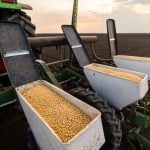
soybeans

Study concludes Manitoba soybean-crushing plant viable

But that’s partly because of market distortions caused by poor rail service and lacking competition

Poor rail service and a lack of competition contribute to the viability of a 2,000-tonne-per-day soybean-crushing plant in Manitoba, a study prepared for the Manitoba Pulse & Soybean Growers (MPSG) and Soy 20/20 says. “Indeed, the numbers tell us that if adequate and regular rail service existed in Manitoba then both a Canadian and/or a


white-feathered turkeys

CFIA blames wild birds for spread of avian influenza

While there are no new cases of bird flu in Canada, the Canadian Food Inspection Agency says 
it’s still too early to breathe a sigh of relief

Officials with the Canadian Food Inspection Agency are confident that the cases of avian influenza they’ve responded to in Ontario and British Columbia are the result of contact with wild birds, not farm-to-farm transmission. “From the seasonality of this disease and the characterization of the virus — we cannot be 100 per cent sure that

Is the Trans-Pacific Partnership a good deal for Canada?

The economic logic behind free trade is that ‘a rising tide lifts all boats’

Is the Trans-Pacific Partnership a bulwark of freedom as proponents claim, or is Canada about to be shoehorned into another free trade deal that will continue the hollowing out of our economy? It depends on your perspective. The TPP, championed by U.S. President Barack Obama as an important addition to the world’s free trade zone


dairy cow

Editorial: More to TPP than milk and eggs

The Trans-Pacific Partnership and what a deal could mean for Canadian producers

The Trans-Pacific Partnership (TPP) trade agreement now under negotiation involves 12 of the world’s largest economies, and has been described as “NAFTA on steroids.” What’s holding it up? Canadian dairy farmers. Or so you’d think about reading some of the national and international media coverage. Some of it made us think of the coverage of

canola seeding

Canola trade seen remaining choppy until seeding done

U.S. corn, soy and wheat will keep trading on the weather

The ICE Futures Canada canola market started off the week ending May 8 with a bang, seeing gains of nearly C$10 per tonne on Monday (May 4). But that’s where the excitement ended. The following days were all pretty uneventful, with quiet activity that led to prices chopping around within a fairly narrow range. Some