
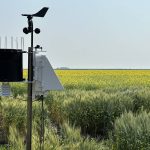
Guy Ash demonstrates how weather station data is used to help inform production decisions.

Evolving technology creating new role for agronomists

New products and new information are changing how agronomists help the family farm

The technology explosion and changes to agricultural systems are altering the view of the average Canadian farm. New technology could mean different things to different people. To some farmers it could be bigger or smaller fields, buying some new equipment, or maybe some more advanced data utilization and management techniques. However, these changes don’t only

Trial and no errors

Trial and no errors

Planning ahead can make on-farm trials run smoothly

A successful on-farm trial doesn’t just appear out of thin air. It takes communication, collaboration and commitment. Those are the lessons a local farm equipment dealer and global life science giant have learned over the past few years as they’ve teamed up and begun taking research to commercial fields in Manitoba. Representatives of BASF and


Myth busting precision agriculture

Myth busting precision agriculture

Cory Willness’s presentation at Farm Forum Event unravelled 10 common myths 
in the emerging precision ag sector

“Precision Ag” is a very common term in today’s agriculture sector, but it can mean different things to different people. New sensors, software, and shiny toys can seem like a must-buy at first, but some producers are suggesting that old-fashioned logic might be the best tool for consistent yields and steady profits. “Right now there’s

Investing in increasingly larger equipment to cover ever-expanding acreages might have run its course in Prairie agriculture.

Scaling up precision decision-making could shrink Prairie fields

Equipment designed for large uniform fields is poorly suited to variable-rate applications to zones within a field

When Terry Aberhart scans the Prairie horizon for ways precision technology can make his family’s Saskatchewan farm more profitable, he sees something big and cumbersome blocking his view. “One of the biggest challenges we have is the size of our equipment,” the award-winning agronomy coach and founder of the consulting firm Sure Growth Technologies said.


Today’s drones are great at selecting pastures and tracking cattle, can read an ear tag from 70 metres up, and offer spectral imaging a hundred times more powerful than 
satellites, says researcher John Church. And while they’re not good at herding, drone technology is close to offering health assessments of individual cows.

Plunging prices and better tech should put drones on your radar

Drones with sophisticated imaging tech can be robust precision tools for managing cattle on pasture

Producers are always being pitched new technology, and the marketing din is arguably louder than ever in this age of precision agriculture. So when producers ask if unmanned aerial vehicles are just expensive toys, it’s a fair question. While John Church would be the first to admit he has a lot of fun researching the

Don Flaten shows the students how to mix and package soil samples to be sent to the lab.

Revisiting the basics of soil sampling and testing

We 
tagged along 
with agronomy students for a soil-sampling primer, and how 
it helps farmers 
make informed decisions

Soil testing. One could call it the agricultural equivalent of a blood test, which shows which and what quantity of nutrients are in the soil so producers can make informed decisions about next year’s nutrient strategy. But less than half of farmers soil test every year, according to stats from Manitoba Agriculture. In 2016, 41


A greenhouse at the University of Winnipeg is growing plants for physics and computer science researchers working on machine-learning problems in precision agriculture.

University of Winnipeg dives into agriculture research

Collaboration to develop expertise in high-tech precision ag technology

A very urban university is starting to sink roots deep into Manitoba’s agriculture sector. The University of Winnipeg is embarking on a collaboration with Enterprise Machine Intelligence and Learning Initiative (or EMILI as it’s known) to contribute to taking the agriculture industry high tech. Ray Bouchard, EMILI chair and president and CEO of Enns Brothers,

Teresa Vallotton teaches the class how to use the text-to-speech program 'Polly.'

Coding camps teach kids to consider careers in agriculture technology

Sisters Teresa Vallotton and Karen Hildebrand have brought their hands-on AI camps to Manitoba for the first time.

The tinny babble of three electronic voices fills the hotel conference room. Three young students bend over laptops, where a program is reading them instructions for how to change a tire. “What is she reading to you in?” Teresa Vallotton asks one teen. “Icelandic,” she says. The student beside her makes her computer speak with


Are farmers drowning in data?

Are farmers drowning in data?

Precision farming data can help identify problems, target treatments and boost productivity, but how do farmers turn it into something useful?

Sean Stanford doesn’t have a degree in computer science. He isn’t set up with the latest precision agriculture equipment. In a world where some look at individual rates for each spray nozzle, Stanford still seeds and sprays at a uniform rate. He is not set up for any variable-rate application and sees little value in

Editorial: The slow road to rural Internet growth

The other day I had the opportunity to sit down with some of the equipment manufacturers developing the latest precision agriculture technology. The discussion was both interesting and informative and hinted at some tantalizing developments as this system really begins to get going. But it also revealed just how dependent the whole thing is going