
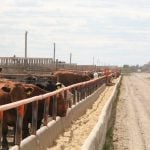
(Photo courtesy Canada Beef Inc.)

Klassen: Texas flooding lifts Canadian feeder market

Fed cattle in counter-seasonal trend

For the week ending Sunday, western Canadian feeder cattle markets traded $6-$8 higher. In some cases, quality yearling packages traded as much as $10 above week-ago levels. Live and feeder cattle futures closed the week US$8-$9 higher as traders monitored flooding conditions in Texas. Alberta packers were buying fed cattle on a live basis in
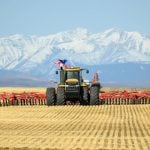
Rain needed for soybeans, other southern Manitoba crops

Rain needed for soybeans, other southern Manitoba crops

Seeded soybeans projected to be up more than 40 million acres from 2022

MarketsFarm – When Toban Dyck started to plant his 600-plus acres of soybeans this year, the soil in the Winkler, Man. area had pretty decent moisture content. But following the combination of hot temperatures and strong winds with little rainfall in May, precipitation is now much needed.  “There’s still a little bit of moisture there.


Aerial view of a wildfire about 20 km north of Valhalla Centre in northwestern Alberta on June 4, 2023. (Alberta Wildfire photo)

Prairie Forecast Update: Forecast pretty much on track

Update issued June 4, covering June 4-7, 2023

The heat and humidity moved into a large portion of the Canadian Prairies late last week and over the weekend as the previous general forecast played out pretty close to what the weather models predicted. There is not much change in the forecast for the next three days. The heat and humidity will continue across

A sample soil map from Manitoba Agriculture’s AgriMap website. Red texts are codes that indicate soil characteristics. Yellow contour lines represent the boundary of a particular soil type. A full explanation of codes can be found on the Manitoba Agriculture website under “Soil Survey.”

Making use of soil surveys

How to understand your soil from the bottom up

Manitoba Agriculture’s soil surveys can help producers understand and manage their farms better, say provincial soil experts. “The surveys we produce can be used for agriculture, land use planning and many other applications,” said Megan Westphal, soil survey specialist with the province’s ag department. Soil data and maps can help producers develop strategies for land


If sufficient rain doesn’t reach newly seeded Prairie crops in a timely fashion, canola futures may finally break higher.

A short but tough week for canola

Another year of tight canola stocks predicted

There wasn’t much to prop up canola values on ICE futures over the shortened week of May 23. As of May 25, the two most actively traded contracts, old-crop July and new-crop November, fell back by $11.20 and $14.40 per tonne respectively. That’s despite the former poking its head above the psychological level of $700/tonne

Cattle prices remain strong as sale volumes grind lower

Cattle prices remain strong as sale volumes grind lower

Several yards will operate at a reduced pace over the summer

Activity at Manitoba’s cattle auction yards was subdued during the week ended May 26. The Victoria Day long weekend marks the unofficial start of summer and movement slows down for the season. Prices remained strong, especially for butcher cows, which accounted for most of the trade at some yards. “Butcher cows continue to hit new


Field peas. (Lisa Guenther photo)

Pulse weekly outlook: Manitoba crops get good start but need rain

Some bean growers seek moisture at lower planting depths

MarketsFarm — Pulse growers in Manitoba are waiting for one thing: rain. So far in May, growing areas of the province have not seen any significant precipitation, according to Dennis Lange, industry development specialist for pulse crops with Manitoba Agriculture. Dry beans, he said, are the last pulse crop farmers have been planting in Manitoba

(Dave Bedard photo)

Spring planting expected complete by week’s end

Manitoba Crop Report, Issue 3 (Week 22)

Precipitation was variable across agro–Manitoba from May 22 to 28 with values ranging from 0 to 41.7 mm. The Northwest and Southwest regions received the highest amounts of precipitation over the past seven days. Climate normals for total accumulated precipitation from May 1 to May 28 range from 31.6 to 58.3 mm and are based