CropLife Canada’s Ted Menzies says a recent report the group commissioned quantifies the value of biotechnology and crop protection products.

CropLife report highlights importance of crop protection and biotechnology

The group says it’s ready to make the case for the value and economic contribution 
of the industry’s technology to the country

CropLife Canada wants to talk about the value of crop protection products and plant biotechnology. To this end it’s commissioned a report examining how much the industry contributes to the country by the consultancy RIAS. Ted Menzies, president of CropLife, says his organization is looking for venues and opportunities to discuss the information contained in

Sandblasting might be a way to kill weeds and leave crops unharmed, lowering the environmental impact of weed control measures and giving organic growers other options.

Abrasive weeding mechanically controls weeds without tillage

A Minnesota-based USDA agronomist had the idea 
after a bumper apricot crop

A new research project in the U.S. Midwest aims to blast weeds away — literally. The technique is known as abrasive weeding and it basically amounts to sandblasting weeds. It all started when Minnesota experienced a bumper crop of backyard apricots in 2007. Frank Forcella, a USDA weed scientist and agronomist, was left with a


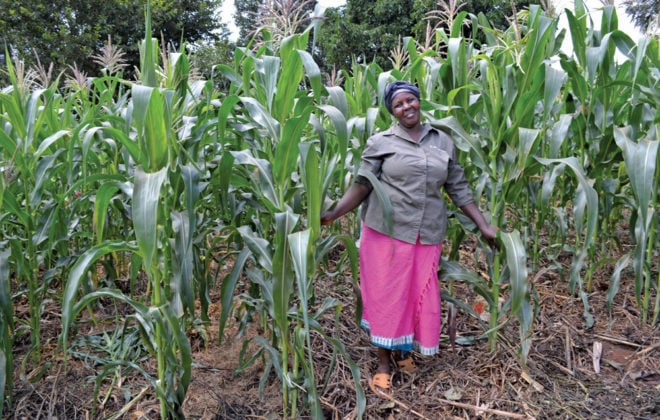
Jane Wanjiko standing in her maize field.

African smallholders are adopting conservation agriculture techniques

When you’re subsisting on three-quarters of an acre, increasing 
maize production from 32 kg a year to 990 kg is a life-changing event

This summer Stefan Epp-Koop travelled to Kenya as part of a Canadian Foodgrains Bank learning tour, focused on the importance of agriculture in achieving numerous development goals: reducing hunger, increasing incomes, empowering women, adapting to a changing climate, and improving nutrition. Throughout the trip he visited farmers, government officials and researchers, exploring solutions that were

Hand going through the field

Developing a Canadian food advantage

Farmers and the industry need to actually demonstrate that their products are produced sustainably

What would you guess is the single most important ingredient in modern food production? Good seeds? Rainfall? Fertilizer? The surprising answer is that around the world, the scarcest and most precious resource for producing food is trust. Luckily, Canada has natural advantages that could allow the people of the world to view us as their


The FAO’s principles of sustainability say yield should not be the only criterion for farming, and that current intensification is detrimental to crop and animal biodiversity.

Defining just what ‘sustainable agriculture’ really means

The term ‘sustainable agriculture’ is used often, but what does it mean? The United Nations Food and Agriculture Organization (FAO) recently issued these five principles to define sustainable agriculture. 1. Improving efficiency in the use of resources is crucial to sustainable agriculture. Modifying current practices can do much to improve the productivity of many food

dairy cow

Dairy initiative seeks to reassure consumers

The program aims to meet consumer concerns in a farmer-friendly fashion

Canadian dairy farmers have launched a mandatory program to document the sector’s commitment to food safety, environmental protection and animal care. The proAction Initiative, a Dairy Farmers of Canada (DFC) undertaking, is designed to show consumers how farmers tend to their animals and land in a sustainable way and will allow farmers to benchmark their


Land use policies challenge new farmers

New farmers face many challenges as they attempt to get established in the business of farming. Last week we examined the issues of farm size and financial risk from the perspective of starting farmers. This week we will look at land use policy relating to new farmers. This issue was brought to our attention by

Cigi CEO JoAnne Buth says Canada has an opportunity to sell more wheat.

Government should do more to support agricultural science

Agriculture needs to respond to consumer demands for more information

The global production and demand for wheat are rising in a lockstep that leaves low carry-over stocks and an opportunity for Canadian farmers to cash in, says JoAnne Buth, CEO of the Canadian International Grains Institute. Wheat is second only to rice as a dietary staple and shows no signs of losing its consumer desirability,


Kalynn Spain, founder of Small Farms Manitoba hosted the organization’s second annual conference in Brandon on Saturday, January 23.

Small Farms Manitoba marks second anniversary

Small Farms Manitoba has a busy year ahead with a number of initiatives on the agenda, including website upgrades, strengthening industry relationships and the development of a food hub

The founder of Small Farms Manitoba is hoping the organization can grow its membership and raise consumer awareness about locally produced foods. “Marketing yourself individually is important but we are also a community and a network and the bigger we can promote this across Manitoba, we can inform more consumers about the small-scale movement and

Organic wheat

Editorial: Ideology and modern farming

Whenever the subject of organic agriculture surfaces in a discussion about modern farming, the “yabuts” start flowing fast and sometimes, furiously. Ya but organic farmers don’t produce as much as “conventional‚” farmers do, so if everyone went organic, there would be shortages, more pressure on land and higher food prices. And so it goes. Those