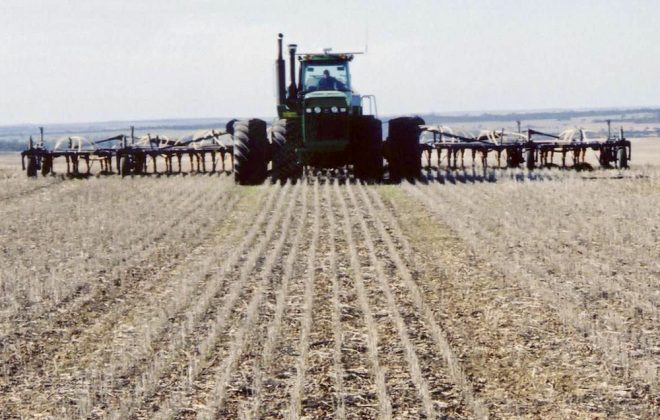
Running equipment on the same tracks all the time is the essence of controlled traffic farming — and while the practice only has a few adherents in Alberta, they are passionate about its benefits.

Controlled traffic farming is proving its worth, say advocates

The system ‘shines’ during droughts and lets farmers seed and harvest sooner when it’s wet, they say

Controlled traffic farming has yet to catch on in a big way in Western Canada, but the extreme conditions over the past two years have shown its worth to two long-term practitioners on opposite ends of the Prairies. “I grew canola and barley last year and we had 28-bushel canola on four and a half

Mud is impacting many farms and ranches this spring.

Reduce muddy conditions for livestock health

With mud impacting many farms and ranches throughout the region, North Dakota State University Extension specialists offer tips for protecting livestock health and managing muddy conditions. “When cattle get wet, their hair lies down and loses insulation value,” says Zac Carlson, NDSU Extension beef cattle specialist. “Mud will further reduce the insulation value of hair coats. Cattle become chilled quicker


CTF systems rely on matching the width of equipment to restrict travel to a few tramways leaving the rest of the field uncompacted.

The straight and narrow of CTF

Tramline farming can limit compaction, reduce costs, increase production and improve soil health

Adam Gurr heard of controlled traffic farming (CTF) about 15 years ago and dismissed it at first. He felt living in a freeze/thaw climate like ours would break up any soil compaction in his fields so it wasn’t necessary here. Still, when he looked closely at crop growth on the previous year’s combine tracks the

The heavy coulters seen here use their uneven profile to transmit forces sideways. Some say it breaks up soil compaction 
but local soil specialists aren’t so sure.

The vertical-tillage question defies pat answers

The controversial practice can serve a purpose, but won’t solve soil compaction

Vertical tillage is a tricky term to grapple with. It’s less a method of tillage than it is a grouping of implements sold under that banner. It is marketed as a means to deal with soil compaction but in reality the implements marketed under that umbrella do little to address that problem. Yet, in certain


VIDEO: Getting down to your roots

VIDEO: Getting down to your roots

Crop Diagnostic School offered a cutaway view of how crop roots move through soil

Along with her colleagues, Marla Riekman, land management specialist with Manitoba Agriculture, took up a shovel last month at Crop Diagnostic School to help show what’s going on underground with roots. Allan Dawson met up with Riekman to learn about the types of root systems in crops, how they extract nutrients from the soil, the effects of

Researchers found that grazing crop residue could actually improve certain soil properties and that compaction concerns were overblown.

Grazing no compaction disaster

Nebraska researchers say grazing even at excess rates isn't a major contributor to soil compaction

It makes sense that a 1,200-pound cow would place quite a lot of pressure on the ground on which it walks. But a new study shows that even these heavy animals can’t do much to compact common soils — if they’re grazed responsibly. Those are the results of a 16-year-long study, established in 1997 by


Lower air pressure in tires to reduce soil compaction

Lower air pressure in tires to reduce soil compaction

There are no easy solutions to soil compaction 
but there are some strategies to help avoid it

For producers soil compaction probably feels like an unwinnable catch-22. They need to get out and perform field operations to grow crops, but each pass contributes to the creation of soil compaction that can seriously hinder productivity. Provincial land management specialist Marla Riekman told producers at the recent St. Jean Baptist Farm Days that there

Marla Rickman speaks to producers in Carman.

Rolling wet soil leads to compaction

Rolling dry soil can increase the likelihood of topsoil loss

When to roll and when not to roll soybeans, that is the question. Speaking at the Manitoba Pulse and Soybean Growers recent SMART day in Carman, provincial soil management specialist Marla Rickman said it’s important to wait for the right conditions to avoid topsoil loss. “Generally you want to be rolling right after seeding, but


Manitoba Agriculture soil fertility specialist John Heard, soil sampling the old-fashioned way, says sampling cereals fields right after combining provides some advantages.

Soil test right after the combine

The tradition has been to sample for soil nutrients later in the fall, but there are compelling reasons to go sooner than later

It’s been the accepted wisdom to soil test as late as possible in the fall, but one soil test lab says it might pay to go earlier. Agvise Laboratories, that has soil-testing labs in North Dakota and Minnesota and a large stable of Canadian customers, told growers in a recent email it may be a

Steve Larocque conducting a presentation.

Is the freeze-thaw effect a myth?

What if the notion that the freeze-thaw action of icy winter weather gives Prairie farmers a free pass on soil compaction problems turns out to be wishful thinking? If so, the implications should be enough to send a chill down a big-iron-loving farmer’s spine. “We often say that we don’t have to worry about soil