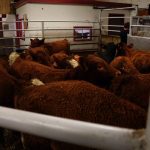
The federal and provincial agriculture ministers, Ralph Eichler (l) and Lawrence MacAuley, signed a new five-year bilateral agriculture agreement last week in Winnipeg.

Province signs five-year agreement worth $176 million

The cost-shared initiative will be consolidated into one program and called Ag Action Manitoba

Funding will begin to flow right away from the new bilateral five-year $176-million agreement signed between Manitoba and the federal government last week, Manitoba Agriculture Minister Ralph Eichler says. This is the Canadian Agri­cultural Partnership (CAP), part of an overall $3-billion federal program supporting cost-shared initiatives delivered by the provinces and territories, to be consolidated

Can Manitoba support 300,000 acres of field peas?

Can Manitoba support 300,000 acres of field peas?

Right now there are headwinds but looming local processing capacity bodes well for the crop

Could Manitoba see 300,000 acres of peas a year? That was the self-admittedly provocative question Manitoba Agriculture pulse extension Terry Buss raised at a March 20 pea producers’ meeting in Brandon. Hitting that mark would mean an acreage five times larger than this coming season’s projected acreage, which has been pegged at 65,000 acres, up


Manitoba has more crop choices than many locations on the Prairies, which makes a more diverse crop rotation possible.

Building a ‘better’ crop rotation

Understand all the interactions within a rotation and their effect on yield

Manitoba is a unique place to farm in the western Canadian Prairies. We enjoy a relatively long growing season, good rainfall (sometimes too much) and have the support of many industry partners, testing a wide range of crop types with adaptation to our climate. With all the crop options we have, a diverse crop rotation

Manitoba Agriculture agri-ecosystems specialist Mitchell Timmerman demonstrates hydrology across soil types as part of a soil fertility update in Brandon Jan. 30-31.

Finding the source of soil salinity

How the problem came to be will determine how to deal with it in the field

Managing soil salinity might have a lot to do with how the problem started. Attendees to a Brandon soil fertility update Jan. 30-31, one of several to run through Manitoba in the last month, were told to consider how old the salinity problem is before making a plan of attack. “Salinity is not a soil


Other crops are seven per cent of the 2017 seeded acres.

Worth a look: Annual production estimates a valuable resource

It can help you calculate your own risk and rewards, but only if you use it

At first glance, the annual Guidelines for Estimating Crop Production Costs released every January looks like good bedtime reading for insomniacs. But sort through the numbers and analysis, and the story that emerges is full of mystery and intrigue. These production estimates are designed to give farmers a reference for determining which crops make the

A lygus bug prepares to wreak havoc on a canola plant.

Be on the watch for insect-issue bleed over

Manitoba Agriculture’s 2017 insect summary may give 
producers an idea of what to scout for, as well as any rotation changes to avoid pest woes next season

Last year’s pest problems may give an idea of what to be on watch for next season. The insect summary for 2017 is in, and Manitoba Agriculture entomologist John Gavloski says the report may give producers valuable insight when planning scouting and, in some cases, rotations. Aphids unknown Not all insects carry over in the


Darren Bond, farm management specialist with Manitoba Agriculture, runs the audience through 2017 commodity markets during Ag Days Jan. 16-18, 2018.

Forget cost per acre — what’s it cost to grow a bushel?

Cost is often expressed as dollars per acre, but farm management specialist Darren Bond says it makes more sense to think of cost in terms of product produced

Darren Bond wants farmers to stop thinking in dollars per acre. The farm management specialist with Manitoba Agriculture says cost per bushel sold is a more valuable number when farmers go to develop a marketing plan. Farmers sell their product per bushel, making it easier to track and predict profitability if cost uses the same

A lygus bug prepares to wreak havoc on a canola plant.

Manitoba crop insects seen in 2017

Manitoba Agriculture entomologist offers his yearly summary of bugs

From aphids to wheat midge, a wide variety of insects made their presence known in Manitoba crops in 2017. John Gavloski, entomologist with Manitoba Agriculture, has compiled a summary entitled ‘Summary of Insects on Crops in Manitoba in 2017‘ of the insects observed in fields across the province. Much of the crop insects identified in


Manitoba Agriculture filling two specialist positions

Manitoba Agriculture has a new oilseed specialist and its new weed specialist is expected to be on the job in January. Dane Froese, who grew up farming in the Winkler area, started work as the province’s oilseed specialist Nov. 6, Anastasia Kubinec, his boss and former oilseed specialist, said in an interview Dec. 1. Kubinec,

Desiccating sunflowers too early can cut yield and test weight. Ideally seed moisture at the time of desiccation will be 14 to 16 per cent, or at least under 20. The back of the sunflower head can be a guide. The bracts in the photo on the left are not fully brown to the bottom. Seeds in this head will be about 30 per cent moisture. The bracts on the right are brown to the bottom and the back of the head is tan coloured. The seeds will be 15 to 20 per cent moisture.

Lots of advantages to desiccating sunflowers

The key is timing and determining if the crop is good enough to justify the additional cost

Desiccating confection or oilseed sunflowers to speed up harvest can deliver profits and peace of mind, but timing is everything, says Anastasia Kubinec, Manitoba Agriculture’s manager of crop industry development. “There has been a move to more producers going to desiccating sunflowers because they do see the economic benefit to it,” Kubinec said during the