
Manitoba Agriculture land management specialist Marla Riekman (l), and farmer Doug Wilton and his son Andrew discuss the ‘soilyourundies’ demonstration in one of Doug’s zero-till fields near Roland, Man. April 18.

What’s in your field?

Planting a pair of tighty whities can help you find out

Doug Wilton is curious about how much soil “wildlife” is in his fields. That’s why the Roland-area farmer is participating in the “soilyourundies” demonstration launched during Soil Conservation Week in April. “The Soil Conservation Council (of Canada) decided this would be something kind of fun and exciting and different to do in order to bring

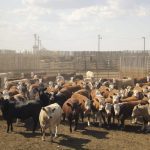
MBFI research co-ordinator Kristelle Harper stands in front of the herd at the Manitoba Beef and Forage Initiatives Johnson Research Farm.

Putting spurge on the menu for research — and cattle

With an incoming learning centre and research ranging from rodent control to grazing systems and leafy spurge, 2017 looks to be busy for Manitoba Beef and Forage Initiatives

Manitoba Beef and Forage Initiatives (MBFI) is ramping up for 2017. Preparations are underway for a long list of projects at the collaborative’s three test farms outside of Brandon. “Some of them are continuing projects from last year,” said MBFI president Ramona Blyth. “Research is never just done in one year, so there’s the carry-over


Tech giants should join global land rights campaign

Treating land insecurity like a disease will help eradicate it in the same way

Global technology giants such as Google and Facebook must join the battle for land rights and help spearhead an international campaign to eradicate insecurity of tenure as if it were an infectious disease, land experts told a World Bank conference. Stig Enemark, professor emeritus of Land Management at Denmark’s Aalborg University, and British land reform

Researchers found that grazing crop residue could actually improve certain soil properties and that compaction concerns were overblown.

Grazing no compaction disaster

Nebraska researchers say grazing even at excess rates isn't a major contributor to soil compaction

It makes sense that a 1,200-pound cow would place quite a lot of pressure on the ground on which it walks. But a new study shows that even these heavy animals can’t do much to compact common soils — if they’re grazed responsibly. Those are the results of a 16-year-long study, established in 1997 by


David Lobb, of the University of Manitoba, says flood solutions will include keeping more water on farms, but not necessarily on fields.

On-farm water collection key to drainage management

Other farming practices such as enhancing soil health and better design 
and maintenance of surface drains can also help

Reducing run-off and improving soil health are the best path to address flooding and excess nutrients, according to a University of Manitoba expert on watershed management. These strategies include more collection of surface water before it leaves the farm and adoption of soil management practices that build soil structure and help water infiltrate, says David

Editorial: Bonanza bind

Over 100 years ago there was a land rush on the northern plains of North America. The arrival of railways suddenly opened vast tracts of land to settlement and agriculture. The world responded with a flood of humanity. These days we think of the romantic image of homesteading families from all corners of the world,


Growing cities are gobbling up more farmland than anything else in Canada.

Urbanization, not foreign ownership, the real threat to farmland

Three per cent of Canada’s arable land was lost to sprawl between 2001 and 2011, investor says


The real threat to farmland is our growing cities, not the tiny amount foreign owners hold. The president and CEO of Bonnefield Financial, Tom Eisenhauer, recently told the Senate agriculture committee that people looking to protect farmland need to look at the real issues. “The biggest threats are urbanization, rezoning and the conversion of farmland

Cutaway of Plant and Roots in Dirt

Scientists studying how to make poorer soils perform better

The work is in response to a growing problem of the loss of prime farmland to urbanization

As Canada steadily loses top-quality farmland to urban sprawl, Agriculture Canada scientists are studying ways to make poorer soils perform better in co-operation with foreign researchers. Brian Gray, assistant deputy minister for science and technology, told the Senate agriculture committee the work will help feed an expected global population of 9.5 billion in 2050. “We’re


Windy Lake Farm receives conservation award

Moving to holistic management practices 
was the key to the operation’s success

Windy Lake Farm is the recipient of the 2016 Pembina Valley Conservation District (PVCD) conservation award. Located near Swan Lake, Windy Lake Farm is Andrew and Corinne Grift’s operation, where they run a 75-head cow-calf herd, free-range Berkshire hogs, free-range chickens and sheep on 600 acres. Their son Joshua, who wants to farm, is also

Farmers had mixed results when planting into green cover crops in 2016.

Cover crops driving planting and tillage innovation

Ontario farmers are on the cutting edge of adopting this technique in Canada

Cover crops continue to be one of the most discussed topics in Ontario crop farming. However the discussion has moved beyond the existence of the soil-health-building practice, to the fine details of how to manage such a complex biological system. There were several sessions at the recent Southwest Ag Conference (SWAC) in Ridgetown dedicated to