
Cattle search for grazing on one of the Interlake’s sparse pastures in July.

On the brink: Drought pushes Interlake beef producers to the edge of viability

Will drought see an exodus from the cattle business in Manitoba's Interlake?

The pictures coming out of the pastures and hayfields between Lake Manitoba and Lake Winnipeg are grim, and they look nothing like July. Across the field, there is little green on the ground. Brown is the predominant colour, and little stands tall enough to block out the occasional rock or cow-pie. It’s a visual image
Critically dry pasture in the RM of Fisher shows little growth in July after only three weeks of grazing.

Feed fears come into focus after poor first cut, flagging pasture

Livestock producers are facing yet another year of both poor first-cut yields and ongoing pasture concerns

Producers are seeing their fears realized with light hay cuts and pasture supplies once again running thin. With the exception of very localized patches of the southeast, which are seeing almost normal growth, most producers harvested 50 to 70 per cent of their normal forage in the first cut, according to John McGregor, hay expert


Rain on some parts of the Prairies last week pressured canola values lower, but the futures recovered as expectations for more rain were dashed.

Canola production outlook turns sour with drought

We may well see four-figure canola values again

With heat and dry conditions across most of the Prairies this spring and summer, any possibility of achieving this year’s projection for 20 million tonnes of canola is pretty much out the window. Even if sufficient rains were to fall, it’s still very likely production would fall well short. Speaking with a number of traders

Farmer and Grainews columnist Toban Dyck inspects wheat on July 6, 2021 near Winkler, Man., where hot and dry weather has led to thin, uneven stands. (Photo: Reuters/Rod Nickel)

Saskatchewan raises salvage threshold for parched crops

Stock watering program also boosted; APAS, Tories' ag critic had called for more drought aid

Saskatchewan’s provincial crop insurance agency is raising the yield threshold at which drought-damaged crops can be grazed, baled for greenfeed or cut for silage with no penalty on future coverage. Saskatchewan Crop Insurance Corp. said Wednesday it would double the “low yield appraisal” threshold values on cereal or pulse crop acres put to feed. SCIC


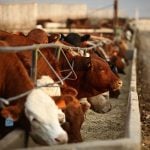
(Photo courtesy Canada Beef Inc.)

Klassen: Feeder market consolidates

Compared to last week, western Canadian feeder cattle markets traded $2-$3 on either side of unchanged. In central and southern Alberta, quality yearling steers weighing 800 lbs. continue to hover at the psychological range of $200-$210; lower-flesh steers fresh off grass weighing 900 lbs. are readily quoted in the range of $185-$190. Saskatchewan values are

(Qingwa/iStock/Getty Images)

USDA pegs wheat ending stocks to be lowest since 2013-14

MarketsFarm — As the U.S. northern Plains continue to deal with severe drought conditions, the U.S. Department of Agriculture (USDA) has significantly lowered its 2021-22 ending stocks estimates for wheat — especially durum and spring wheat. According to USDA’s monthly world agriculture supply and demand estimates (WASDE) released Monday, 2021-22 ending stocks for wheat are


CBOT December 2021 corn (candlesticks) with MGEX, CBOT and K.C. September 2021 wheats (green, yellow and orange lines). (Barchart)

U.S. grains: Soybeans, corn fall on cool, wet forecast

Wheat supported by dryness in northern Plains

Chicago | Reuters — Chicago soybean futures ended lower on Thursday, pressured by cool, rainy forecasts across the U.S. growing belt, though dryness in the upper Midwest continues to threaten developing crops. Corn eased as beneficial rains aided crops entering pollination, while wheat firmed as sparse moisture reached drought-hit spring wheat regions. The most-active soybean

File photo of an Alberta wheat field. (ImagineGolf/E+/Getty Images)

Feed weekly outlook: Alberta feed prices rising

MarketsFarm — Higher-than-normal temperatures and continued demand for feed have caused prices for Alberta feed barley and feed wheat to increase over the past few weeks. However, that demand has pulled back somewhat. According to Prairie Ag Hotwire data from Wednesday, high-delivered bids for Alberta feed barley were at $7.84 per bushel, 48 cents higher