
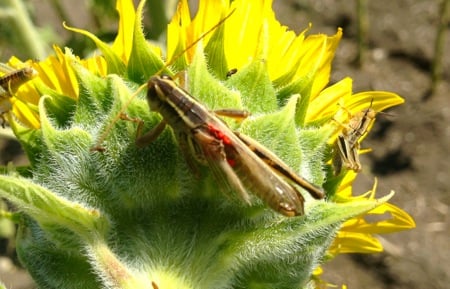
Grasshopper on a sunflower under attack from red mites.

Invasion of the body snatchers

Southwestern Manitoba grasshoppers being preyed upon by parasitic red mites

This grasshopper munching on a sunflower in southwestern Manitoba is being devoured by parasitic red mites (Eutrombidium locustarum), says Manitoba Agriculture, Food and Rural Development (MAFRD) entomologist John Gavloski. The mites feed on the blood (hemolymph) of grasshoppers. They also prey on grasshopper eggs. Each female mite can lay up to 4,000 eggs, providing mite
The banded sunflower moth. The economic threshold for control in confectionery sunflowers is two per head. The ideal crop stage for control is R4 to R5.1.  
photo: anastasia kubinec MAFRD

Time to scout sunflower fields

Farmers should be watching for two disease and insect pests

Sunflower growers should scout their fields for sunflower rust, sclerotinia head rot, lygus bugs and the banded sunflower moth, says Anastasia Kubinec, oilseed specialist with Manitoba Agriculture, Food and Rural Initiatives. The four pests can affect sunflower yield and quality, especially in confectionery sunflowers where the seed is sold for human consumption. “You have to


beekeepers

Neonic insecticides widespread in Iowa waters

Government researchers say the broad use of neonicotinoids 
should be closely examined

A class of insecticides popular with corn and soybean farmers in the U.S. Midwest but feared as a factor in the decline of U.S. honeybee colonies and other crop pollinators, has been found to be widespread through rivers and streams in Iowa, according to a government study released July 24. The study, released by the

Food Day in Canada

Food Day in Canada

RecipeSwap: Lentils and Barley Salad with Roasted Tomatoes, Spinach and Goat Cheese, Barbecue Sauce, Wild Cranberry Vinaigrette, Prairie Spice Cake

Ever wondered why we get to spend next Monday sleeping in, watching parades, and setting off fireworks? We have Toronto City Hall — no, not the current installation — to thank. Way back in 1869, the council of the day decided everybody needed “a day of recreation” and declared the first Monday of August a


John Heard (centre) of Manitoba Agriculture, Food and Rural Development says the 2014 Crop Diagnostic School, which was sold out this year, keeps evolving to agronomists’ needs.  photo: allan dawson

2014 Crop Diagnostic School sold out

The diagnostic school continues to evolve to meet the needs of Manitoba agronomists


The 2014 Crop Diagnostic School was sold out this year, proof that after almost 20 years the school has something new to teach. “We’re flattered by the interest,” John Heard, the school’s ringmaster and soil fertility specialist with Manitoba Agriculture, Food and Rural Development (MAFRD), said in an interview July 17. “It has been a

Manitoba Insect and Disease Update: July 25, 2014

Manitoba Agriculture’s weekly Insect and Disease Update is now available. Visit the MAFRD website for full text and images. Highlights: Goss’s wilt and leaf blight disease are showing up in corn. Ergot disease infection is now showing up in fall rye and grasses. Blackleg infection on lower stems/roots on canola is showing up. Downy mildew on sunflowers is


Most North Americans use velvet antler as dried powder in capsules, for recovery from injury or exercise, to boost testosterone, and improve circulation.

Regaining access to China markets

Tainted food scandals have convinced Chinese buyers that imports are safer

Cervid (elk and other deer) products have been used and prized in China for at least 2,700 years. That makes China a very valuable marketplace for cervid products. Indeed, it was a good market until Canada and the U.S. took action to contain and eradicate BSE in early 2003. China immediately closed its markets to


This filed of canola is at the 50 per cent bloom stage. The optimum time to apply a fungicide to protect canola from sclerotinia is at 20 to 30 per cent bloom, but it can be applied up to 50 per cent bloom. photo lionel kaskiw, mafrd

Tools to assess sclerotinia risk in canola

The risk was high last week, but it might not be this week

The sclerotinia risk was high in most of Manitoba last week, but it may have changed this week and the risk could be different a week from now, says Manitoba Agriculture, Food and Rural Development (MAFRD) oilseed specialist Anastasia Kubinec. That’s why it pays farmers to assess the risk to their own canola crops before

Blackleg stem

Guenther: Wanted for science: Southern Alberta canola fields

Reward: Better industry-wide strategies for managing blackleg

Dr. Dilantha Fernando, a University of Manitoba researcher, is leading a group of researchers who intend to pinpoint avirulence genes in blackleg found in farmers’ fields. Researchers with Agriculture and Agri-Food Canada and Alberta Innovates – Technology Futures are also involved. Researchers will also study how the fungus adapts to different canola cultivars and how