

Teamsters union workers picket outside Canadian Pacific Railway’s Toronto Yard after the company halted operations and locked out employees over a labour dispute March 20, 2022.

Shippers call for essential designation for railways

In a world of uncertainty, grain companies say labour peace necessary

The recent railway labour disruption at Canadian Pacific Railways starkly underlines the transportation-related vulnerability of Canada’s agriculture sector, industry watchers say. An online seminar organized by the Canadian Agri-Food Policy Institute (CAPI) heard March 28 that fertilizer shipments in and out of the country are balanced on a knife edge, and Canada’s global reputation as

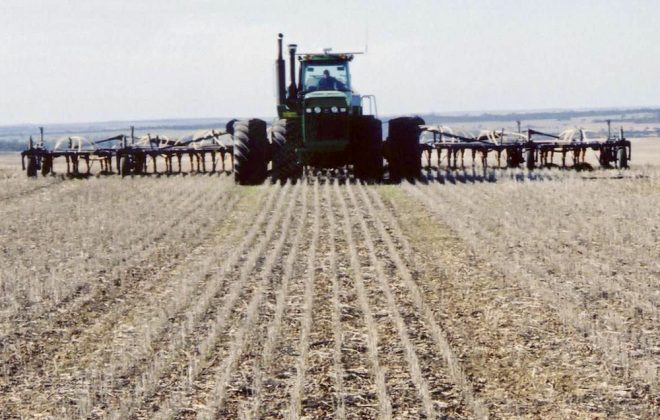
CTF systems rely on matching the width of equipment to restrict travel to a few tramways leaving the rest of the field uncompacted.

The straight and narrow of CTF

Tramline farming can limit compaction, reduce costs, increase production and improve soil health

Adam Gurr heard of controlled traffic farming (CTF) about 15 years ago and dismissed it at first. He felt living in a freeze/thaw climate like ours would break up any soil compaction in his fields so it wasn’t necessary here. Still, when he looked closely at crop growth on the previous year’s combine tracks the


Early controlled traffic farming pioneer saw benefit in soil biology

Two-year study showed significant improvements in several areas

When Adam Gurr talks about the history of controlled traffic farming (CTF) in Canada he’ll tell you about Dean Glenney, a now-retired agricultural engineer and farmer from Ontario. He could get phenomenal corn yields and he felt it was because of his use of CTF. “When you visit Dean’s farm, he brings a shovel out,

There are many microbes that are used as biofertilizers, including bacteria and fungi, and the most common application is to improve crop nutrient status.

Comment: Unintended consequences of bioproducts

Adding fungi to soil may introduce invasive species, threatening ecosystems

Invasive, alien species are bad for ecosystems. They reduce biodiversity and disrupt food chains, including our own. History is full of examples of intentional and unintentional introductions of invasive species. VIDEO: Struvite shows promise as organic fertilizer The introduction of cane toads to Northern Australia in the 1930s to fight cane beetles led to the


The scale of economic sanctions imposed on Russia since its invasion of Ukraine are unprecedented.

Comment: Battered but not broken

How global trade is responding to Russia’s invasion of Ukraine

Russia’s first McDonald’s opened in 1990, just months after the fall of the Berlin Wall. It was a potent symbol that the Cold War was ending and a great ideological wound healing. Now every McDonald’s in Russia is closed, as nations and corporations reduce, suspend or sever ties in response to the invasion of Ukraine.

The U.S. Department of Agriculture pegged 2022 U.S. corn plantings at 89.49 million acres based largely on producer surveys conducted in the first half of March.

Analysts blow U.S. corn acreage predictions again

The trade could redeem itself in June when the next estimates drop

Reuters – U.S. planting intentions kept their unpredictable reputation alive March 30, as corn acres fell outside the range of analyst estimates for a fourth consecutive year. The trade reversed its overestimation trend on soybean area, but the miss was still substantial. Market participants have recently come a little closer to the reported corn and


Are Manitoba hog producers on the verge of viral spring? As the seasons turn, the risk of livestock disease is climbing in the province.

PED outbreak hits record levels

An atypical, and ongoing, fall-winter outbreak has experts worried about what spring will bring

Ordinarily the risk of PED infections in Manitoba hog herds rises with the temperatures in the spring. But for the first time, this year the sector is heading into the usual risk season with an epidemic outbreak already raging. As of March 30, Manitoba’s office of the chief veterinary officer (CVO) had confirmed 88 cases


(Lightspeedshutter/iStock/Getty Images)

Advance Payments Program to offer 100 per cent up front

Feds temporarily waive 60 per cent up-front limit

Canadian farmers seeking pre-production cash advances under the federal Advance Payments Program ahead of this year’s spring seeding will be able to get the entire eligible amount up front. Federal Agriculture Minister Marie-Claude Bibeau on Wednesday announced a “temporary waiving” of the program’s usual requirement that pre-production cash advances be issued in instalments of 60

(Alfio Manciagli/iStock/Getty Images)

Australian canola production heading downward, but still sizeable

New second-biggest harvest expected, USDA predicts

MarketsFarm — Despite canola production in Australia being set to drop 26 per cent in 2022-23, the country’s farmers are still projected to harvest the second largest crop, according to the U.S. Department of Agriculture’s attaché in Canberra. In the attaché’s report, released Monday, canola production for the coming crop year was projected to be