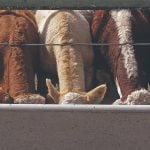
Cows graze on perennial intermediate wheatgrass developed at the University of Manitoba.

Livestock research gains higher profile in province

An easy-to-understand website is designed to give producers greater insight into research efforts

Manitoba farmers have a new window into livestock research conducted in the province. A recent update to the website for the National Centre for Livestock and the Environment (NCLE) has a central goal of engaging producers more effectively. “A lot of the funding for this type of research does really come from producers,” says NCLE

Manitoba Agronomists Conference co-chair, Tammy Jones speaking at Manitoba Agriculture’s Crop Diagnostic School in 2019.

Agronomist conference aims to find the tools that work

Manitoba Agronomists Conference looks to demystify agricultural climate policy

After two years of meeting virtually, the Manitoba Agronomists Conference is back in person and ready to tackle climate change. “It’s very exciting for us to be able to have that ability to interact in person,” says conference co-chair Tammy Jones, an agronomist with Corteva Agriscience who is co-chairing with Marla Riekman, a soil specialist


A new research chair aims to give Manitoba farmers new and better tools to fight weeds in their fields.

New research chair aimed at weeds

Farmers’ dollars help kick start new research chair position at U of M

A new University of Manitoba research chair is taking the fight against weeds to the next level. The Manitoba Crop Protection Chair in Weed Management is dedicated to research that will support integrated weed management strategies. In late September, the university announced the appointment of Dilshan Benaragama to the new role. “This is a great

Sue Clayton.

Clayton new head of school of agriculture

Well-known agriculture education expert rejoins the university Oct. 17

Sue Clayton is taking the reins at the University of Manitoba’s School of Agriculture. She’ll be joining the organization as its new director Oct. 17 after seven years as the director of Agriculture in the Classroom-Manitoba (AITC-M). In a media release, the university noted that Clayton’s broad network within the agriculture industry, government, organizations and


Laying hens in the free-run aviary at University of Manitoba  photo: Manitoba Egg Farmers

Bringing egg farming into public view

State-of-the-art 4,500 laying-hen research centre slated for 2023 opening

A new, high-tech egg-laying research centre is on the horizon for the University of Manitoba’s Glenlea Research Station. The 4,500 laying-hen barn is expected to be a world-class facility outfitted with cutting-edge scientific testing equipment. The facility will replace the current one on the University of Manitoba (UM) Fort Garry campus that is out of

Filiz Koskel, recipient of the Terry G. Falconer Memorial Rh Institute Foundation Emerging Researcher Award in the Applied Sciences.

Playing with food never gets old

FACES OF AG | Filiz Koskel continues a family tradition of working in food and agriculture

A Manitoba researcher specializing in plant proteins has won an award for emerging researchers. Filiz Koskel was one recipient of the Terry G. Falconer Memorial Award from the Winnipeg Rh Institute, aimed at rewarding early-career researchers. She is a food science researcher at the Food and Human Nutritional Sciences Department at the University of Manitoba


Bruce Campbell speaks at the grand opening of the Bruce D. Campbell Farm and Food Discovery Centre on September 16, 2011.

Bruce D. Campbell leaves lasting agriculture legacy

Passages: Landmark Feeds owner turned efforts to philanthropic work after sale of business

Bruce D. Campbell was a successful agriculture entrepreneur. But following his death last month, he’s being just as widely remembered for his philanthropic work later in life. Campbell grew up on his family’s farm in Chater, Manitoba, just west of Brandon. He was born on June 25, 1936 to Duncan and Kathleen Campbell. After finishing

Funding, people needed for strategic protein research: report

Funding, people needed for strategic protein research: report

The province released its Manitoba Protein Research Strategy on June 8

The province has taken another step towards boosting protein research, but governments will need to cough up cash and find more people and equipment to make it happen, survey data shows. “One of the key pillars of the Manitoba Protein Advantage is the harnessing of the great wealth of agri-food knowledge and research expertise in our province,” said


The research team that discovered the bioinoculants at the BioCision fermentation facility this spring. Top row, left to right: John Sorensen, Rob Gulden. Middle row: Scot Wushke, Vikram Bisht. Bottom row: Stan Lozecznik, Tajinder Kainth, Richard Sparling, Bert Smith. Missing: April Johnson.

Phosphorus boosters and broad-spectrum antifungal found in Prairie soils

Researchers say naturally occurring microbes can make phosphorus more readily available

A group of Manitoba researchers have isolated two naturally occurring micro-organisms they say will help farmers better utilize phosphorus and fight plant diseases. The work of the scientists, from the University of Manitoba and KGS Group, has centred around two novel bacterium dubbed KGS-2 and KGS-3. Stan Lozecznik, senior environmental engineer with KGS Group, said

“This (supply management) is very different from a direct payment to farmers,” says Ryan Cardwell. “It’s hard to understand.”

Supply management views especially strong

Views proved unresponsive to new information, researchers find

Supply management is a controversial policy and was since implemented for Canadian production of milk, eggs, chicken and turkey in the 1970s. How people feel about it is shaped by their ‘big-picture world views,’ including wealth redistribution, inequality, free trade and political party support, said University of Manitoba agricultural economist Ryan Cardwell while delivering the