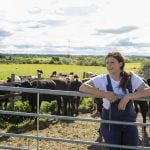
Ramping up phosphorus for alfalfa

Ramping up phosphorus for alfalfa

Building soil phosphorus when fertilizer prices are lower may have big impacts for future profit, 
tour attendees heard Aug. 30 at the Manitoba Beef and Forage Initiatives Brookdale site

Producers got a side-by-side comparison of different phosphorus treatments in alfalfa Aug. 30. The phosphorus ramp, presented during the Manitoba Beef and Forage Initiatives (MBFI) Brookdale field tour, showcased consecutive strips of alfalfa grown with progressively more phosphorus. The ramp tracks crop impact in the three years following a one-time phosphorus application ranging from no


New report describes ‘three-tiered’ food system operating in Canada

New report describes ‘three-tiered’ food system operating in Canada

A University of Guelph researcher takes a close look at Canada’s evolving alternative food market

Kelly Hodgins was selling garden produce at a B.C. farmers’ market in 2013 when she began noticing something was different about her customers. There were new faces arriving at the market. The province had introduced a new program making coupons available to lower-income families to shop B.C.’s well-established farmers’ markets. “It was kind of an

This barn will remain, but most of the rest of the facilities will be demolished at the University of Guelph’s Elora Beef Research Station to make way for new beef research buildings. (John Greig photo)

Guelph gets new beef research facility

The federal and provincial governments and the Beef Farmers of Ontario have all announced funding for buildings and programs at the University of Guelph’s renewed beef research station this week. The funds announced are to help create a completely new cow-calf and heifer research facility next to the current beef research station, and a new


Groups across Canada’s agriculture and food sectors feel the time is right for a national food policy.

Farm and food talks bring new voices to the policy table

The national food policy development process will pull many out of their comfort zone

The meeting the Canadian Federation of Agriculture hosted in Ottawa June 5 wasn’t the usual assembly of farmers. Participants included a broad spectrum of stakeholders with an interest in food, including Food Secure Canada, the Nutrition Resource Centre of the Ontario Public Health Association, the Maple Leaf Centre for Action on Food Security and the

Still a lot to learn about hog nutrition

Still a lot to learn about hog nutrition

Ideas for small but significant changes may be difficult to incorporate into large-scale operations

As the hog industry becomes more integrated, small changes in nutrition can have significant financial impacts across large systems. That means that swine nutritionists and academics are challenged to think about what level of proof is needed for changes to be implemented in the barn. That is one of the conundrums facing swine nutrition, says


Predators, such as (A) an Orius nymph, (B) Asian lady beetle, (C) aphid midge larva, and (D) parasitic wasps typically suppress early-season infestations of soybean aphid.

U.S. study questions neonics for soybean aphid control

The effectiveness of the insecticide has diminished by the time the plants 
are at the stage when the insects arrive

A multi-university study says that neonicotinoid insecticide seed treatments have little effect on soybean aphid populations, as the pesticide has disappeared in plant tissue by the time the aphids arrive. The two-year study was a joint effort of Purdue University, Iowa State University, Kansas State University, North Dakota State University, the University of Minnesota, South


Soldier fly larvae like these can convert waste food into high-protein feed.

Insect entrees

Insects are going to play a more important role in the human food chain, but that might not mean direct consumption

A professor emeritus at the University of Guelph says insects might be a more sustainable source of nutrition, but just how they’ll be used is up in the air. David Waltner-Toews, an epidemiologist who taught in the U of G’s Ontario Veterinary College, studied the topic for his new book, Eat the Beetles! which will

Youth want to stay on farm

Youth want to stay on farm

The project will look at how new farmers make it work 
as they enter the business

New research aims to debunk the idea that young people want to leave the family farm and move to the city. Annette Desmarais of the University of Manitoba is one of nine researchers involved in the study, which will look at barriers young farmers face in multiple countries, including Canada, India, China and Indonesia. Titled,