
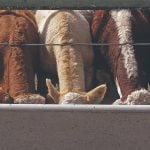
Larry Wagner, a Virden-area producer discusses his management strategies in a pasture on his operation last summer.

Bale grazing – benefiting the pasture and your wallet

Bale grazing has the potential to reduce overwintering costs and leaves substantial 
nutrients behind, promoting increased forage production and quality

Not only can bale grazing reduce costs and time in the tractor, it can also boost forage growth and overall production. “The advantages of bale grazing are that you are able to save money and reduce operating cost by lowering yardage, tractor use and removing the need to haul manure,” said Shawn Cabak, livestock specialist

Getting fall fertility just right requires attention to detail

Getting fall fertility just right requires attention to detail

Keep your fertilizer on your land and out of the spring run-off

As the crop comes off some farmers are already thinking about next spring — specifically about getting a jump on things by fertilizing this fall. There are lots of compelling reasons to follow this strategy. Fertilizer prices tend to be lower this time of year, and spreading the workload out lets them get the crop


FarmScene, and the days of Manitoba Agriculture on CKY-TV

FarmScene, and the days of Manitoba Agriculture on CKY-TV

Our History: September 1980

This ad from our Sept. 25, 1980 issue reminds of a time when Manitoba Agriculture had its own communication staff which prepared weekly press releases and a TV program which was broadcast on CKY-TV. Much of that issue was dedicated to reports and opinion on a rapeseed pricing controversy. The recently formed Grain Transport Authority,

Fall frost can cut soybean yields and reduce quality, but fortunately this year most Manitoba soybean fields are now mature enough that frost would do little damage, says Manitoba Agriculture’s pulse specialist Dennis Lange.

Soybeans mostly safe from frost now

Manitoba Agriculture pulse specialist Dennis Lange has advice on harvesting weedy soybean fields

Soybean yields are now largely locked in — but quality could still take a hit for future frosts. Dennis Lange, Manitoba Agriculture pulse crop specialist, says this progress is readily apparent in the province’s record 1.6 million acres of soybeans. “This year driving around the countryside you are seeing lots of varieties started to dry


Fresh off the field

Fresh off the field

With winter cereal seeding season upon us, here’s the 2016 MCVET winter cereal yield data

In Manitoba, interest in fall rye is increasing, with 112,000 acres seeded the fall of 2015. Although winter wheat acres have declined in recent years, there are still very strong economic and agronomic arguments to be made for including winter wheat in rotation. There are a number of newer winter wheat and fall rye varieties,


Manitoba Crop Report and Crop Weather report: No. 17

Conditions as of August 22, 2016

Sporadic rainfall, high humidity and wet field conditions have slowed harvest progress in areas of Manitoba. However, harvest does continue as weather and field conditions allow. Winter wheat and fall rye harvest is complete. Winter wheat yields range from 50 to 100 bushels per acre, with an estimated provincial average of 75 bushels per acre.

Larvae on sclerotinia infected plant tissue.

Crop insect concerns low, some soybean crops report brown spot

Manitoba Insect and Disease summary for August 17

Summary Insects: Insect pest concerns are currently low. Most canola crops are now past the stage where Lygus bugs would be of concern. Only trace levels of soybean aphids have been found so far. Grasshopper counts have so far generally been low. Plant pathogens: Various diseases continue to be reported in field crops.. Disease Update Corn:


Fusarium head blight in canary grass.

Lygus bugs, moths present in sunflowers, keep your eye on stored grain

Manitoba Insect and Disease summary for August 10

Summary Insects: Insects of highest importance to scout for currently are Lygus bugs in canola and sunflowers, and banded sunflower moths in sunflowers. Only trace levels of soybean aphids have been found so far. There have still been no reports of high levels of larvae of bertha armyworms in Manitoba. Plant Pathogens: Various diseases continue

Staging critical for pre-harvest glyphosate

The crop must be mature before applying the non-selective herbicide

“Glyphosate is not a desiccant.” And just to be sure listeners got the message Manitoba Agriculture cereals specialist Pam de Rocquigny repeated the statement again during the Westman CropTalk webinar July 27: “Glyphosate is not a desiccant. “I no longer want to see anyone referring to when they are applying a pre-harvest glyphosate application… that