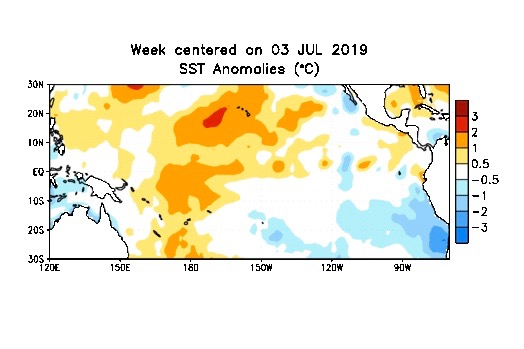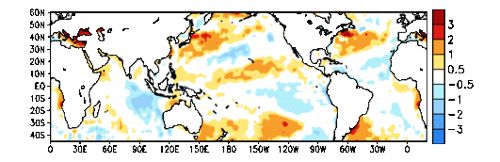
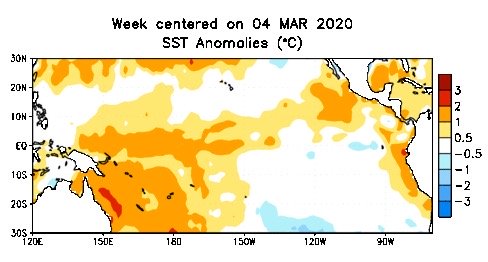
Pacific Ocean sea surface temperature anomalies in degrees Celsius for the week centred on Jan. 31. (CPC.ncep.noaa.gov)

La Nina seen likely to fade by spring

Reuters — The current La Nina weather cycle is likely to transition into more neutral conditions by spring, a U.S. government weather forecaster said Thursday. La Nina is characterized by unusually cold ocean temperatures in the equatorial Pacific Ocean and is linked with floods and droughts. It is the opposite phase of what is known


Despite El Niño coming to an end earlier this year, the globe still appears to be running a temperature.

Warm global temperatures and La Niña

Usually La Niña means colder temperatures but this is a weak one

I figured it was time to review what has been going on with global temperatures over the last few months. Despite El Niño coming to an end earlier this year, the globe still appears to be running a temperature. September came in as the fourth-warmest September on record according to both NOAA and NASA, while


La Niña developing in time for winter

Just how powerful the weather phenomenon will be this season is still up in the air

I must begin with a bit of an apology. I had promised that we would be looking at trends in overnight temperatures across the Prairies this week, but we will not be able to cover it this time around. As I was working on the final crunching of the data I realized that I had


Sea surface temperature anomalies over the Pacific for the week centred on May 31. (CPC.ncep.noaa.gov)

U.S. forecaster sees El Nino unlikely through fall

Reuters — A U.S. government weather forecaster on Thursday said there are no active El Nino or La Nina patterns and that neutral conditions are likely in the Northern Hemisphere during fall 2017. However, chances for El Nino remain elevated, between 35 and 50 per cent, relative to the long-term average into the fall, the

USA, Oregon, Cannon beach

El Niño conditions are developing in the Pacific

We know La Niña and El Niño both have an effect on weather — but predicting it is still a real challenge

El Niño conditions are developing across the Pacific with an increasing probability that a full-fledged El Niño episode will occur during the second half of 2017. Pacific equatorial winds have slackened since the start of the year and a characteristic tongue of warm water has begun to form stretching from Peru towards the international dateline.