
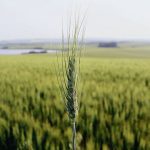
“What we’re trying to do here with these types of studies is to do some valuation of the grasslands.” – Marcos Cordeiro, University of Manitoba.

Using forages to fight flooding

Modelling study puts long-term numbers on forage’s flood prevention role

Planting more forage would be valuable for flood control, and new research has numbers to back that up. “We knew this from the start,” said Marcos Cordeiro, study lead and assistant professor of animal science at the University of Manitoba. Previous research, such as a study based in Saskatchewan in 2003, had already flagged forage
Grazing mentors offer expert advice, path to on-farm funding

Grazing mentors offer expert advice, path to on-farm funding

Mentorship program takes aim at rotational grazing knowledge gap

A new mentor program may prompt more farmers to add rotational grazing to their management plans. The Manitoba Forage and Grassland Association (MFGA) has provided the Manitoba Association of Watersheds with access to roughly 15 grazing experts. Those experts are spread across the province and will be made available for one-on-one mentorships through the program.


(Dave Bedard photo)

Spring planting expected complete by week’s end

Manitoba Crop Report, Issue 3 (Week 22)

Precipitation was variable across agro–Manitoba from May 22 to 28 with values ranging from 0 to 41.7 mm. The Northwest and Southwest regions received the highest amounts of precipitation over the past seven days. Climate normals for total accumulated precipitation from May 1 to May 28 range from 31.6 to 58.3 mm and are based

Figure 1: Seeding progression in 2023 compared to previous years.

Seeding progress behind five-year average, soybean, canola seen lagging

Manitoba Crop Report: Issue 1 (week 20)

Weekly Provincial Summary  Precipitation was variable across agro–Manitoba from May 8 to 14 with values ranging from 0 to 48.9 mm. Mid-week rains brought the highest observed precipitation to the Northwest and Southwest regions. Climate normals for total accumulated precipitation from May 1 to May 14 range from 13.1 to 29.2 mm and are based


A field tour participant examines the wider corn rows and multi-species intercrop for an extended grazing trial at MBFI’s in September 2021.

Manitoba Beef and Forages joins Smart Farm network

The partnership hones in on tech validation with an eye for what will actually work on farms

A network of “Smart Farms” dedicated to jumpstarting on-farm technology has added a Manitoba name to their roster. The Manitoba Beef and Forage Initiatives (MBFI), an applied research and demonstration farm north of Brandon, has joined the Pan-Canadian Smart Farm Network, it was announced Feb. 2. The network, spearheaded by Olds College of Agriculture and

Manitoba Agriculture Forage and Livestock specialist Elizabeth Nernberg speaks on test plots of various annual forages.

Annual forages best in dry years

Trials show better production during drought, says provincial livestock specialist

When you think of forages, you often think of perennials like alfalfa, clover or timothy, which are there for the long haul and perfect for baling or silage. While they have many strengths, one weakness became evident last year. They don’t do well when it’s really hot and dry. [READ MORE] Nitrate risk comes from


Teff a promising forage in dry year

Results so far are from small plots in short trials

James Frey of the Parkland Crop Diversity Foundation stands in a plot of teff grass, an African annual that’s new to the province and to the Parklands. In a small plot trial, it shows promise as a warm-season forage. “It originally comes from northeastern Africa, sort of in the Ethiopian area, where it is grown

Nitrate risk comes from variety of sources

It’s not just a drought that increases risk to the herd

When a forage crop is stressed, it can accumulate nitrates. Elizabeth Nernberg, provincial forage and livestock specialist, says this can occur in any season and from a variety of conditions. “Last year we did see some higher levels because any kind of plant stress can cause that.” she said. “Typically hail or frost are the


Sorghum or milo is a potential nitrate accumulator and should be tested prior to haying or grazing.

Test forages for nitrate prior to haying or grazing

High temperatures combined with adequate moisture can impact metabolism and cause nitrate to build up in plants

Although much of the region has received adequate moisture this summer, it is important to remember there is still potential for nitrate toxicity in many forage crops, including small grains, brassicas, millet, sorghum/sudangrass and corn harvested for hay. “Nitrate is a common form of nitrogen found in the soil, which is taken up by plants

VIDEO: What does a healthy pasture look like?

VIDEO: What does a healthy pasture look like?

Rangeland biologist answers the question, ‘can cattle be trained to eat spurge?’

A number of situations – some within a producer’s control, some not – can compromise the health of pastures and grasslands of not being able to grow quality forages to feed livestock. During a field day in July hosted by Manitoba Beef & Forage Initiatives, Mae Elsinger, a rangeland and pasture biologist with Agriculture and