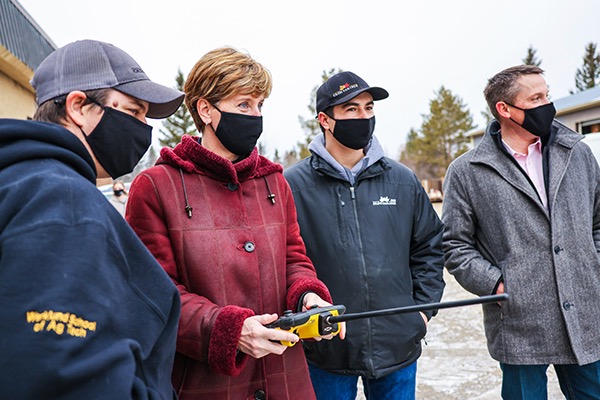
Jeff Veenstra grows vegetables on Wild Earth Farms near Birds Hill Park, northeast of Winnipeg.

Acreage requirement drop for veggie insurance first step for small-scale farmers

Move shows MASC is listening to call for scale-appropriate BRMs, says Direct Farm Manitoba

A drop in acreage required to insure vegetable crops has opened a door for smaller-scale and direct-marketing farmers. “This has really changed our ability to be insured quite significantly,” said Jeff Veenstra who farms northeast of Winnipeg. On January 25, the province announced it would reduce the minimum required acres for vegetable acreage loss insurance
“I think moving forward there will be some modifications and some improvements to the program… Will it be what all agriculture wants? It may not be all of that.” – Bill Campbell.

Still hope for improvements to AgriStability

KAP says co-operation to address drought a positive sign for risk management negotiations

It appears the major AgriStability overhaul many farmers want is unlikely any time soon, but Bill Campbell is optimistic improvements can still be made. “I think moving forward there will be some modifications and some improvements to the program,” Campbell, president of the Keystone Agricultural Producers (KAP), said in an interview Dec. 8, the day


Federal Agriculture Minister Marie-Claude Bibeau (second from left) and Nate Horner (right), her Alberta counterpart, during a tour of Olds College’s Smart Farm on Thursday. (Photo: Olds College/Sergei Belski, www.oldscollege.ca)

Alberta looks for feed, Ottawa promises cash for B.C.

Alberta to help with veterinary testing after B.C.'s lab flooded, Alberta ag minister says

Even though supplies are low because of drought, Alberta is looking for feed to send to B.C. livestock producers, while Ottawa will provide emergency financial assistance to farmers dealing with flooding and closed roads in the hard-hit province. “We’ve been working with the B.C. department of agriculture,” Alberta Agriculture Minister Nate Horner said during a

Marie-Claude Bibeau, Dave Epp, Yves Perron and Alistair MacGregor laid out their parties’ positions in an agriculture leaders’ debate on Sept. 9, 2021. (Video screengrab from Canadian Federation of Agriculture via YouTube)

Federal support for farmers focus of ag leaders’ debate

AgriStability, carbon levy exemptions, supply management among topics

An agricultural debate ahead of the federal election gave representatives from political parties an opportunity to pitch their ideas to producers, resulting in debate over how best to support farmers. Thursday evening’s debate, hosted by the Canadian Federation of Agriculture, had plenty of discussion about climate change and how best to support producers in a


File photo of the flags of Canada and its provinces and territories at Canada Place in Vancouver. (lilly3/iStock/Getty Images)

Feds launch consultations on next ag policy framework

Programming types, cost-sharing among expected contentious points

Consultations for Canada’s next agricultural policy framework are officially underway. The five-year framework agreement currently in place, known as the Canadian Agricultural Partnership (CAP), is a $3 billion funding deal between federal, provincial and territorial governments that funds a wide range of programming within the sector. That deal, agreed upon in mid-2017, kicked off in

Such criticism is misleading, and wrongly places the blame on Ottawa.

Opinion: Feds came with cash, Prairies didn’t

The western provinces want to blame the feds for failing to fund, while keeping their own purses closed

The Prairie provinces are being disingenuous in their failure to take responsibility for AgriStability reform talks that floundered largely due to their tight pockets. Yes, the AgriStability saga between Prairie provinces and the federal government continues, despite the two sides agreeing on a major reform. After more than a year of back-and-forth negotiations, provinces agreed


A new proposed program to AgriStability could be modelled similar to crop insurance.

Whole-farm income insurance program gaining traction

The proposal is sure to be a topic of discussion at intergovernmental meetings later this year

Support for an alternative program to AgriStability continues to gain momentum. Canadian agricultural ministers are continuing to consider replacing AgriStability with a margin-based income protection program as soon as 2023. Complaints of AgriStability being costly and ineffective, particularly on the Prairies, prompted governments in those jurisdictions to explore other options. Talks to reform AgriStability thus

Editorial: Effective ag stabilization programs a must

It’s tempting to look into the shadows for a deep, dark conspiracy behind the three Prairie provinces’ reluctance to fully support AgriStability. The farm income support program, cost shared 60-40 by the federal and provincial governments, compensates participating farmers if their farm income minus eligible expenses drops below a certain threshold. Farmers and their organizations


Federal Agriculture Minister Marie-Claude Bibeau speaks to media in Winnipeg on Feb. 13, 2020. (Dave Bedard photo)

Yes or no now on AgriStability changes, ag minister says

Farm and commodity groups line up to press provinces for decision

Ottawa’s proposals for changes to the AgriStability farm income stabilization program require a yes or no answer from participating provinces, not more discussion, the federal ag minister said Wednesday. “It has been just over 110 days since we made the offer to the provinces to improve AgriStability,” Agriculture Minister Marie-Claude Bibeau and Winnipeg MP Jim

Letters: BRM commitment needed

I have watched closely the ongoing discussion regarding business risk management (BRM) occurring with and between the provinces and the federal minister of agriculture, Honourable Marie-Claude Bibeau. Farm organizations such as the Keystone Agricultural Producers, as well as other signatories, have long maintained that the current suite of BRMs, especially AgriStability, do not provide a