

Spray specialist Tom Wolf of Sprayers 101 helps demonstrate the WEEDit system this July, using water- sensitive pads laid on the ground to show droplet placement.

Adding some IQ to smart spraying

Weeds are in for some one-on-one attention with the latest spot-spraying tech coming down the pipe

It looks like something out of science fiction. Above a Saskatchewan field, a line of drones rises in formation, sensors primed to pick out enemy targets below. But this isn’t the latest Terminator movie. This is Daniel McCann’s brainchild for green-on-green spot spraying, an offshoot of precision spraying that promises to identify and take out

“We’ve actually sent people out into fields with cameras in Saskatchewan and Alberta and Manitoba to actually capture the weeds and crops that are growing right here.” – Daniel McCann, Precision.ai.

Smart spot spraying still has a way to go

Farmers need to be 100 per cent confident these new technologies will work when they hit the field

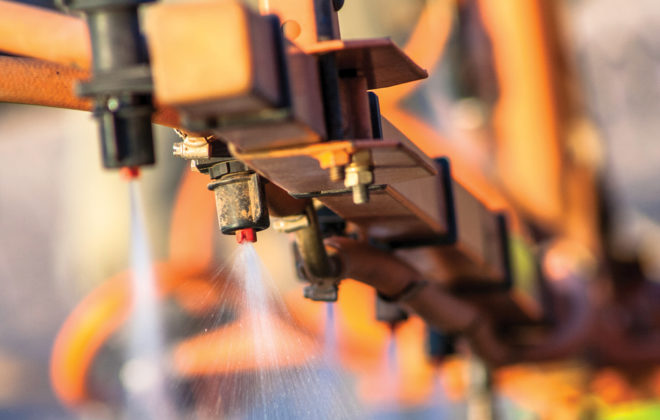
Like any developing technology, spot-spraying systems are far from perfect. In a Manitoba demonstration this July, attendees noted that the WEEDit system missed some smaller weeds during a single pass. That could be addresses by adjusting sensor sensitivity or by turning on “dual mode,” which sprays a constant quarter-rate to take care of less hardy


Faster internet may bring technology to more farms

Faster internet may bring technology to more farms

In 2017, 84 per cent of farmers were using precision ag tech, but half said their internet wasn’t fast enough

Rural internet improvements may have implications for precision agriculture, farm technology — and Netflix binging. “We all hate waiting for that circle of death,” said Trevor Armitage, vice-president of global operations at Farmers Edge, referring to the familiar buffering symbol used while waiting for available bandwidth to catch up to demand. He said user experience drives much

The DOT lines itself up to attach to a SeedMaster branded attachment at Canada’s Farm Progress Show last year in Regina, Sask.

Move over Tesla, agriculture is where the real autonomy is at

DOT's autonomous platform to bring hands-free navigation to the field

We’ve heard lots about the coming revolution of self-driving cars. Some of the biggest tech giants on the planet like Google and Tesla are working hard to bring this to roads around the world. But closer to home, with far less fanfare, farmers are already bringing autonomy to the field in the form of SeedMaster’s


Vermeer’s ZR5 self-propelled baler demonstration was a major draw during a hay and silage day at Manitoba Beef and Forage Initiatives north of Brandon earlier this year.

Is this baler yet another step toward driverless machinery?

Vermeer promises its new self-propelled unit will make baling as easy as driving down the highway

Autonomous farming has taken a step from the grain crop to the hayfield. Vermeer’s ZR5 self-propelled baler has made waves in the U.S. and now in Canada after the machine made its Canadian debut in Manitoba earlier this summer. It was a major draw at equipment demos in both Glenboro and the Manitoba Beef and

“You really don’t do anything on this machine but steer it.”– Corey Dalman, Vermeer.

Boots on the ground with Vermeer’s ZR5 baler

Digging into the finer details on the ZR5’s promises and capabilities

Vermeer expects its modular design to be a selling point for the ZR5, both for ease of service and safety. The baling chamber is hydraulically connected to the power unit similar to a front-end loader. When disconnected, a switch in the cab lifts the baler from the power unit, allowing the farmer to drive away.


Christian Wytinck of Cypress River says GPS has a myriad of uses on the family’s farms, mostly revolving around greater efficiency.

Section control helps farmer find more acres

GPS locates overlooked acres

Christian Wytinck always seemed to run out of seed be- fore he finished seeding one of the fields on the family’s farm operation near Cypress River, Man. “We just bought this one field close by and when we went to farm it, Dad thought it would seed 295 acres, but when I went to actually

Steel tariffs made farm equipment manufacturing margins smaller last year.

Tariffs made for ‘lean year’ for agriculture manufacturers

The lifting of the U.S.-Canada steel tariffs should make trade easier, but it might be too early to tell if it will reduce the cost of farm machinery

Despite dropped steel tariffs, one Manitoba manufacturer of agricultural equipment says it’s too early to be optimistic. “I think it’s just going to be a regular day of business,” said Darren Blazeiko, general manager of Cancade CBI Ltd. in Brandon. Why it matters: The tariffs have made imports of steel and equipment and exports of


Kubota’s current highest-horsepower line of tractors is the M7 line, manufactured in France.

The next made-in-Canada tractor

What will Buhler make for Kubota’s move into the heavy-horsepower market?

Japan’s Kubota Corp. is poised to join Massey Harris, Cockshutt and Versatile on the short but distinguished list of farm tractors made in Canada. Buhler Industries, already well known as the manufacturer of Versatile tractors at its Clarence Avenue plant in Winnipeg, has opened its factory floor to also produce Kubota’s highest-horsepower tractor yet for

High-tech systems can make managing information during the busy seeding season easier and more informative.

Crop planning the digital way

It may be time to ditch the old notebook in favour of a new way of doing business in the spring

Producers of the past relied on written records, the Farmer’s Almanac and a good pair of workboots to check their fields as they planned their spring planting operations. Today’s producers can reach for the smartphone or tablet in their tractors to access a digital platform with all the information they need to make crop decisions