
Steve Kenyon talking about pasture weeds

Steve Kenyon: The weed whisperer

Alberta cattle farmer shares his 
tips on successful practices

When Steve Kenyon speaks to producers about pasture management, he likes to rile up the crowd. “There’s no such thing as weeds,” he said to cattle farmers gathered in the Boissevain community centre last week. “What we call a weed is just a plant that hasn’t learned to grow in rows yet. Or we haven’t

man standing beside hay-baling machinery

VIDEO: Quebec haymakers use homemade dryer to improve hay quality

The Normandins also modified a small hay baler to convert big square bales into small ones

David Normandin and his brother Mathieu preferred driving tractors to milking cows and that’s why they make hay and not milk. The brothers, along with their father Luc and Luc’s partner’s daughter, Audrey Mailloux, operate Norfoin Inc., 57 km southeast of Montreal in the Montérégie region of la belle province. The operation had been a


cow eating hay

Editorial: Foraging for a national voice

Just four years since its inception, the Canadian Forage and Grassland Association is struggling after losing the support of the sector that arguably benefits the most from its activities. Eighty per cent of Canada’s beef production depends on forages as the main feed source. Of the $5.1 billion of economic activity forages contribute to the

bale making machine

CFGA makes the case for more publicly funded forage research

The association also has a plan for performance testing new varieties and restoring lost inoculants

Cuts in federal government-funded forage research came easier than others because they generated fewer complaints, Ron Pidskalny told the Canadian Forage and Grassland Association’s (CFGA) annual meeting Nov 16. Pidskalny, who was the CFGA’s executive director until resigning Nov. 19, said that’s what a former high-level Agriculture and Agri-Food Canada official told him. Cutting a


men looking at hay

National forage association loses funding, executive director

Canada’s biggest acreage crop running on fumes

Forage is Canada’s biggest crop, generating billions in revenues and environmental benefits, but it’s struggling and so is the national organization created five years ago to promote it. The Canadian Forage and Grassland Association, has lost a major funder and its executive director. The Canadian Cattlemen’s Association withdrew its support, which amounted to $20,000 annually,

Simon Ellis, Manitoba farmer

With no AgriRecovery yet in sight, farmers face a tough winter ahead

KAP is still pushing for AgriRecovery to offset what was for many farmers a terrible growing season

It was a tough year for many Manitoba farmers and it could be an even tougher winter, according to farmers speaking at Keystone Agricultural Producers’ (KAP) fall General Council meeting Oct. 30. “There will be farmers who will not make land payments and machinery payments due to the fact they have not got their crop,


pallet of crop seed on a conveyor

VIDEO: BrettYoung opens state-of-the-art seed treatment facility

Many aspects of production, treating and packing are fully automated, computer-controlled

BrettYoung celebrated its 80th anniversary by opening a new 28,000 square foot high-capacity seed treating and coating facility at its Winnipeg headquarters Oct. 28. Manitoba Co-operator reporter Allan Dawson took a tour of the new facility and spoke with BrettYoung chief executive officer Calvin Sonntag and Cory Baseraba, the chief operating officer.

cattle feeding at a trough

Cattle producers have forage concerns after wet season

High nitrate levels in frost-stressed crops can be fatal for cattle

Cattle producers should test their feed this year because wet weather has compromised the nutritional value in late-seeded cereal crops, and cold weather could make them potentially dangerous, a provincial forage specialist says. “We’re quite concerned about nitrates this year after the stress that the plants have been under all summer and then with the recent


Forages and grasslands are not just about cattle and hay, they also provide a major environmental benefit for all Canadians.  
top and above photo: Canadian Forage and Grassland Association

The fight for the future of forages

There has been a dramatic drop in forage research, but it’s not just because producers could make more money growing canola

What’s Canada largest crop? The usual answer is “wheat,” which in 2012 was seeded on about 20 million acres. But that year, cultivated forages made up 33 million acres, and more than 36 million acres were in native or unimproved pastures and rangeland. Yet farmers who manage grasslands and forage fields say their industry is

Brian Harper says he’s doubled the carrying capacity of his pastures by 
using a high stock density system.

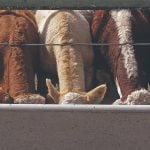
Get in line and move on — grazing an acre at a time

Switching to a high stock density system with 128 paddocks instead of 16


I call it my ‘big red swather,’” Brian Harper told a group of cattle producers visiting his farm near here last August. Harper smiled and as if on cue, 63,550 lbs. of his herd of Shaver Beefblend/Lincoln Red cattle started munching their way down one of his field’s narrow one-acre grazing paddocks. “Up to 2013,