Don’t worry, we are going to finish last issue’s discussion about the seasons.
Before that, though, let’s take a look ahead at what the latest weather models are predicting for the next few months. We will wait until early April for our annual look back at the winter’s weather.
Let’s begin with the Old Farmer’s Almanac. Their outlook calls for a warmer-than-average end to March, followed by near-average temperatures in April and May. Precipitation across all three months is expected to stay close to average.
Read Also
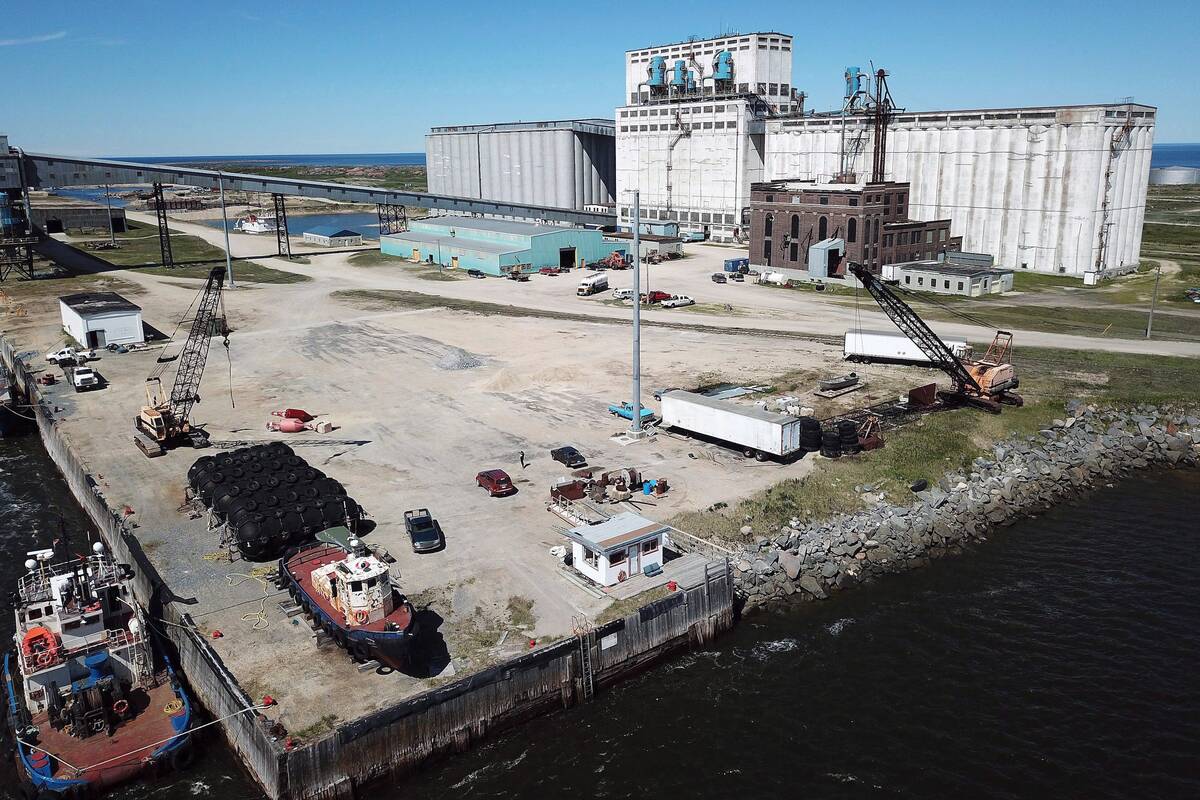
Making way for Port of Churchill expansion
Rail car limits, climate research and marine planning will determine if the Port of Churchill actually can grow beyond its four-month shipping season into year-round trade.
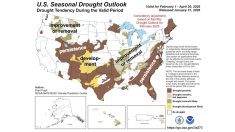
Next, looking at NOAA’s seasonal outlook (extrapolated north into the Prairies), it suggests near- to below-average temperatures from March through May across Manitoba, while Saskatchewan and Alberta are expected to see temperatures closer to average. Precipitation is projected to be near average across the Prairies overall, though the far eastern Prairies may have a slightly higher chance of above-average amounts.
Moving on to some of the more reliable long-range models: the CFS model calls for above-average temperatures to finish March, followed by slightly cooler-than-average conditions in April, with the greatest chance of below-average temperatures across western regions. Temperatures are then forecast to return to above-average in May.
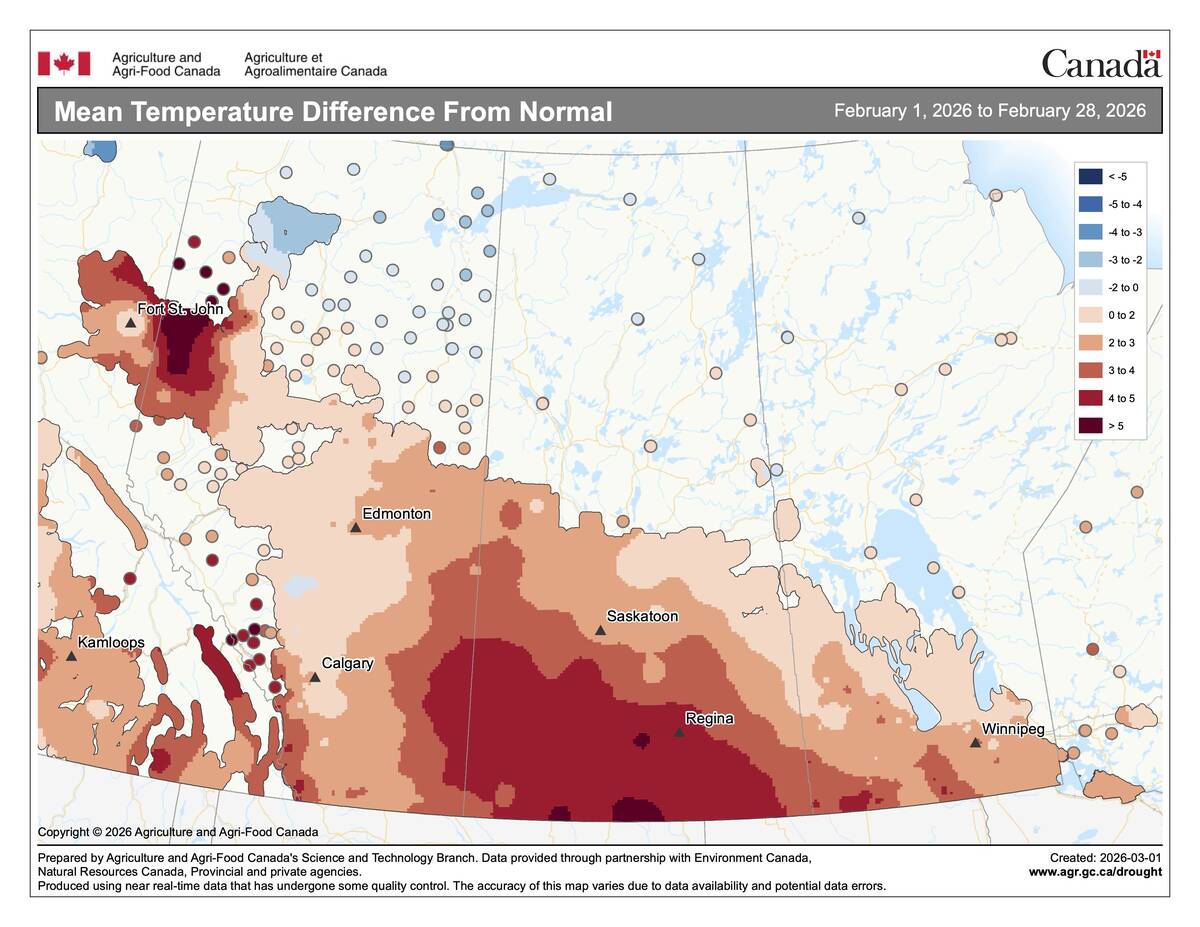
In terms of precipitation, the model suggests near- to above-average amounts for the remainder of March, with above-average precipitation continuing across the southern half of the Prairies through April. By May, the eastern Prairies are expected to see near- to above-average amounts, while western regions may experience near- to slightly below-average precipitation.
The Canadian CanSIPS model presents a somewhat different outlook. It calls for well-below-average temperatures in March, particularly across the northern Prairies. These colder conditions are forecast to moderate to slightly below-average in April, with southern Alberta possibly seeing slightly above-average values. This warming trend continues into May, when most regions are expected to see above-average temperatures.
The precipitation outlook from CanSIPS differs from the CFS model, with March expected to bring near-average amounts, followed by below-average precipitation in both April and May.
The final model in our comparison is the European ECMWF model. This model forecasts near-average temperatures in both March and April, followed by near- to slightly above-average temperatures in May. Its precipitation outlook is similar to that of the CanSIPS model, projecting near- to slightly below-average precipitation through all three months.
Finally, a few words of personal weather wisdom. At this point, I am leaning toward the CFS model overall, with one exception: I suspect the second half of March may trend closer to near- to below-average temperatures. Here’s hoping you get exactly the type of weather you need and want in the months ahead.
The march of the seasons
Now, let’s get back to the science behind the seasons. This time, we’re looking at day length.
Day length is measured as the interval between sunrise and sunset each day. The two extremes — the shortest and longest days — occur in December and June and are referred to as the solstices. Around Dec. 21-22, we experience the winter solstice, when the sun is directly overhead at 23.5° south latitude. At this time, the Northern Hemisphere experiences its shortest day of the year. On June 20 or June 21, we experience the summer solstice, when the sun is directly overhead at 23.5° north latitude, giving us our longest day.
You might expect the shortest days to be the coldest and the longest days the warmest, but that is not usually the case. The coldest and warmest periods typically occur about a month later, due to the time it takes for the Earth’s surface and atmosphere to respond to changes in solar heating.
The other two important dates in the seasonal cycle are the vernal and autumnal equinoxes. These happen when the sun is directly over the equator, giving roughly 12 hours of daylight to all places on Earth. The vernal equinox occurs between March 20-21, while the autumnal equinox occurs Sept. 22 or Sept. 23.
Atmospheric composition
We will revisit the sun’s journey from south to north and back again later in this series, as this simple movement helps drive much of the weather we experience here in Canada. For now, we turn our attention to the composition of the atmosphere.
There are two main ways to divide the atmosphere. Based on composition, it can be separated into the heterosphere and the homosphere. The heterosphere begins at about 80 kilometres above the Earth and extends outward toward space. It contains only about 0.001 per cent of the atmosphere’s total mass, and the gases in this region are not evenly mixed.
The homosphere, which includes everything below 80 kilometres, contains the vast majority of the atmosphere’s mass. While gas density decreases rapidly with height, the mixture of gases remains fairly uniform, except for water vapour and ozone. Gravity compresses air near the surface, which is why density decreases so quickly with altitude.
By about 5,000 metres, nearly half of the atmosphere’s mass lies below you. At 11,000 metres — where most jet aircraft fly — more than 75 per cent of the atmosphere’s mass is beneath you.
Within the homosphere, the atmosphere is composed mainly of three gases: nitrogen (78.084 per cent), oxygen (20.946 per cent), and argon (0.934 per cent). The remaining 0.034 per cent consists of trace gases such as neon, helium, carbon dioxide, methane, krypton, and ozone.
Another way to describe the atmosphere is by temperature. Using this method, it is divided into four layers: the troposphere, stratosphere, mesosphere, and thermosphere. These layers are the ones most familiar to many people and are particularly useful when studying how weather develops and behaves.