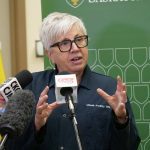
Claudia Schievelbein and Guy Kastler spoke about Europe’s experience with UPOV ’91 at the University of Manitoba Feb. 22 at a meeting organized by the National Farmers Union with funding from Growing Forward 2 and Interlake Forage Seeds Ltd. Schievelbein is an organic farmer and farm reporter in Germany. Kastler is an organic farmer in France and advocate for farm-saved seed.

Analysis: Rising seed costs on farmer radar

There are different options for producers to consider

There are no crops without seed. It’s as essential to production as air, soil, water and sunshine. Seed is also increasingly expensive ranking in the top three “operating expenses” for Manitoba crop producers along with fertilizer and pesticides. (Operating costs do not include fixed costs such as land and equipment or labour.) The National Farmers

A polar bear sculpture made of ice stands outside the Global Seed Vault in Longyearbyen at the facility’s opening in February 2008. The vault has been built in a mountainside cavern on Spitsbergen Island around 1,000 km (600 miles) from the North Pole to store the world’s crop seeds in case of disaster.

Doomsday Arctic seed vault to receive two deposits in 2016

The vault built to protect the world's seed supplied is built into the side of a Norwegian mountain

Two new consignments of crop seeds will be deposited this year in the “doomsday vault” built in an Arctic mountainside to safeguard global supplies. The vault — which opened on the Svalbard archipelago between Norway and the North Pole in 2008 — is designed to protect crop seeds such as beans, rice and wheat against


New Plant Breeders’ Rights rules under UPOV ’91 give seed companies the option of tracking down those who infringe on those rights through the entire grain system. Lorne Hadley, executive director of the Canadian Plant Technology Agency, says pedigreed seed growers need to help communicate the new regulations to their farmer-customers.

Tracking down illicit seed sellers

Private investigators are helping the seed trade 
enforce plant breeders’ rights

Undercover private investigators are helping nab seed dealers suspected of contravening Canadian Plant Breeders’ Rights (PBR) regulations, the executive director of the Canadian Plant Technology Agency (CPTA) says. Lorne Hadley told the Manitoba Seed Growers’ Association’s annual meeting in Winnipeg Dec. 10 his agency has co-ordinated 70 investigations resulting in “a number of cases going

frost damage on a soybean seedling

Look to more than calendar for best time to plant soybeans

Soybeans don’t like cold and they are very susceptible to spring frost

Now is the time to plant soybeans in Manitoba according to the calendar, but date is just one of four factors to consider, says Terry Buss, a farm production advisor with Manitoba Agriculture, Food and Rural Development (MAFRD) based in Beausejour. The others are soil temperature, the weather forecast for 24 hours before and after


soybean plant

Bringing soybeans in from the cold

A Brandon research scientist is studying the effects of cool temperatures during the Manitoba growing season

A Brandon research scientist is studying how cold temperatures during the growing season can put a chill on soybean production. Ramona Mohr, who works at the Agriculture and Agri-Food Canada’s Brandon Research Centre, says it starts with a “chilling effect” at planting. Mohr presented preliminary results from her studies at North Star Genetics’ annual soybean

two men standing in an agricultural seed treatment facility

BrettYoung unveils new seed-treating facility at Winnipeg headquarters

The 28,000-square-foot facility can process 50 million pounds of seed a year

BrettYoung opened its new seed-treating and -coating facility at its headquarters just outside of Winnipeg Oct. 28. It’s the single biggest investment the 80-year-old, family-owned company has ever made, BrettYoung chief executive officer Calvin Sonntag said in an interview. “It signals our ongoing commitment to agriculture and to customers and supplier-partners,” he said. “This investment


hand running through a pile of grain

Right to save seed will be absolutely clear, Ritz vows

The government has introduced amendments to its Agricultural Growth Act 
to make the language around seed saving clearer

Legislation updating plant breeders’ rights will be amended to make it absolutely clear that farmers can save and replant seeds from crops they have grown, says Agriculture Minister Gerry Ritz. It was one of several amendments the government plans for the Agriculture Growth Act, which was forced through second reading in the Commons in June.

Plant Breeders’ Rights (PBR) and Bill C-18

Despite what detractors say, both farmers and breeders will benefit

As public plant breeders with Agriculture and Agri-Food Canada and the University of Saskatchewan for a combined total of over 100 years, we were pleased to see the recently tabled Agricultural Growth Act (Bill C-18). This bill encompasses desirable amendments to the present Plant Breeders’ Rights (PBR) Act that will bring Canada into conformity with


Canadian Seed Growers Association executive director Dale Adolphe says the current variety registration has lots of flexibility, but government is sometimes slow to move crop kinds after the industry has requested it.

Seed growers support current variety registration system

Canada has a flexible variety registration system so it doesn’t need changing, Dale Adolphe, executive director of the Canadian Seed Growers Association, told the Manitoba Seed Growers Association’s annual meeting in Winnipeg Dec. 12. But what does need changing, he added, is how quickly the federal government moves a crop kind to a different registration

Gerry Ritz

Canada to sign UPOV ’91

Farmers will pay royalties on crop instead of seed

The federal government is poised to sign on to an international treaty that will see farmers pay seed royalties when they sell their crop. Agriculture Minister Gerry Ritz said last week the decision to adopt UPOV ’91 by Aug. 1, 2014 will provide plant breeders with a better return on investment and encourage more private-sector