

Farmer and sustainable agriculture devotee Tony McQuail.

Better energy balance key to future of agriculture

Ten calories in for one calorie out isn’t a balanced approach, says advocate Tony McQuail

In Grade 10 science, Tony McQuail’s class conducted an experiment. They were given a jar of banana pulp and a male and female fruit fly. Every day, he and his classmates would examine the jar. By day 26, there were more than 100 fruit flies. By day 28, there were more than 200. By day
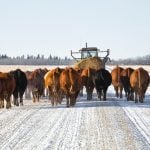
Regenerative ag conference hears grazing is vital to environmental outcomes, but that most grain growers don’t want livestock.

Cows for crops? Searching for the low-hanging fruit on carbon

Building soil carbon must make sense at the bank and in the work day

There are easy starting points to build soil carbon. Getting them to make sense on the balance sheet is another matter. That was one message heard by a panel of grain producers, livestock producers and production experts who gathered at the recent Manitoba Forage and Grassland Association regenerative agriculture conference in Brandon. Why it matters:


Keynote speaker, Amanda Fitzsimmons.

Watersheds anticipate near-normal annual conference

After two years of COVID-affected events, the group looks forward to a return to normal

With a little luck, the 2022 Manitoba Association of Watersheds (MAW) annual conference will be unencumbered by COVID restrictions this time around. In 2020, like most other conferences held in that calendar year, MAW’s conference was a strictly virtual event. However, in 2021, MAW hosted their festival in a brief window during last year’s conference

Editorial: Let’s be careful not to greenwash regenerative agriculture

Food companies like to use descriptors such as “non-GMO”, “gluten-free”, “humane certified” and numerous labels to differentiate their products in the marketplace. These often follow consumer trends, usually initiated by lobbyists for environmental, animal welfare, nutrition and health groups. They can also be considered greenwashing when they are used incorrectly or fraudulently. The latest trend


General Mills has set a goal of expanding regenerative agriculture practices on one million acres by 2030.

Funding expands for regenerative agriculture

General Mills and ALUS announce $2.3-million partnership

Regenerative agriculture proponents in Manitoba and Saskatchewan are getting another $2.3 million to work with. On July 27, food giant General Mills and stewardship organization ALUS announced the funds as part of “a multi-year partnership to support farmers and accelerate regenerative agriculture” in the two provinces. In a joint statement released on the ALUS website,

Photo: McCain Foods Ltd.

McCain acquires predictive crop technology

McCain Foods Ltd. has purchased predictive crop intelligence technology from Resson, a ‘vision intelligence technology’ firm headquartered in Fredericton, N.B. McCain has been a long-time partner with Resson, working together for nine years to develop algorithms that forecast farm yields using remote sensing technology. The technology will enable producers to make more appropriate decisions through


Signage outside McCain’s Farms of The Future site at Florenceville-Bristol, about 110 km northwest of Fredericton. (Photos courtesy McCain)

Learning from McCain’s regenerative farming practices

Potato processing giant aims to 'de-risk' practices for growers

In 2021 McCain said it was going to launch three regenerative potato farming operations by 2025 and would label them “Farms of the Future.” The first, just outside of Florenceville-Bristol, N.B., now offers data to reflect on the effectiveness of the practices at the potato farm after its first fully operational season. “If we don’t

Shipwheel Cattle Feeders of Taber, Alta. has found it can boost soil organic matter by integrating regenerative agriculture practices.

Carbon offset program made for regenerative individuality

REGENERATIVE | Researchers created a carbon map of Alberta so they could zoom in on farms’ soil carbon content

A developing carbon offset program is designed to encourage and incentivize regenerative farming without forcing producers to fit a cookie-cutter protocol. “To try to standardize something that is fundamentally adaptive and site specific, and also based on a lot of innovation, it’s going to put a cap on the innovation that can happen,” said Kimberly


Regenerative dairy farmers Henry Nyhof (left to right), Sean Smith and Paul Kernaleguen with conference organizer Ryan Boyd.

Dairy farmers well positioned for regenerative ag, producers say

BALANCES | Increased grazing has seen decreases in butterfat but overall increases in cows’ health, reduced input costs

Canadian dairy farmers may be among the best positioned to take up regenerative farming practices, said producers during a panel discussion at the 2021 Regenerative Ag Conference, held in Brandon Nov. 15 to 17. Supply management means a steady income which can give farmers more confidence to take risks, said Sean Smith, a dairy farmer near Minnedosa. Fairly small herds

Callum Morrison takes moisture readings in a soybean cash crop that is part of a long-term cover cropping field trial in Carman.

Cover crop survey reveals risks and benefits

Producers like the potential but say short season, lack of moisture key concerns

Planting a cover crop is a new idea this far north. It has its agronomic advantages, it keeps roots in the soil after the harvest, although it comes with its problems as well, especially in Western Canada. Prairie farmers were historically skeptical about cover cropping. Some say it’s purposely growing “weeds” that will deplete your