
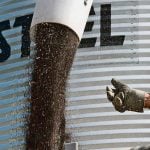
Grain drying and other agricultural activities will be exempt from the carbon tax — if the federal government signs off on the provincial plan.

Province going ahead on flat carbon tax, lower PST

The province says farmers will get their wish on grain drying and barn heating exemptions, if the federal government accepts the provincial plan

The province is again pushing for a $25-per-tonne flat rate on carbon tax — along with exemptions on fuel for grain drying and heating barns — despite an ongoing spat with Ottawa. At the same time, the province has announced that the PST will be dropping from seven to six per cent. Both are set

China continues to produce, import and consume plenty of canola. But for the past year very little has come from Canada.

One year after China canola ban, there is still no resolution

No easy resolution to China/Canada trade dispute, says Canola Council of Canada president

March 6, 2020 marked a sombre anniversary for Canada’s canola industry. It’s been a year since China banned the majority of imports of Canadian canola, and an end to the ban is nowhere in sight. “It’s a very frustrating situation for producers and the industry,” said Jim Everson, president of the Canola Council of Canada.


Debate over seed royalties could be nearing end

Debate over seed royalties could be nearing end

A pilot project could be the beginning of the end for this long-standing issue

The long-awaited process of determining the future of seed royalty rates in Canada is approaching its final stages. At least, it seems that way. Consider first the process officially began in 2013 when the then federal government led by the Conservative party introduced a law allowing royalty collection on seeds. (Some may recognize this as

Canada has yet to sign the new three-way trade agreement between itself, United States and Mexico.

Lawmakers urged to pass CUSMA quickly

The bulk of concerns were raised by the dairy sector which is losing market share

An overwhelming majority of witnesses testifying to the Agriculture and Agri-Food Committee in Ottawa are supporting the quick ratification of the “new NAFTA” trade deal, but the dairy industry continues to voice its opposition. Parliamentarians in Ottawa represent the last of the three countries involved in the Canada-U.S.-Mexico Agreement (CUSMA) to ratify the deal, with the law


Editor’s Take: Government support efforts are small change

It’s been an interesting week, from the editor’s chair, watching the stories related to agriculture policy come in. One of the most interesting was from the Canadian Federation of Agriculture AGM, where that organization issued a clear call for greater understanding. As Ottawa correspondent D.C. Fraser reports, CFA vice-president Chris van den Heuvel suggested that

Federal Agricultural Minister Marie-Claude Bibeau says the carbon tax impact on grain drying is “not that significant.”

CFA urges government to better consider agriculture

The sector shouldn’t be ‘collateral damage’ when government direction is set

The Canadian Federation of Agriculture (CFA) wants to see Ottawa doing a better job of considering farmers when making decisions. That theme emerged from the recent annual general meeting of the group, held in Ottawa. “There’s a lot of good, sound policy in there that we want to see and move forward. But, you know,


Protesters have caused rail shipping disruption which is beginning to result in critical shortages.

Tipping point nears as rail blockades continue

Farmers are innocent bystanders who are getting hit hard, and a crisis is looming

Rail blockades are reaching a “tipping point” for farmers, according to the Canadian Federation of Agriculture (CFA). Mary Robinson, president of CFA, told her membership near the end of February that farmers are being “severely and harshly impacted by the random blockades.” “We have nothing to do with this dispute. The widespread collateral damage of

A demonstrator stands at a blockade on CN track west of Edmonton on Feb. 19, 2020.

Editor’s Take: Leadership needed on rail blockades

Where do the rights of protesters end and the responsibility of government begin? In the Canada of 2020, that’s no longer a rhetorical question or a philosophical exercise. It’s a reality that governments and citizens find themselves grappling with. The recent rail blockades are disrupting lives and the national economy with serious repercussions. For a


India offers to import livestock products to seal trade deal with Trump

India has offered to partially open up its poultry and dairy markets to win a limited trade deal during U.S. President Donald Trump’s first official visit to the country this month, people familiar with the protracted talks say. India, the world’s largest milk-producing nation, has traditionally restricted dairy imports to protect the livelihoods of 80

Marie-Claude Bibeau, federal agriculture minister, attended CropConnect 2020 last week in Winnipeg.

Bibeau announces funding, but offers little on standing issues

The federal agriculture minister spoke briefly last week in Winnipeg

The federal agriculture minister told CropConnect attendees about two new programs last week, but had little new to say on long-standing producer concerns. Marie-Claude Bibeau was at the annual event to meet with Manitoba farmers and while there announced a total of $1.2 million in funding for the grain industry. Most of the money is