
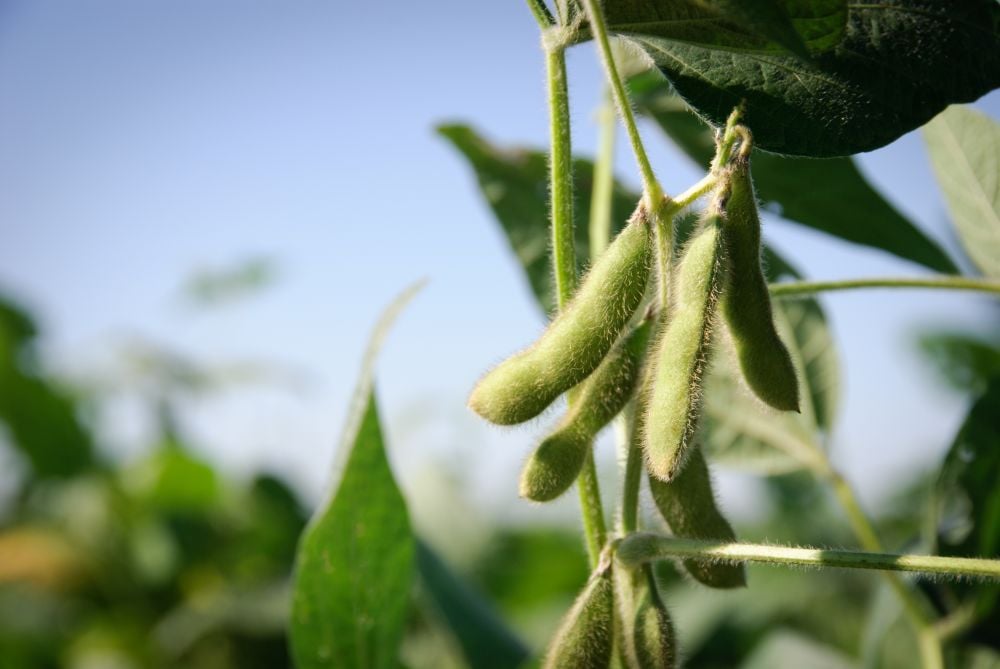


The bambara nut, seen here after being dug, is one type of legume that could benefit from its wild relatives.

Researchers break the wild-domestic barrier in legumes

They’re hoping to tap wild relatives for important traits 
such as disease and pest resistance

Domesticating plants to grow as crops can turn out to be a double-edged scythe. On one hand, selecting specific desirable traits, such as high yields, can increase crop productivity. But other important traits, such as resistance to pests, can be lost. To mitigate this, researchers often turn to the wild relatives of crops. These wild
Dr. Rob Duncan (l) is the first Canadian to be given the Early Career Scientist Award from the National Association of Plant Breeders.

U of M plant breeder earns international accolades

The University of Manitoba’s Rob Duncan is a rising star in the world of plant breeding 
and just earned a prestigious U.S. award

A Manitoban is the first Canadian to earn a major international plant-breeding award. Rob Duncan, a brassica breeder with the University of Manitoba, has been named winner of the National Association of Plant Breeders (NAPB) Early Career Scientist Award. Duncan, who grew up in rural Manitoba, was given the award in early August during the


Hand over wheat field in early summer evening.

Changing the discussion on genetic engineering

A genetic engineering researcher who is married to an organic farmer is trying to bridge the gap between consumers and science

The evolution of genetic engineering will continue, with more diverse options, giving scientists more flexibility to breed crops better for farmers and human nutrition. But farmers and researchers will continue to have to explain the technology to consumers focused on the genetic level, said Pamela Ronald. Ronald, a genetic engineering researcher at the University of

SeCan says PBR enforcement will ensure farmers get the best possible varieties by rewarding the breeders who develop them.

Saskatchewan farmer pays up after breaching plant breeders’ rights

Seed companies warn infringers potentially face significant costs, not only for unpaid royalties 
but also the investigation and court costs

Canada has had plant breeders’ rights (PBR) regulations for 25 years, yet some farmers still breach them. Dustin Hawkins, who farms near Kincaid, Sask., is the latest to be penalized for the unauthorized advertising and sale of durum wheat varieties AC Transcend and AC Strongfield, whose rights are held by FP Genetics and SeCan, respectively.


BrettYoung’s Eric Gregory and (l to r) DL Seeds’ Kevin McCallum and Sakaria Liban in the DL Seeds screening greenhouse.

Homegrown canola breeder sees opportunities and challenges

BrettYoung and DL Seeds say they’ll continue to be a major player in canola breeding in Western Canada

A Manitoba-based canola-breeding consortium says the current wave of lifescience mergers isn’t necessarily bad news for them. Winnipeg’s BrettYoung and Morden’s DL Seeds, a joint venture of two of the largest European oilseed rape-breeding companies, have been working together for a number of years to bring canola hybrids to market. They’ve seen their market share

SeCan is celebrating its 40th anniversary. The not-for-profit company is Canada’s biggest distributor of certified seed.

SeCan celebrates 40th anniversary

Canada’s largest certified seed distributor is even more relevant today, says general manager Jeff Reid

SeCan was ahead of the curve when founded in 1976 — and still is today, says general manager Jeff Reid. “I think it is interesting that 40 years after SeCan was initiated, it seems in many respects to almost be just coming-of-age now, with all the talk about public, private and producer partnerships,” Reid said


Canada to regulate CRISPR technology

Canada to regulate CRISPR technology

The new gene editing tool may not produce GMO products, but they will be considered 'novel'

UPDATED, June 24, 2016: Plants modified using the controversial gene editing technology known as CRISPR/Cas-9 won’t be sailing past regulatory scrutiny to the marketplace in Canada as they currently do in the U.S. While the U.S. regulatory system has determined plants developed using CRISPR are not GMOs and therefore do not fall under the regulatory

Wheat seeds spilling from hand, close-up

PBR enforcement numbers highest on record

Financial penalties can range from a few thousand dollars to tens of thousands, depending on the level of illegal sales

This past year was the busiest on record for plant breeders’ rights education and enforcement. Todd Hyra, western Canadian business manager for SeCan, said there were over 400 advertisements for seed sales that required investigation industry-wide through the Canadian Plant Technology Agency (CPTA), the body established to protect intellectual property rights. “SeCan alone had 40


Find out the type of Plant Breeders’ Rights a variety has and who has those rights at  cdnseed.org/library/crop-kinds-database.

What you can do to comply with seed laws

The first step is buying certified seed, the second is documenting it

The simplest way for farmers to avoid breaching Plant Breeders’ Rights (PBR) rules, including under the newly implemented UPOV ’91, is to buy certified seed, says Lorne Hadley, executive director of the Canadian Plant Technology Agency (CPTA). What constitutes a breach? It boils down to buying seed that doesn’t return a royalty to the variety’s

New Plant Breeders’ Rights rules under UPOV ’91 give seed companies the option of tracking down those who infringe on those rights through the entire grain system. Lorne Hadley, executive director of the Canadian Plant Technology Agency, says pedigreed seed growers need to help communicate the new regulations to their farmer-customers.

Tracking down illicit seed sellers

Private investigators are helping the seed trade 
enforce plant breeders’ rights

Undercover private investigators are helping nab seed dealers suspected of contravening Canadian Plant Breeders’ Rights (PBR) regulations, the executive director of the Canadian Plant Technology Agency (CPTA) says. Lorne Hadley told the Manitoba Seed Growers’ Association’s annual meeting in Winnipeg Dec. 10 his agency has co-ordinated 70 investigations resulting in “a number of cases going