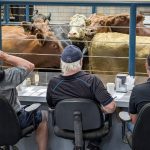
“If you’re decreasing the number of days on feed, you can improve all of your sustainability metrics.” – Kim Ominski, University of Manitoba animal science professor.

Burps and belches next cow environmental target

It’s a natural byproduct of a rumen — and the cattle sector’s next big challenge

Enteric methane will be the federal government’s next big target agricultural producers are expected to aim for. It’s the methane cattle produce when they digest food. It’s released mainly through respiration. Agriculture and Agri-Food Canada (AAFC) made two big announcements recently that brought methane to the forefront of their climate change policy. In December, at


“The thought behind [this study] is that perhaps not every individual in the herd will need to be fed a feed supplement to reduce methane emissions.” – Katie Wood, University of Guelph.

On-pasture feed efficiency can reduce cattle emissions

University of Guelph uses unique technology to measure feed efficiency and enteric methane emissions

Feeding canola oil to beef cows could be one way to reduce their enteric methane emissions and increase feed efficiency. That’s among the takeaways from work at the University of Guelph’s Elora Research Station. Researchers there have adopted unique technology to investigate the link between feed efficiency and enteric methane emissions. Why it matters: Feed-efficient

A flux tower installed as part of a network of sensors measuring greenhouse gas emissions across Canadian wetlands.

Prairie wetlands emissions lower than expected

Research from Ducks Unlimited Canada used high-tech towers to measure greenhouse gas coming off wetlands

Wetlands in Western Canada may emit significantly less methane than previously thought, according to recent research from Ducks Unlimited Canada. “There was always this notion that Prairie wetlands might be emitting a bunch of methane in the spring as they thaw,” said project lead Pascal Badiou, one of the scientists working for DUC’s research arm,


Marl Creek Renewables.

Biogas can meet rural energy needs

Proponents say government needs to stop insisting on electrification

Glacier FarmMedia – The landscape for renewable natural gas production on Canadian farms is getting bigger, but provincial and federal governments must stop thinking of the fuel in the same way as they do for natural gas derived from fossil fuels. That was the take-home message from a group of panelists representing the agriculture sector

(Scharfsinn86/iStock/Getty Images)

U.S. EPA proposes revamp of biofuel program to include EVs

Mandated biofuel levels to rise through 2025

New York | Reuters — U.S. President Joe Biden’s administration on Thursday unveiled a three-year proposal to expand the U.S. biofuels policy with bigger volume mandates and — for the first time — to include a pathway for electric vehicle manufacturers to generate lucrative credits. Biden wants to fight climate change by reducing fossil fuel


U.S. special presidential envoy for climate John Kerry and Agriculture Sectretary Tom Vilsack applaud U.S. President Joe Biden’s speech at the COP27 climate summit at Sharm el-Sheikh, Egypt on Nov. 11, 2022. (Photo: Reuters/Kevin Lamarque)

Farm climate innovation commitments at COP27 double to US$8 billion

Agriculture could outpace other industries to net zero: Vilsack

Sharm el-Sheikh, Egypt | Reuters — An initiative led by the United States and the United Arab Emirates to help agriculture adapt to climate change and reduce emissions through innovation has doubled investment commitments to US$8 billion and extended its reach, it said on Friday. The Agriculture Innovation Mission for Climate (AIM for Climate) was

New Zealand farmers to face livestock emissions charges

Reuters – The New Zealand government has confirmed plans to separately price agricultural long-lived gases and biogenic methane that mainly comes from cow and sheep burps, in a plan that concerns farm groups. The government recently released its proposed plan on agricultural emissions pricing, which when introduced in 2025 will make New Zealand, a large


Ag university students make up Moller’s milking workforce.

How do you make a Danish cow stop burping?

The Danish dairy sector is under pressure to curb emissions, especially methane

Four fibreglass boxes, like small rooms, stand inside a bright, pristine space. Each box has metal stanchions, a hefty air-handling unit and a rubber mat that could be thought of as a bed. “So,” asks one of several journalists clad in biosecurity gear, “you trap the cow in there with their burps?” “No, no, no,

Patrick Darcy, a seaweed harvester, heaves a sack full of harvested Dillisk seaweed (palmaria palmata) to carry on his back in the County Clare village of Quilty, Ireland.

Ireland looks to seaweed in quest to curb methane from cows

While there’s lots of interest in the method, it’s years away from mass production

Athenry, Ireland | Reuters –– Scientists are combing Ireland’s west coast for seaweed to feed to cattle and sheep after research showed it could stop them breathing out so much climate-warming methane. The project, co-ordinated by a state agriculture body, is tapping into the country’s growing seaweed harvesting industry, which is seeking new markets as