Don Flaten speaks about nitrogen during a recent field tour at the National Centre for Livestock and the Environment.  Photo: Shannon VanRaes

Too early to alter nitrogen guidelines

Solid manure applications may actually release more nitrogen over time, not less

The questions, how much nitrogen was applied and how much is available don’t have the same answer. Seven crops into a long-term study on nutrient management at the National Centre for Livestock and the Environment, researchers have found that current provincial guidelines for estimating nitrogen availability may not reflect reality when it comes using solid

livestock manure pit

New PEDv study looks at manure pits

Researchers want to know whether the virus is lurking in manure pits and how long it can survive

Researchers are hoping the province’s manure pits will hold some clues to controlling the porcine epidemic diarrhea (PED) virus. The council, the Manitoba Livestock Manure Management Initiative and Manitoba Agriculture, Food and Rural Development are asking producers to submit manure samples to help assesses where the virus could be lurking and how long it survives.


Although late, Manitoba’s first-cut hay is mostly up now and yielded well outside of the flood area, says John McGregor of the Manitoba Forage and Hayland Association. This field was being baled near Miami July 29.  photo: allan dawson

First-cut hay late, but plentiful in unflooded areas

Hay will be scarce and costly in flooded areas, but that could be offset by producers reducing cow herds

Manitoba’s first-cut hay crop, while late, is yielding average to above average in areas not hit by excessive moisture or flooding, says John McGregor of the Manitoba Forage and Grassland Association. “There’s a lot there, but they (beef farmers) don’t just rely on one cut,” McGregor said in an interview July 30. “They need to

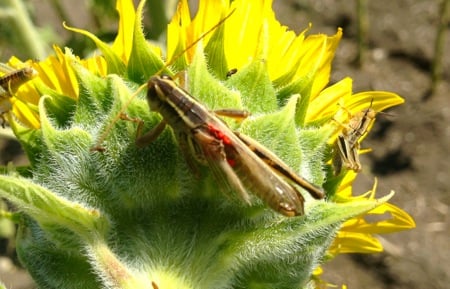
Grasshopper on a sunflower under attack from red mites.

Invasion of the body snatchers

Southwestern Manitoba grasshoppers being preyed upon by parasitic red mites

This grasshopper munching on a sunflower in southwestern Manitoba is being devoured by parasitic red mites (Eutrombidium locustarum), says Manitoba Agriculture, Food and Rural Development (MAFRD) entomologist John Gavloski. The mites feed on the blood (hemolymph) of grasshoppers. They also prey on grasshopper eggs. Each female mite can lay up to 4,000 eggs, providing mite


photo: DANIEL BETZE

Opposition seeks high ground as flood waters recede

Manitoba’s opposition party wants action on flood mitigation 
but is a little shallow on details

There are some muddy politics swirling around Manitoba’s flood waters. On July 30, Manitoba’s opposition Tories called for a moratorium on drainage in both Saskatchewan and Manitoba, as part of a Progressive Conservative plan to reduce flooding. Tory water critic, Shannon Martin said he had asked “the province to engage our counterparts in Saskatchewan to

No pressed apple juice this year

No pressed apple juice this year

Jean-Guy Cote says his family still deciding whether to rebuild after April 22 fire destroyed their apple press at Landmark

A fire that destroyed Manitoba’s only government-permitted apple press this spring means customers with bags of backyard apples will be hard pressed to find anywhere to process them later this summer. Apple Junction, owned by John Boy Farms at Landmark, along with Mom’s Country Pantry at the same site burned to the ground April 22


Ron Helwer
 1933 –

Agriculture Hall of Fame: Ron Helwer

Five new members of the Manitoba Agricultural Hall of Fame were inducted July 17 at a ceremony in Portage la Prairie. We're featuring a new inductee each week

Ron Helwer was born and raised at Libau, Manitoba. He married Vera Katazinski in 1956 and together they raised three children, Sherry, Reg and Gail. Ron began his business career in 1952 as a partner with his father Fred and brother Harvey in Libau where they operated a Massey Harris dealership. In 1956 they expanded

Mixed crop and livestock farming can be good for the soil.  Photo: Laura Rance

Conservation and livestock can be a good mix

While intensive livestock production can cause waste and nutrients to pile up, 
mixed farms are better able to recycle nutrients

When Ian Grossart harvests alfalfa on his farm in southwestern Manitoba, he knows where most of the nutrients he’s just removed are going to end up — back on his land. “With the cattle we compost all of our own manure, so that becomes a big part of our fertility program,” he said. “And because


Souris River flooding north of Melita, Man.

KAP still pushing AgriRecovery

The Manitoba and Saskatchewan governments say they’re still assessing the damage

Keystone Agricultural Producers (KAP) continues to build a case for an AgriRecovery program to assist Manitoba farmers who couldn’t seed or lost crops due to flooding or excessive moisture this season. “We’re continuing to engage as many members as we can to get information and provide supporting rationale for a program,” KAP president Doug Chorney

mink fur

Mink ranchers get reprieve from depressed market

The federal government has extended the deadline for repaying cash advances

Canada’s financially beleaguered mink producers received a bit of good news last week when the federal government extended the deadline for repaying their 2013 cash advances. Producers now have until June 1, 2015 to repay their Advance Payment Program (APP) cash advances instead of September 30, 2014. The move provides some relief for producers who