
measuring forage crop height with a ruler

Green Gold Report looks at choosing your optimum cutting time for forage

Forage and grassland conditions for Central and Eastern Manitoba

This is the second release for the Green Gold program assessing forage conditions in Manitoba. Reports will be issued from various areas of the Province (Eastern, Central, Interlake, and Western) in the weeks and months ahead. The reports below are the most recent forage conditions for Eastern and Central Manitoba. Click on the applicable link below: Green

alfalfa leaf

Green Gold Report forage conditions see light frost damage on alfalfa

Forage and grassland conditions for Eastern Manitoba as of May 11, 2015

This is the first release for the Green Gold program assessing forage conditions in Manitoba. Reports will be issued from various areas of the Province (Eastern, Central, Interlake, and Western) in the weeks and months ahead. Click here to view or download the full report. For more information email John McGregor, Manitoba Forage and Grassland Association Extension


alfalfa plant

Program aims for best time to take first alfalfa cut

Twice weekly reports will be emailed out, including in the Manitoba Co-operator’s Daily News

Determining the optimum time to take the first cut of alfalfa is as simple as subscribing to an email, thanks to the Manitoba Forage and Grassland Association’s (MFGA) Green Gold Program. Starting in mid-May, 15 to 20 alfalfa fields across Manitoba will be sampled twice a week and the relative feed value (RFV) calculated by

From left: Agriculture Minister Ron Kostyshyn along with Canadian Cattlemen’s Association Ramona Byth, Manitoba Beef Producers president Heinz Reimer and Brandon-Souris MP Larry Maguire announced funding for a new research project geared toward sustainable beef production.

Governments invest in sustainable beef production research

Several organizations will partner to develop two demonstration sites near Brandon

The federal and provincial governments have announced $3.1 million in support over three years for applied research on sustainable beef production at two sites near Brandon. Manitoba Agriculture, Food and Rural Development Minister Ron Kostyshyn and Brandon-Souris MP Larry Maguire were on hand at the Manitoba Beef Producers annual general meeting here last week to


Brian Harper says he’s doubled the carrying capacity of his pastures by 
using a high stock density system.

Get in line and move on — grazing an acre at a time

Switching to a high stock density system with 128 paddocks instead of 16


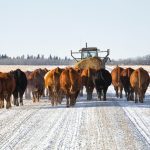
I call it my ‘big red swather,’” Brian Harper told a group of cattle producers visiting his farm near here last August. Harper smiled and as if on cue, 63,550 lbs. of his herd of Shaver Beefblend/Lincoln Red cattle started munching their way down one of his field’s narrow one-acre grazing paddocks. “Up to 2013,

Although late, Manitoba’s first-cut hay is mostly up now and yielded well outside of the flood area, says John McGregor of the Manitoba Forage and Hayland Association. This field was being baled near Miami July 29.  photo: allan dawson

First-cut hay late, but plentiful in unflooded areas

Hay will be scarce and costly in flooded areas, but that could be offset by producers reducing cow herds

Manitoba’s first-cut hay crop, while late, is yielding average to above average in areas not hit by excessive moisture or flooding, says John McGregor of the Manitoba Forage and Grassland Association. “There’s a lot there, but they (beef farmers) don’t just rely on one cut,” McGregor said in an interview July 30. “They need to


Drying time can be reduced

Drying time can be reduced

With wet weather wreaking havoc in many parts of the province, 
some producers are cutting their forage when the weather lets them, not when it’s optimal quality

Farmers use a variety of methods to determine when alfalfa is ready for the first cut of the year, but this season a lot of those methods went straight out the window. “So how many of you are just cutting when it’s dry enough to get on the field?” Dan Undersander, an extension and forage