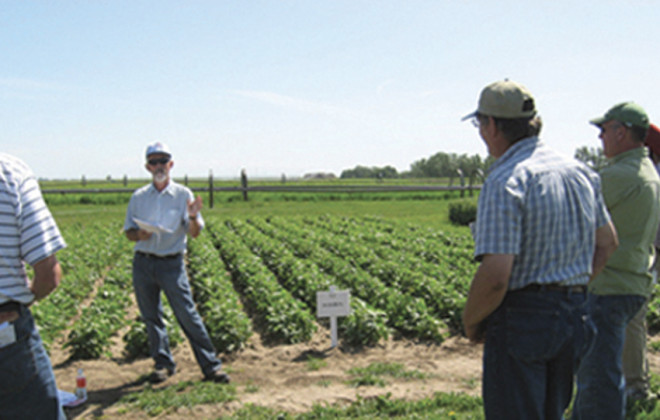
A healthy soil that’s high in carbon can make your farm a more efficient user of nutrients.

Carbon key to building resilience on farms

Building soil carbon supports soil biota 
and makes for a healthier farming system


Farmers often see themselves as feeding the world, but farmers attending the Organic Connections conference here recently were told the first step towards that goal is feeding the “starving and homeless” micro-organisms in their soil. “Your job is to feed them and maintain their habitat,” Kristine Nichols, the chief scientist with the Rodale Institute told
Lillian Wambui talks about her farm in front of a field of pigeon peas.

Low-tech, co-operative approaches support smallholder farmers

A simple plastic sheet may not look like much, but it can change lives and communities

Over 70 per cent of hungry people in the world today are smallholder farmers. Those producing food are, ironically, the most likely to go without. This summer I visited Kenya with Canadian Foodgrains Bank to explore what can be done to address hunger and support the smallholder farmers (farmers with less than 10 acres of


Manitoba Agriculture soil fertility specialist John Heard, soil sampling the old-fashioned way, says sampling cereals fields right after combining provides some advantages.

Soil test right after the combine

The tradition has been to sample for soil nutrients later in the fall, but there are compelling reasons to go sooner than later

It’s been the accepted wisdom to soil test as late as possible in the fall, but one soil test lab says it might pay to go earlier. Agvise Laboratories, that has soil-testing labs in North Dakota and Minnesota and a large stable of Canadian customers, told growers in a recent email it may be a

South African holistic management specialist, Ian Mitchell-Innes from South Africa, discussed management tactics with a group of Manitoba producers in Lenore on July 12.

Focusing on nutrition will also help the pasture

World-renowned holistic management specialist 
says green is not the only right colour for grass

Many graziers have a theory that if you look after the soil, the rest of the operation will take care of itself, but Ian Mitchell-Innes looks at it the other way around. “The biggest mistake that people make after learning about holistic management is they try and save the ground. I did this also when


A flooded field in the Interlake in 2013.

North Interlake drainage issues to be addressed

Pilot program aims to improve water management in the RM of Bifrost-Riverton

A recent announcement is a watershed moment for a largely producer-led group seeking to reduce flooding and increase agricultural productivity in Manitoba’s Interlake region. The federal and provincial governments have announced $1 million in Growing Forward 2 funding for a pilot project in the Rural Municipality of Bifrost-Riverton, which aims to improve drainage and address

The soil created by adding charcoal and kitchen waste, at left, is visually superior to the usual red African earth on the right.

Centuries-old African soil technique could combat climate change

Adding kitchen waste and charcoal to nutrient-poor rainforest soils makes them capable of supporting intensive farming

A farming technique practised for centuries in West Africa, which transforms nutrient-poor rainforest soil into fertile farmland, could combat climate change and revolutionize farming across the continent, researchers say. Adding kitchen waste and charcoal to tropical soil can turn it into fertile, black soil which traps carbon and reduces emissions of greenhouse gases into the


Soil scientist Frank Larney showcases his work at a field day, which is an open house for farmers and agriculture industry representatives to learn about the latest field research.

Pulses plus conservation practices equal healthy soils

Combining pulse crops and soil-friendly farming practices looks like a real winner

Pulse crops are playing an important role in building soil quality, especially when they’re combined with a host of soil-friendly farming techniques. That’s the finding of a 12-year study by researchers at Agriculture and Agri-Food Canada’s Lethbridge Research Centre, led by soil scientist Frank Larney. In the study, published in Agronomy Journal, Larney and company

Soybean Field

Farmland. They never stopped making it

Forty-five years ago, anyone in agriculture was offered the same advice: “Buy land; they’re not making it anymore.” But “they” were making it, lots of it. According to United Nations data, the world’s farmable land base grew by about 240 million acres between 1971 and 1991. The “not-making-it-anymore” believers, however, plunged ahead and U.S. land


Manitoba conservation districts are looking at establishing soil health programs to demonstrate how to increase water infiltration.

Conservation districts aim to improve water infiltration

Cover crops could be the key to building higher organic matter and catching water

The best place to store water is where it falls. That’s the conclusion of four Manitoba conservation districts that are banding together to launch a new project that will demonstrate how to build organic matter in soil and make it a sink for rainfall and meltwater. “Our surface water management strategy has been built on

Land use policies challenge new farmers

New farmers face many challenges as they attempt to get established in the business of farming. Last week we examined the issues of farm size and financial risk from the perspective of starting farmers. This week we will look at land use policy relating to new farmers. This issue was brought to our attention by