

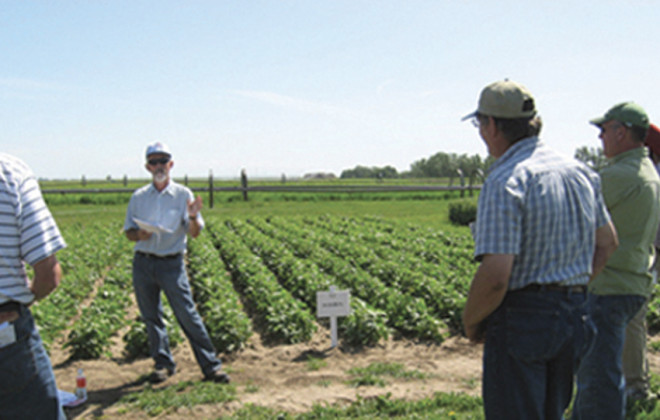
Soil scientist Frank Larney showcases his work at a field day, which is an open house for farmers and agriculture industry representatives to learn about the latest field research.

Pulses plus conservation practices equal healthy soils

Combining pulse crops and soil-friendly farming practices looks like a real winner

Pulse crops are playing an important role in building soil quality, especially when they’re combined with a host of soil-friendly farming techniques. That’s the finding of a 12-year study by researchers at Agriculture and Agri-Food Canada’s Lethbridge Research Centre, led by soil scientist Frank Larney. In the study, published in Agronomy Journal, Larney and company

Gabe Brown is pictured while hosting a field tour on his North Dakota operation in October 2015.

Cover cropping – tips of the trade

Cover crop grower Gabe Brown says the best place to start when designing a species mix is to understand what your field needs and find the species that best addresses those issues

The first step to success using cover crops is defining the problem you need to fix. Gabe Brown, a North Dakota farmer and cover crop advocate, told an April 6 Ducks Unlimited grazing club meeting in Lenore that too often farmers plant before they truly have a strategy. “The first thing you need to do


Cutaway of Plant and Roots in Dirt

Healthy soils mean a sustainable future

Causes, consequences of and solutions to soil erosion are always connected

Healthy societies and healthy economies are the product of healthy soil. Healthy soil produces abundant inexpensive food in a sustainable and reliable way. This requires soil care on the part of land managers and courage on the part of policy-makers who oversee soil protection. Scientists who understand soil formation tell us the only sustainable way

A pea/oat/tillage radish cover crop seeded in early August, pictured on October 17.

Cover crops breaking out of livestock niche

Benefits of cover crops shown to accrue to grain portion of mixed operations, causing some without livestock to consider them

Cover crops could be a game changer for Manitoba, and not just for mixed crop and livestock operations. Typically those farms have been the earliest adopters of this new technique, said Michael Thiele, who works with the province’s grazing clubs through a Ducks Unlimited program. “These guys growing cover crops are finding that using and


North Dakota producer, Gabe Brown spoke on cover crops and soil health strategies at the Ducks Unlimited grazing club event  in Lenore on April 6.

Taking grazing-management tips from Mother Nature

Gabe Brown says his success in cover cropping has come through 
observing and mimicking nature’s processes

North Dakota farmer and cover crop and soil health expert Gabe Brown says if farmers give the techniques he advocates an honest try they’ll be hooked. “Take one field and promise yourself that for five years you will focus on the principles of soil health,” said Brown. If you stick with it for those five

Most fields may have dried out from floods in 2010 and 2011, but there’s a lingering effect from compaction and poor aeration.

A wet cycle has caused some farmers to rethink zero till

Seeding & Tillage Focus: As the province’s wet cycle appears poised to break, soil compaction is a lingering after-effect

The past few years have been a bit hard on zero till in Manitoba. Faced with a flood followed by a long wet cycle, more and more farmers in the southwest part of the province were forced to do something they thought they’d left in the past — pull out their tillage implements. Their aim,


CanoLAB participants worked through an exercise of extracting the DNA from a strawberry to get a better understanding of how canola diagnostics work.

Canola issues, close up and hands on

CanoLAB participants were given an overview of how different crops are best integrated into canola rotations

This year’s canoLAB put a sharp focus on canola rotations and expanded the scope slightly, beyond a single crop. “This year we are not only looking at canola but crops that would be in rotation with canola, so it is intended to be a holistic or systems approach to farming,” said Angela Brackenreed, agronomy specialist

Reducing agriculture’s carbon footprint by focusing on soil

Reducing agriculture’s carbon footprint by focusing on soil

Storing water where it falls is another area where agriculture should do a better job

“Has shown great improvement, but needs to do better.” That’s David Rourke’s report card on progress to improve soil health on the Prairies. “We will need to look at minimizing soil disturbance, more plant diversity and keeping something growing on our land from snow to snow,” the Minto-area producer told the Manitoba Sustainable Energy Association


“Nearly 33 per cent of the world’s arable land has been lost to erosion or pollution in the last 40 years.” – Duncan Cameron, University of Sheffield.

Developing a sustainable model for intensive agriculture

U.K. scientists warn on soil loss and call for biotech 
‘to wean crops off the artificial world we have created for them’

Speaking at the 21st Conference of the Parties in Paris on Dec. 2, experts from the University of Sheffield’s Grantham Centre for Sustainable Futures revealed that nearly 33 per cent of the world’s arable land has been lost to erosion or pollution in the last 40 years and vital action must now be taken to

The size of the Gulf of Mexico dead zone in 2011. The coloured gradients indicate the oxygen levels that present in the water at that recorded time.

Fertilizer run-off is just one piece of the dead zone puzzle

More perennial crops and protecting wetlands would help reduce 
the low-to-no-oxygen zone in the Gulf of Mexico

It’s true that fertilizer run-off, sewage, and other pollutants from the Corn Belt have significantly boosted dead zones in the Gulf of Mexico. That’s because up to half of the fertilizer applied isn’t absorbed by crops, and in order to grow more food we’re using 20 times more fertilizer in the Corn Belt today than