Saskatchewan seed grower Kevin Elmy says cover crops are the future, but admits it’s not an easy system to learn.

Cover crops offer big potential, pose bigger learning curve

It’s got easier to draw a crowd for a cover crop talk, but those looking 
for a one-size-fits-all solution will be disappointed

Looking over at the emptied room that had been packed with attentive farmers a few minutes earlier, cover crops guru Kevin Elmy could only shake his head. “If I had given a talk here five years ago, maybe the front row might have been filled — maybe,” the Saskatchewan farmer said after his FarmTech presentation,

An example of a cover crop mixture in the U.S. where some producers are using cocktails of 20 or more species. However, the U of M’s Yvonne Lawley warns about brassicas such as tillage radish, which might contribute to diseases such as clubroot in canola. 

Season too short for cover crops? Maybe not

They could have a fit for Western Canada, but they require 
just as much planning as any other crop choice


Open just about any U.S. farming publication and you won’t read for long before seeing the words “cover crop.” There’s been an explosion of interest in the practice of sowing a cheap mixture of seed to cover the soil after harvest, and then seeding directly into it the following year. The benefits go beyond soil


Farmers had mixed results when planting into green cover crops in 2016.

Cover crops driving planting and tillage innovation

Ontario farmers are on the cutting edge of adopting this technique in Canada

Cover crops continue to be one of the most discussed topics in Ontario crop farming. However the discussion has moved beyond the existence of the soil-health-building practice, to the fine details of how to manage such a complex biological system. There were several sessions at the recent Southwest Ag Conference (SWAC) in Ridgetown dedicated to

An example of rill erosion which occurs when run-off water forms small channels while running down bare soil.

More emphasis should be placed on soil health, MCDA speaker says

Cover crops, reduced tillage, crop and livestock diversity can all help reduce watershed challenges

We’ve all had those moments when we realize what we do most of the time matters more than what we attempt once in a while. One of those light bulbs snapped on for Ryan Canart while sitting at a soil health conference in Alberta awhile back. The district manager for the Upper Assiniboine River Conservation


A multi-species cover crop can mimic how soil was initially created, with a collection of root exudates from each individual species.

Cover cropping improves land and bank balance

Ontario farmer Blake Vince has harnessed the power of cover crops on his operation

Despite not having cattle on his operation, Blake Vince says he is still a livestock farmer. “Where my livestock are is below my feet and sadly we forget that. The soil is alive, it is a collection of living organisms,” Vince, a Canadian Nuffield Scholar and fifth-generation Ontario farmer, said during a presentation at the

Blake Vince, fifth-generation Ontario farmer, offers up a homegrown suggestion on how to test the microbial activity in your soil.

What does your underwear say about your soils?

The underwear test can be a visual indicator of the activity 
that is taking place in your soil

A lot, providing you bury it in a field, according to Ontario farmer Blake Vince, a cover crop and soil health advocate and Nuffield Scholar. Doing so will help you understand what’s happening beneath your feet, he says. “We understand things we can see,” Vince said at the recent Canadian Forage and Grasslands conference in


Editorial: Hedge your risks: go underground

The dust is settling in the wake of last week’s U.S. election but it will be a while yet before we understand what the results mean for Canadians, including farmers. It’s an understatement to say Donald Trump’s election win came as a surprise, quite possibly even to him. The fact that his opponent received more

Martin Entz stands in the porch of a tiny clubhouse built so researchers and students could take shelter from the weather at the Glenlea Long-Term Study.

Twenty-five years of organics

Canada’s longest-running study of organic crop systems continues to yield new results

Martin Entz points down a road that is more mud than gravel as he drives towards a pint-size field house and a cluster of research plots. “This has become a real destination, it didn’t start out that way, but it certainly is now,” he said, turning towards the Glenlea Long-Term Rotation Study — the oldest


Young graziers need to do more with less, and cover crop cocktail mixes are a way they can do that, says grazier Graeme Finn.

This ain’t your grandad’s grazing system

Innovative producers, especially younger ones, are looking to cover crop cocktail mixes to get more production per acre

Nearly 150 people — some from as far away as Manitoba — converged on a farm near Hardisty recently to learn more about cover crop cocktail mixes. But tour organizer Graeme Finn noticed something a little different about the crowd at the event in late August — it was mainly young farmers. “Young people can’t

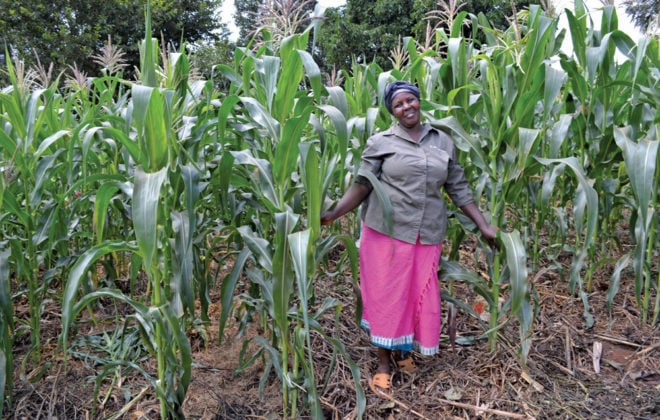
Jane Wanjiko standing in her maize field.

African smallholders are adopting conservation agriculture techniques

When you’re subsisting on three-quarters of an acre, increasing 
maize production from 32 kg a year to 990 kg is a life-changing event

This summer Stefan Epp-Koop travelled to Kenya as part of a Canadian Foodgrains Bank learning tour, focused on the importance of agriculture in achieving numerous development goals: reducing hunger, increasing incomes, empowering women, adapting to a changing climate, and improving nutrition. Throughout the trip he visited farmers, government officials and researchers, exploring solutions that were