

Crop residue burning authorizations begin Aug. 1

Crop residue burning authorizations begin Aug. 1

Failure to follow the regulations could result in fines of up to $50,000

Manitoba Agriculture, Food and Rural Development (MAFRD) reminds producers who choose to burn crop residue that authorization is required between Aug. 1 and Nov. 15. Authorizations are issued daily by 11 a.m. based on weather, moisture and favourable smoke dispersion conditions.  Night burning is banned year-round. Producers may also require a burning permit, if located
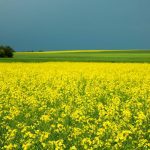


Yield potential for soybeans looking good

Yield potential for soybeans looking good

The Bean Report for July 30, 2015

Soybeans Soybeans are in the pod filling to early seed stages, R-3 to R-5. Crops reaching R-5 are slightly ahead of previous years and correspond to early varieties, early seeding and/ or higher than normal accumulated heat units, especially in southwestern Manitoba. Despite localized areas being affected by hail and excess moisture, overall yield potential

Tell us about your hay situation!

Tell us about your hay situation!

Please participate in a quick MFGA survey

In May and June, MFGA published our Green Gold reports to provide Manitoba forage producers with information as to how alfalfa is progressing in their area and, particularly, when to make their first cut for optimum quality. We saw Mother Nature’s influence this year as alfalfa was at the optimum stage in some areas, yet the


White head from wheat stem maggot (l), and larva of wheat stem maggot.

Manitoba crop insect and disease update

Summary of conditions as of July 28, 2015

Plant Pathogens: At the Crop Diagnostic Lab there are canola plants coming in with blackleg and sclerotinia. Some soybeans have been showing root rot – rhizoctonia and fusarium. Some sunflower fields are showing basal and mid-stalk sclerotinia. Some flax fields are showing pasmo lesions on stem and leaves. Insects: Levels of armyworms are starting to decline in some fields as

Manitoba Crop Report and Crop Weather report: Issue 13

Manitoba Crop Report and Crop Weather report: Issue 13

Conditions as of July 27, 2015

Generally, the condition of most crop types is rated as good in Manitoba. The continuing hot and humid weather conditions are advancing crops quickly. Harvest of winter wheat and fall rye is expected to start this week. To date, low disease pressure is noted in the winter cereal crops. Thunderstorms of varying severity resulted in


MASC estimates Manitoba farmers planted more canola, wheat and soybeans this spring

MASC estimates Manitoba farmers planted more canola, wheat and soybeans this spring

Acres too wet to seed down dramatically from 2014

Plantings of Manitoba’s three biggest acreage crops — canola, wheat and soybeans — are all projected to be higher in 2015, according to the Manitoba Agricultural Service Corporation’s (MASC) latest estimate. Based on assessing 94 per cent of farmers’ seeded acreage reports filed for crop insurance MASC estimates Manitoba farmers this spring sowed 3.2 million

Len Epp stands with bison about to be exported to the United States.

Bison demand is growing. Producer numbers? Not so much

Surprisingly agile, bison require the right equipment and tough fencing to be handled safely

Turn down Road 88 North in Manitoba’s Interlake and you can still see the “Gunton Bull Test Station” sign. But don’t expect to see any cattle. “I’m kinda glad they left the old sign up,” said Len Epp. “It’s nice to have the history, even if it’s all bison now.” The co-owner of the Rockwood


Somerset-area organic farmer Jeremiah Evans is impressed with the weed control he’s getting with a new U.K.-made in-row cultivator.

Precision tillage offers new option for organic weed control

Frustrated with lack of weed control, organic farmer Jeremiah Evans has 
tried a U.K.-made in-row cultivator and he’s impressed with the results

Jeremiah Evans has a new high-tech hand helping him control weeds on his organic farm. Last fall the Somerset-area farmer took delivery of a custom-built U.K.-manufactured Garford Robocrop in-row cultivator, which uses special software to identify and target weeds, leaving the crop behind. After seeing what it could do to his wild oats, thistle and

Chris Siow, a research scientist at the Canadian Centre for Agri-Food Research in Health and Medicine is studying the health benefits of lingonberries.

Wild or farmed? Lingonberries seek place in Manitoba agriculture

Tiny, tart and full of goodness, Manitoba’s wild lingonberries are even healthier than those grown in other areas

Today they belong to the category often labelled as “superfoods,” but Dave Buck has always known that lingonberries were good tasting and nutritious. “I grew up in the bush,” he said. “And I can remember when I was young, my parents would pick the berries, they’d juice them. We’d have juice at Christmas and then