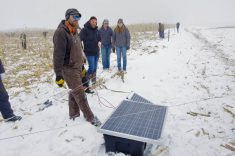
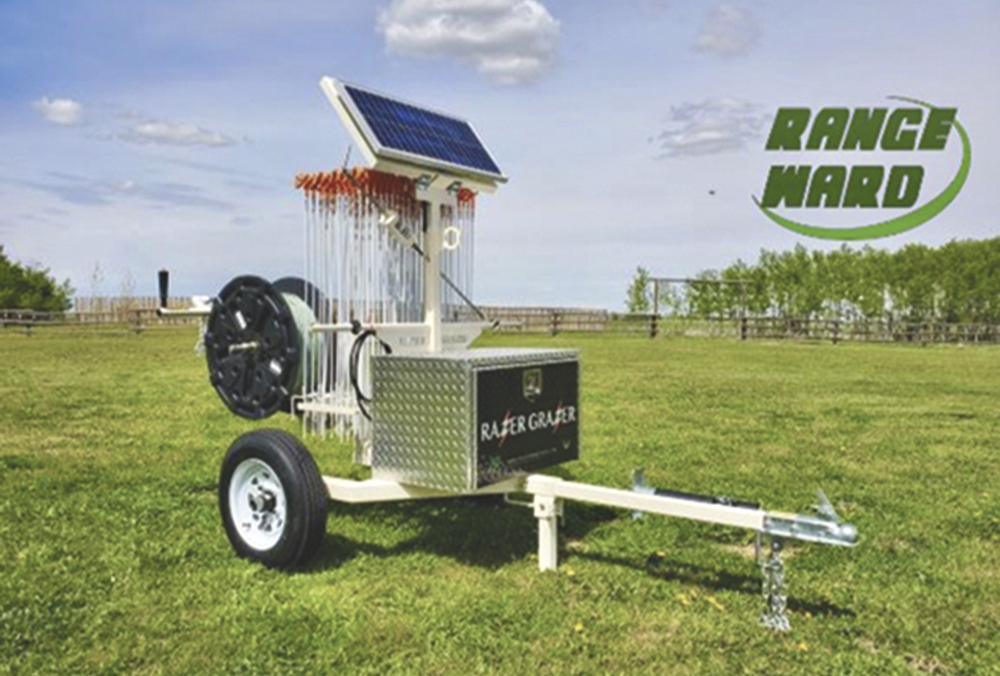
The orange metal box sitting on the grazing land near Shellmouth didn’t come cheap.
But Arron Nerbas says it’s already more than paid for itself in terms of additional forage production and enhanced environmental services.
The “box” in question is a Range Ward Power Grazer, one of three owned by Nerbas Bros. Angus — a purebred and commercial cattle operation that has built itself on forage-centric genetics and regenerative agriculture practices.
It’s those practices and, in particular, adaptive grazing, where the Power Grazer comes in.
Read Also
Video veterinary telemedicine valuable — within limits
Telemedicine makes veterinarians more acessable to farmers, but not every horse health issue can be diagnosed or treated through a screen.
Why it matters: Fans of the equipment line argue that the remote, solar-based Range Ward fencing products allow for more flexibility when designing grazing systems.
Produced by Alberta-based Range Ward, the Power Grazer is the largest in a line of remote, solar-powered fencing products that promise more convenient, highly visible fencing without needing a nearby power source.
The Power Grazer comes set up with a 140-watt solar panel and one mile’s worth of the company’s trademark braided power line on a motorized reel. Its lineup also inclues the smaller Razer Grazer — set up with a 50-watt panel and half-mile reel — plus a double-wire Razer Grazer model for bison. Motorized reels, marketed under the name Power Arm are also sold separately and can be installed on a truck or side-by-side similar to a standard hand-reel.
“It really depends on their landscape, what tasks or what jobs they’ve got in mind for the equipment,” Range Ward sales manager Neil Thorsteinson said.
“Typically, you would see the Power Grazer being taken into use in large-landscape applications, like huge farms or ranches where they might be even just splitting four or five 6,000-acre fields in half or thirds,” he added. “Versus the smaller Razer Grazer, set up to be a little more versatile and ambidextrous and built for smaller-landscape farms and ranches where they might be just using the machine to cross-fence a quarter section or set up a quick alley or a small catch pen.”
Convenience and time management are perhaps the biggest selling points of the products, according to Thorsteinson.
Each system, he noted, is self contained with anything the producer might need to set up the paddock, from power generation to pigtail posts, with no need to spend time in the yard gathering components.
“Everything you need is on board,” he said. “You just hook on with your quad and drive out to the field and put your fence up. In today’s day and age, everybody just seems to have a million jobs to do and time is really valuable.”
The Power Grazer, the largest model, adds fork pockets to the removable hitch and three-point hitch of the Razer Grazer for another transport option.
The products also garner interest from producers with more remote pastures, Thorsteinson said.
“That’s the No. 1 reason they look at it, because they need fence over there and they don’t have power,” he said. “Then they see, once they get it over there, there’s so many different applications or ways they can be using the machine.”
For Nerbas, the first taste of Range Ward came in 2014, when the farm purchased its first Power Grazer after seeing it at a holistic management conference.
As with many farms pitching regenerative grazing, Nerbas Bros. Angus argues that adaptive rotational grazing increases soil health, extends the grazing season and, ultimately, increases the forage produced on grazing land more resilient to stresses such as the drought suffered through much of the province this year.
The Power Grazer, therefore, looked like it might be a good fit in their system compared to their old system of cross-fencing 60- to 80-acre paddocks with single-string high-tensile wire.

In 2018, Nerbas Bros. Angus added a second Power Grazer to add flexibility in managing its different herds. A third machine was added this year.
“That kind of gets us to a point that, based on our management herds — which is, there’s five normally running in the summer — we can kind of hopscotch and share and use them at different times,” Arron Nerbas said.
Eventually, Range Ward approached the ranch, asking if they would become Manitoba’s first dealer for the company.
Cost
Cost is among the largest issues causing farmers to balk, Thorsteinson acknowledged.
A Power Grazer, for example, currently retails for at least $13,000, according to the Range Ward website, while even the smaller Razer Grazer starts at $9,400 and, with additional reels or posts, may come closer to $11,000 to $12,000.
For a frugal cow-calf producer, that looks like a lot of money.
In response to the cost question, Thorsteinson says he often argues for the versatility of the product.
“They’ve got one or two uses for it in mind right now, and they will quickly find that there are so many more applications where they can be using the equipment,” he said. “It’s going to be a tool that they use kind of all year round if they’re inclined, similar to a quad.”
In one case, he argued, a potential customer found that money saved by opening up previously unused grazing areas (therefore avoiding fuel and feed costs) more than justified the cost of the product.
The upfront cost looks big, Nerbas also said, noting that his own initial purchase came with serious consideration on whether it was worth the financial hit.
“You’ve also got to look at, what is this thing going to do for us and what is the return on investment, not only from a monetary side — profit in your operation with more grass,” he said. “But it’s the big picture too on the environment and having a healthy, functioning ecosystem on your operation as well.”
At the same time, he also said, recent years have seen the rise of various programs that might cost share a purchase such as a watering system or fencing equipment.
Tips
Range Ward does suggest that farmers take precautions against curious cows in the field.
Thorsteinson suggested that producers add additional temporary fencing or other barriers that keep cattle away from direct contact around the Power Grazer, if the machine cannot be set up outside a perimeter fence.
Nerbas agreed, although he added that his cattle generally leave the machine alone.
Also important, however, Nerbas urged producers not to get lazy on grounding.
“On a portable, temporary system, sometimes that can be something that you take a shortcut on and just stick in a one-foot rebar post, but you do have to make sure that you’re using proper ground rods and having them in the ground far enough to really have the system energized properly,” he warned.
Among the possible issues of the system however, juice is generally not one of them when the system is working properly.
In fact, Nerbas said, the machine is almost overbuilt on power generation. Although the equipment’s solar panel can be raised to more efficiently capture energy, Nerbas noted that, in practice, they have generally not needed that feature.
Get flexible
But while the Power Grazer has become an important tool for the Nerbas management strategy, it does not operate in isolation.
Flexibility is one of the main keys of the ranch’s philosophy, and requires the farm to have a foundation of flexibility-friendly infrastructure to work.
For Nerbas, that extends to the farm’s solar watering system, Power Grazers and additional reels for easier cross-fencing.
“The temporary system gives you more flexibility to change a little bit in your grazing patterns, which we feel is important,” he said. “Instead of having, for example, a permanent wire setup and then you have a water system where you always put it and then you have a high-traffic area, the temporary systems give you flexibility to put your water system somewhere else and change your paddocks as you go… you don’t get high-traffic areas. You don’t get certain areas being grazed down year after year. Essentially it just gives the land more relief and then increases the biodiversity, because you’re changing the grazing patterns. Ultimately it’s more grass, healthier soil, healthier landscapes.”
Expanding range
Range Ward products get most of their traction closer to home in Alberta, although Thorsteinson noted that the company has made recent inroads in B.C. and the more eastern Prairies.
There have not been many sales in Manitoba so far, Nerbas said, although he has fielded plenty of interest.
“I find that the product, unless you see it first hand, physically or how it’s being used… it’s hard to kind of wrap your head around what it can do and the value associated with it. It really is a demonstrative type of product,” he said.