
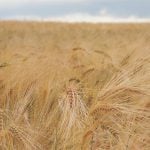
Camelina is a low-input oilseed that grows well in cool conditions and is capable of withstanding drought.

Camelina: A viable complementary crop

Boasting a short growing season, minimal input costs and drought tolerance, 
camelina may be a decent complementary option for Manitoba producers

There are a couple of bugs to work out, but the agronomics look good, especially in rotation with soybeans. If the market potential can be realized, camelina may become a bigger part of the crop mix in Western Canada. “The interesting thing about camelina from an agronomic point of view is that it is a
Regrowth in swaths cannot be sprayed.

Canola regrowth under swaths can’t be sprayed

Rain and delayed harvest have caused some cut canola plants to regrow. This regrowth coming up through swaths can make for increased green matter going through the combine. This regrowth cannot be sprayed. Once canola is cut, no product can be applied. Pre-harvest intervals are closed for all products, and spraying swaths mean residues will


canola field

Cool down canola ASAP to prevent spoilage

With the recent heat wave farmers need to be even more vigilant with their canola

All canola should be conditioned shortly after it goes in the bin. Canola that goes into the bin hot is at much higher risk of spoilage and conditioning will reduce the grain temperature. It will also help dry down dockage, which may have higher moisture content than the seed. Note that straight-combined canola may have

swathing canola

Canola maturity matters in desiccation timing

The Canola Council of Canada’s Spray to Swath calculator shows 
just how long to wait after spraying a desiccant or other pre-harvest chemical

In desiccation — as in life — success is usually defined by maturity. “Whatever product you’re using, make sure you’re using it when the majority of the plants in the field is physiologically mature,” said Harry Brook, crop specialist with Alberta Agriculture and Forestry. “You get into problems when they’re immature. It doesn’t preserve your


Mario Tenuta holds up a jar containing soybean roots with nematodes for inspection at the Ian N. Morrison research farm near Carman.

Soybean cyst nematode co-evolved with crop

They are tiny world travellers and Manitoba’s Red River Valley could be 
the next stop on the soybean cyst nematode’s global tour

In the middle of the Ian N. Morrison research farm near Carman, an unlikely scene is unfolding as farmers and agronomists crowd around what looks like an old jam jar. “Careful, we don’t want this to break,” Mario Tenuta stresses, with a bit of a chuckle. But what’s inside the tightly sealed jar is no

canola plant

Editorial: We might need 100-bushel canola

The Canola 100 Agri-Prize for the first to achieve 100-bushel canola makes for an interesting challenge. Despite a favourable lingering PR image as the “Cinderella crop,” a look at the numbers suggests canola is showing signs of middle age. A few patches in a good growing year might even approach 80 to 90 bushels now,


Martin Entz speaks about organic soybeans near Carman.

Higher seeding rate needed for organic soybeans

Transitioning to organic soybeans is possible with strategic planning

It’s a simple question, one that Martin Entz hopes producers will seriously consider. “Why not grow organic soybeans?” he asked producers gathered at the Ian N. Morrison research farm near Carman late last month for the Manitoba Pulse & Soybean Growers’ annual SMART Day. “Something farmers are always looking for is on-farm diversification, so we’ve

Greg Bartley takes producers through his research plots.

Black earth doesn’t equate to warmer soil temperatures

Spaces went fast for this year’s Manitoba Pulse & Soybean Growers SMART Day

Wagons were filled to capacity and then some at the Ian N. Morrison research farm near Carman late last month, as the Manitoba Pulse & Soybean Growers held its annual SMART Day for soybean producers and agronomists. “Programs like this are hugely beneficial, especially for guys like myself, who are just realizing that I know


VIDEO: Research on volunteer canola in soybean crops

VIDEO: Research on volunteer canola in soybean crops

Crop Diagnostic School: Wider rows, integrated management being studied to pressure volunteer canola

At the recent Crop Diagnostic School, Rob Gulden, an associate professor at the University of Manitoba, spoke about current and ongoing research to address the problem of volunteer canola in soybean crops. Wide row spacing and integrated management techniques with cereal crops are being tested as well as combining herbicide groups for in-crop application to measure

Volunteer canola grows amid soybean test plots.

Less nitrogen equals less volunteer canola

Tighter row spacing may put the squeeze on late-emerging or slow-growing weeds, but not so for volunteer canola

Looking to reduce volunteer canola in your soybeans? Hold off on that extra nitrogen, or better yet, find a field that’s been depleted. Standing amid research plots at the Ian N. Morrison Research Farm near Carman, University of Manitoba PhD student Charles Geddes explained some of the work being done to combat volunteer canola during