




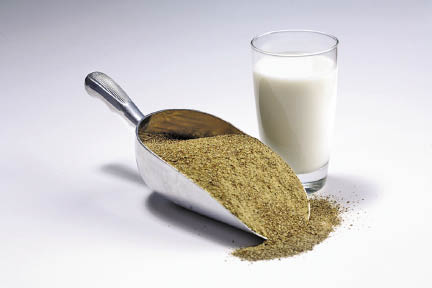
The Chinese have 7.2 million reasons to switch their dairy cows to canola meal from other protein rations. That’s how many more litres of milk their 12 million cows would produce every day based on a year-long joint Sino-Canadian study conducted by Chinese academics, in co-operation with China’s five largest dairy companies. “Canola meal has
Milking the benefits of canola meal

Winnipeg-based Ag Canada wheat breeder goes private
Stephen Fox, an Agriculture and Agri-Food Canada researcher and developer of such popular hard red spring wheat varieties as Kane and AC Unity, is leaving the federal government to work in the private sector. Fox will join DL Seeds next month, as a canola breeder at its Winnipeg facility. “It will be an exciting change
Alliance seeks improved wheat photosynthesis, nutrient use
Alliance seeks improved wheat photosynthesis, nutrient use The Canadian Wheat Alliance wants to boost wheat yields by developing new varieties with increased tolerance to drought, heat, cold and diseases such as fusarium head blight and rust. “By working in an integrated fashion and bringing in additional collaborators and contributors, the alliance is striving to ensure

Where is AAFC’s wheat-breeding program headed?
After closing Winnipeg’s Cereal Research Centre, the federal government has invested $85 million in a new wheat research program in Saskatoon
Agriculture and Agri-Food Canada (AAFC) has led Canadian wheat breeding for more than 100 years, but recent actions by the federal government have some wondering about its future role. A year ago, Ottawa announced it will close AAFC’s venerable Cereal Research Centre on the University of Manitoba’s Winnipeg campus because it would cost too much
More heavy rain delays seeding, causes flooding in south-central Manitoba
Two heavy dumps of rain within a week of each other in south-central Manitoba caused widespread overland flooding and put seeding on hold. Farmers in the Miami, Darlingford and Thornhill areas are now praying for warm, dry, windy weather but at press time June 3 the forecast was for more showers by the weekend. Official

Liquid nitrogen splash puts KAP president in hospital
Keystone Agricultural Producers president Doug Chorney got a crash course in farm safety this spring after a seemingly benign splash of liquid nitrogen landed him in hospital with severe dehydration. The Selkirk-area farmer was decoupling a pressurized hose May 15 when he was sprayed with liquid nitrogen. Sunglasses protected his eyes and he washed it

Options for farmers struggling to fertilize wet fields
Manitoba farmers struggling with fertilizer applications because it’s too wet have options, says provincial soil fertility specialist John Heard. Ideally nitrogen should be banded ahead, or at the time of seeding, but that’s not always possible, he said. For example, a farmer might have a supply problem or fields too wet to support a loaded

CWB optimistic about privatization plans post-monopoly
The new CWB, a government-owned grain company created last Aug. 1, continues to work towards privatization, says its president and CEO Ian White. “We still hope we can find a mechanism to have farmers as shareholders (but) with the amount of capital we think we need maybe others as well,” White said in an interview
AAFC Brandon beef research cuts condemned
The Agriculture and Agri-Food Canada (AAFC) Research Centre at Brandon is losing eight full-time employees, 850 head of cattle and $300,000 a year in revenue because the federal government is shutting down its beef research program. Whether the herd is sold or moved, it will be the first time in the centre’s 127-year history without
CWB issues final annual report from single-desk era
Ownership of the board's assets is still disputed
Cereals sold through the Canadian Wheat Board last year fetched prices ranging from $7.48 to $15.30 a tonne more than U.S. prices, the board’s final annual report under the single-desk era shows. The Canadian Wheat Board earned $7.2 billion in revenue, distributing $4.85 billion to farmers — the third highest for both on record —