




Minto farmer says end to beef research program at Brandon is the latest in a string of government decisions made without consultation
Ottawa should have consulted farmers before making the “unilateral” decision to close the beef research program at Agriculture and Agri-Food Canada’s Brandon Research Centre, say delegates to Keystone Agricultural Producers’ recent general council meeting. “This is just bad, bad, bad government,” said Minto farmer Bill Campbell, who moved the resolution calling on the federal government to
KAP delegates demand federal government consult farmers before cutting programs

National soil science meeting meets Manitoba mud
A look back in time on Manitoba's escarpment — and a vision of what the future could be
Dale and Caroline Steppler’s farm on the Manitoba Escarpment was shaped by glaciers, but today the challenge is keeping nutrients from running down to Lake Winnipeg
In an abandoned shale pit a busload of muddied-shoed soil scientists from across Canada and beyond peer back millions of years into the geological history of this part of the Manitoba Escarpment west of Miami. Marine dinosaur fossils are routinely discovered nearby in the bentonite clay formed from prehistoric volcanic ash. They once swam in
Corn good for Manitoba’s economy
Manitoba’s corn industry punches above its weight when contributing to the provincial and national economy, according to a study prepared for Informa Economics for the Manitoba Corn Growers Association (MCGA). The consulting company estimates Manitoba corn production provided nearly $117 million in added value to the provincial economy in 2012 based on direct and indirect
CGC security program pays out on Bissma Pacific. Inc.
Grain commission security program kicks in Fourteen western Canadian farmers have been paid for crops delivered to an Ontario grain dealer that went into receivership in November. A total of 28 claims were made under the Canadian Grain Commission’s Payment Protection Program after Bissma Pacific Inc., a Pickering-based company that mainly bought western Canadian pulses,
CWB retirees keep indexed pensions
No matter what happens to revamped Canadian Wheat Board, its retired employees will still receive indexed pensions. The federal government gave $348 million last year to cover CWB’s “legacy liabilities,” including pensions and pensioners’ benefits. Some of those funds were used to purchase a $150-million indexed group annuity buy-in from Sun Life Financial, the CWB
Noxious weed control to be strengthened in Manitoba
Keystone Agricultural Producers’ president Doug Chorney is anxious to see details on how the Manitoba government will better protect farmland from noxious weeds as part of its ban on cosmetic pesticides. “I am encouraged by that, but we want to make sure that is the case,” Chorney said July 3 in an interview. “It’s important
Researcher wants to know if farmers are happy with the contracts they sign
Production, marketing, and technology-use contracts are increasingly common but are they fair to farmers or tilted in companies’ favour?
Lots of farmers don’t like them but are production, marketing, and technology-use contracts unfair to farmers? “We still hear from our members that the contracts are typically quite one-sided,” said Doug Faller, policy manager with the Agricultural Producers of Saskatchewan. “Now with the changes to the wheat board and so on, the need for addressing
Trifoliate stage best for rolling soybeans after emergence
Don’t roll soybeans until they reach the first trifoliate stage, advises Dennis Lange, or you risk breaking too many young plants. “You don’t want any beans at the hook stage,” said the Altona-based farm production adviser with Manitoba Agriculture Food and Rural Initiatives. “Only roll if you have some stones or dirt that will cause
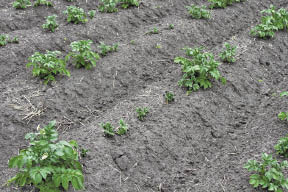
Potato seed growers want less herbicide drift
Sometimes potato plants show no signs of damage, but tuber germination can suffer and only be discovered the following year
When it comes to seed potatoes and herbicide drift, what you can’t see can hurt you. Increased use of glyphosate as a pre-harvest burn-down, as well as increased acreage for Roundup Ready corn and soybeans, has upped the use of the ubiquitous herbicide — and that’s upped the risk for seed potato growers. “If it’s
On-farm reservoirs good for the environment and farmers’ pocketbook too
A pilot project near Elm Creek is testing an on-farm reservoir as an economic way to ease the threat of flooding and reduce nutrient losses into Lake Winnipeg
Like most farmers in the Red River Valley, Carl Classen sometimes has too much water on his fields, then not enough. But he has a two-pronged solution: Improve drainage to get water off his land faster, but instead of sending it downstream to potentially flood someone else, he’s storing it in a reservoir to irrigate