
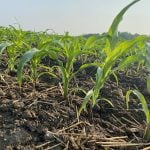
The five Manitoba commodity groups working towards a merger have no preconceived ideas on what a new association will look like, says Pam de Rocquigny, general manager of the Manitoba Wheat and Barley Association and Manitoba Corn Growers Association.

Commodity groups exploring merger

For now Manitoba’s canola, winter cereal and oat producer associations have opted to remain on their own

Five Manitoba commodity groups have signed a deal to spend the next year working towards a merger. The Manitoba Corn Growers Association (MCGA), Manitoba Pulse & Soybean Growers Association (MPSG), Manitoba Flax Growers Association (MFGA), National Sunflower Association of Canada (NSAC) and the Manitoba Wheat and Barley Association (MWBGA) signed a memorandum of understanding (MOU)
Merger years in making

Grassroots farmers first raised the idea in Manitoba

The first talk of farm groups merging began in 2013 when Halbstadt-area farmer Danny Penner circulated a letter calling on commodity groups to merge nationally to save farmers money. At the provincial level groups began exploring the idea quietly in 2014 with discussions between staffers at the various organizations. Some of the interest stemmed from


Grain Farmers of Ontario an example of commodity group merger

The group began by merging corn, soybeans and wheat into a single association, but has since added barley and oats

One of the clearest examples of what merged farm groups might look like is the Grain Farmers of Ontario (GFO). It began operations Jan. 1, 2010 after Ontario corn, soybean and wheat farmers voted strongly to merge their individual commodity groups, GFO chief executive officer Barry Senft, said May 4. In 2015 Ontario barley and

(Photo courtesy Canada Beef Inc.)

Prairie feed wheat, barley at seasonal highs

CNS Canada –– Feed barley and feed wheat appear to be settling into some seasonal highs, according to a market-watcher in Alberta. “Whether it goes up much more remains to be seen,” said Jim Beusekom of Market Place Commodities in Lethbridge. “Between Easter and May long weekend, we’re probably at a high.” High vomitoxin (10


A new and more complete barley genome may set the stage for new and better varieties.

Barley genome fully mapped

German researchers, leading an international consortium, 
say they’ve given us the best picture yet of the barley genome

Scientists at Helmholtz Zentrum München, a German research centre, have published the closest look yet at the barley genome. They recently published their findings in the journal Nature and lead author Heidrum Gundlach says they hope the new and more detailed barley genome will help develop varieties resistant to pathogens and tolerant of climate fluctuations.

A canola field in northwestern Saskatchewan on Oct. 5, 2016 after the area was blanketed by wet snow.  (Lisa Guenther photo)

StatsCan data confirm tight canola supplies

CNS Canada — Grain and oilseed stocks data released Friday from Statistics Canada were bullish for canola and wheat — though analysts suggest the effects of the report on the market may be short-lived. Figures for barley, lentils and peas were above year-ago levels, but movements in those markets are more likely be driven by


Weed-Bane herbicide, ‘harmless to humans’

Weed-Bane herbicide, ‘harmless to humans’

Our History: May 1948

Naugatuck Weed-Bane advertised in our May 6, 1948 issue was said to be a 2,4-D formulation developed specifically for Canada’s colder climate, and harmless to grass, soil, animals and humans. We reported that flooding was causing serious damage along the Red and Assiniboine rivers, and that many homes had been flooded on low river land

KAP debates how to spend the Canadian Grain Commission’s operating surplus

The CGC says it can’t refund the money, but it can spend it with the federal government’s approval on things related to its mandate

The Canadian Grain Commission (CGC) cannot return its operating surplus to farmers or grain companies as some farm groups suggest, according to Remi Gosselin, manager of corporate information services. “The Canada Grain Act and the Canada Grain Act regulations do not provide for refunds or rebates,” he said in an interview April 28. Nor will


Wild oats, known to be highly competitive with wheat, have declined in relative abundance, according to weed survey results.

Weed rankings shuffle in latest provincial weed survey

Wild oats are down, but experts are warning producers to take a closer look at their foxtail, it might not be the species they think

Green foxtail is still the province’s top weed, yellow foxtail is on the rise and wild oats have declined, according to last year’s Manitoba Weed Survey results. Wild oats, usually the second-most-abundant weed in the province, slipped to fourth in 2016, overtaken by both wild buckwheat and barnyard grass. Dr. Jeanette Gaultier, principal investigator of

(Photo courtesy United Soybean Board)

Manitoba crop groups officially on merger track

Five Manitoba-based crop producer associations, nearly all of which already work out of the same building, have a memorandum of understanding to work toward forming a single merged grower group. The Manitoba Corn Growers Association (MCGA), Manitoba Pulse and Soybean Growers Association (MPSG), National Sunflower Association of Canada (NSAC) and the Manitoba Wheat and Barley