
Canola south of Ethelton, Sask. on Aug. 3, 2017. (Dave Bedard photo)

Larger crops expected in StatsCan report

CNS Canada — Canada’s canola and wheat production likely ended up larger than earlier expectations, but just how much more remains to be seen, as industry participants await the Statistics Canada production report due out Wednesday. “The finish seemed to be better than what the weather looked like earlier in the year,” said Neil Townsend
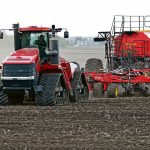
(Dave Bedard photo)

Trade expecting bigger canola, wheat numbers from StatsCan

Reuters — Canadian farmers harvested the biggest canola crop on record, slightly larger than was expected in September, a Reuters survey of 15 traders and analysts showed ahead of a key government report. Wheat production is also seen higher than earlier expectations, as favourable weather produced big yields. Statistics Canada will release its final crop


Dr. Alan Moulin takes tour attendees through the field.

Mixing and matching inputs and rotations

Brandon researchers spent 18 years combining three different input levels and crop rotations to study the impact on nutrients, soil quality, yield and implications for climate change

Farming for short-term yield will be different than long-term soil benefit. That’s not a new idea, but it has been driven home by 18 years of research spearheaded by researcher scientists Alan Moulin and Taras Lychuk of Brandon’s Agriculture and Agri-Food Canada research station. From 1994-2003, the pair’s team cross-compared organic, reduced- input no till,


Everyone needs to be a trade policy expert

Everyone needs to be a trade policy expert

Time for those who have benefited from free trade to stand up for it

Inattention, indifference and inaction are no longer options for those in agriculture with regard to U.S. foreign policy. Free trade has remained a key, philosophical driver for U.S. feed grains for decades, benefiting corn, barley and sorghum growers — among many other commodities. Now, agriculture must answer the call to defend trade and the rewards

Harvest goes hands free

Harvest goes hands free

British researchers have put automation to test in the farm field

A U.K. research project has planted, tended and harvested the first crop — of spring barley — that’s never seen direct human labour. Hands Free Hectare was aiming to test the concept in the field and consciously chose smaller machinery, said Jonathan Gill, a researcher at Harper University. “There’s been a focus in recent years


During KAP’s Nov. 1 advisory council meeting Starbuck farmer Ed Rempel said he shared concerns raised by Butch Harder of Lowe Farm about losing farmer representation if five Manitoba commodity groups merge into one association.

Commodity merger gets chilly reception from some

Some farmers worried over loss of input

The Keystone Agricultural Producers’ (KAP) meeting room was chilly, then Starbuck farmer Ed Rempel explained why. “Well Mr. Chairman, I think hell just froze over because I agree with everything Butch Harder just said.” The room erupted with laughter. Harder, a KAP District 3 representative who farms at Lowe Farm, had just told KAP’s fall

The Manitoba Organic Alliance announced the working group Oct. 23 during its annual meeting in Brandon.

Organic Alliance says crop insurance needs an update on organic production

Organic growers argue that insurance excludes critical production practices, but change may come with some real logistical problems, according to MASC

Organic farmers in Manitoba hope a new working group will help solve long-standing crop insurance issues. The body will have members from both the Manitoba Organic Alliance (MOA) and Manitoba Agricultural Services Corporation (MASC). “There’s definite improvements that need to be made, so we want to know what the timeline on that is,” MOA president


The wheat-like cereal emmer was one of the earliest crops to show evidence of human influence.

Early intervention

Humans appear to have influenced crop plants far earlier 
than previously understood

It turns out the roots for farming run deeper than previously thought — about 10,000 years deeper to be precise. New research from the U.K.’s University of Warwick has shown ancient hunter-gatherers began to systemically affect the evolution of crops as far back as 30,000 years ago. Professor Robin Allaby has discovered that human crop