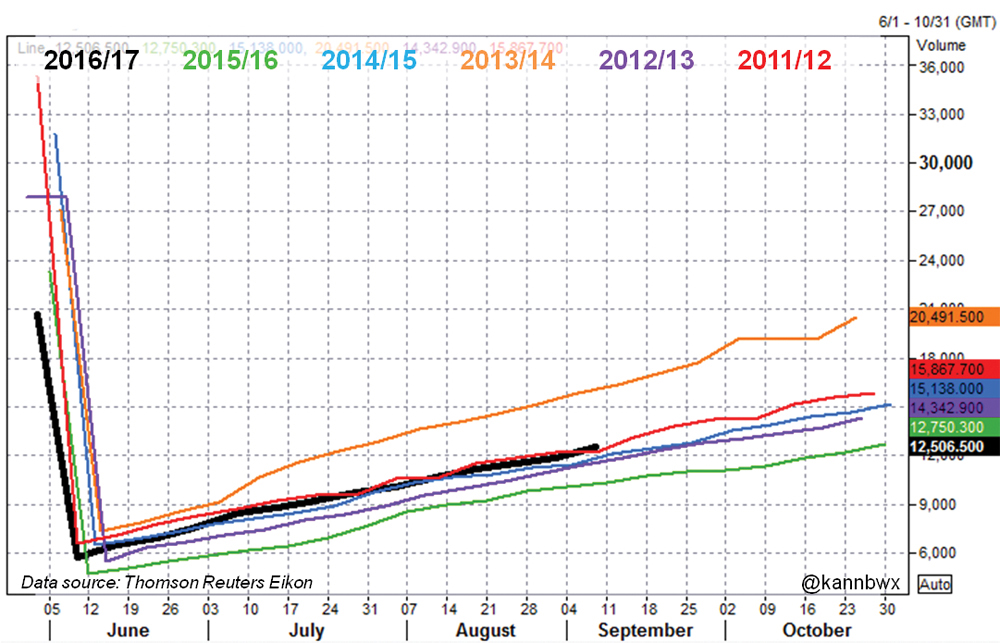
Although it has been dogged by a lot of doom and gloom of late, the U.S. wheat market may be finally starting to see a break in the clouds.
Last season, it seemed that the United States just could not sell any wheat, and without the sales, domestic wheat stocks ballooned to the largest volume in almost 30 years.
Between June 2015 and May 2016, the United States — once the world’s breadbasket — shipped the lowest quantity of wheat since 1971-72. With the world full of wheat, the premium cost of the U.S. product had sent buyers elsewhere.
Read Also

Government silence loud on AAFC cuts
Canada’s federal government trumpets fiscal responsibility; their silence on a day of massive Agriculture and Agri-Food Canada cuts was baffling at best.
But the situation has changed. U.S. wheat shipments are in their prime at this time of year, just before soybeans come online in October. And there are certainly more sales on the books this year than last year.
Data through Sept. 1 shows that wheat sales in the current season, which began on June 1, stand at the second-highest level of the previous five seasons.
Actual shipments thus far in the 2016-17 marketing year are off to a better start than the previous two campaigns. Weekly inspection data implies that the United States shipped about 100 million bushels of wheat in August, a very respectable amount compared with the last few years.
The fact that the world has become inundated with wheat in recent seasons did not help U.S. wheat trade last marketing year, especially since buyers had cheaper options available. But now the price is much more favourable for the U.S. grain.
Since early 2015, the U.S. dollar index has been elevated to levels not seen since the early 2000s, which has also made domestic wheat a tougher sell. Luckily for U.S. grain sellers, the dollar has now weakened compared with the start of this year.
The price of U.S. wheat, particularly the soft red winter variety grown in the eastern part of the Wheat Belt, has recently become competitive with its foreign rivals, especially those in Europe.
World wheat supply will likely grow this year compared with last year, as other key producers have turned up yet another huge crop.
The United States faces stiff competition with Russia and Ukraine, which together comprise the world’s largest exporting region, accounting for one-quarter of world wheat exports last year. Russia’s wheat crop has easily set a new record, while Ukraine has nearly tied its record crop.
Russia’s cause will be helped even further by the elimination of the wheat export duty, to take effect on Sept. 15 and last through July 1, 2018, so Russian sellers will be extra eager to find customers.
Karen Braun is a grain markets columnist for Reuters, the opinions expressed here are her own.