Every few years I like to revisit the topic of the “perfect Christmas holiday weather.”
The big question at this time of year always turns to whether or not we’ll have perfect Christmas weather, but in reality, the real million-dollar question — just what is perfect Christmas weather?
For those of you who have followed my articles, it’s probably no secret that my perfect Christmas weather is to have a nice big snowstorm that keeps everyone at home for a couple of days.
Read Also

4R compliance comes up short
Most Canadian farmers think they follow 4R practices, but a Fertilizer Canada survey found far fewer acres actually meet the standard.
I know that a big storm at this time of the year would cause all sorts of problems and hardships. But deep down inside, it is the idea of being stuck at home for a few days, no pressure to go anywhere because you can’t, plenty of food available, family around you, and hopefully something new to play with, just sounds perfect to me.
Basically, a perfect time to be forced to sit back and just relax and get away from all the holiday bustle.
That’s my holiday weather wish but I am sure there are others out there who would prefer no snow and record warmth, or daytime highs right around zero with great big lazy snowflakes falling — or maybe even clear skies and frigid cold!
All I know is, it takes all kinds to make the world go round and what is perfect for one person is not perfect for another.
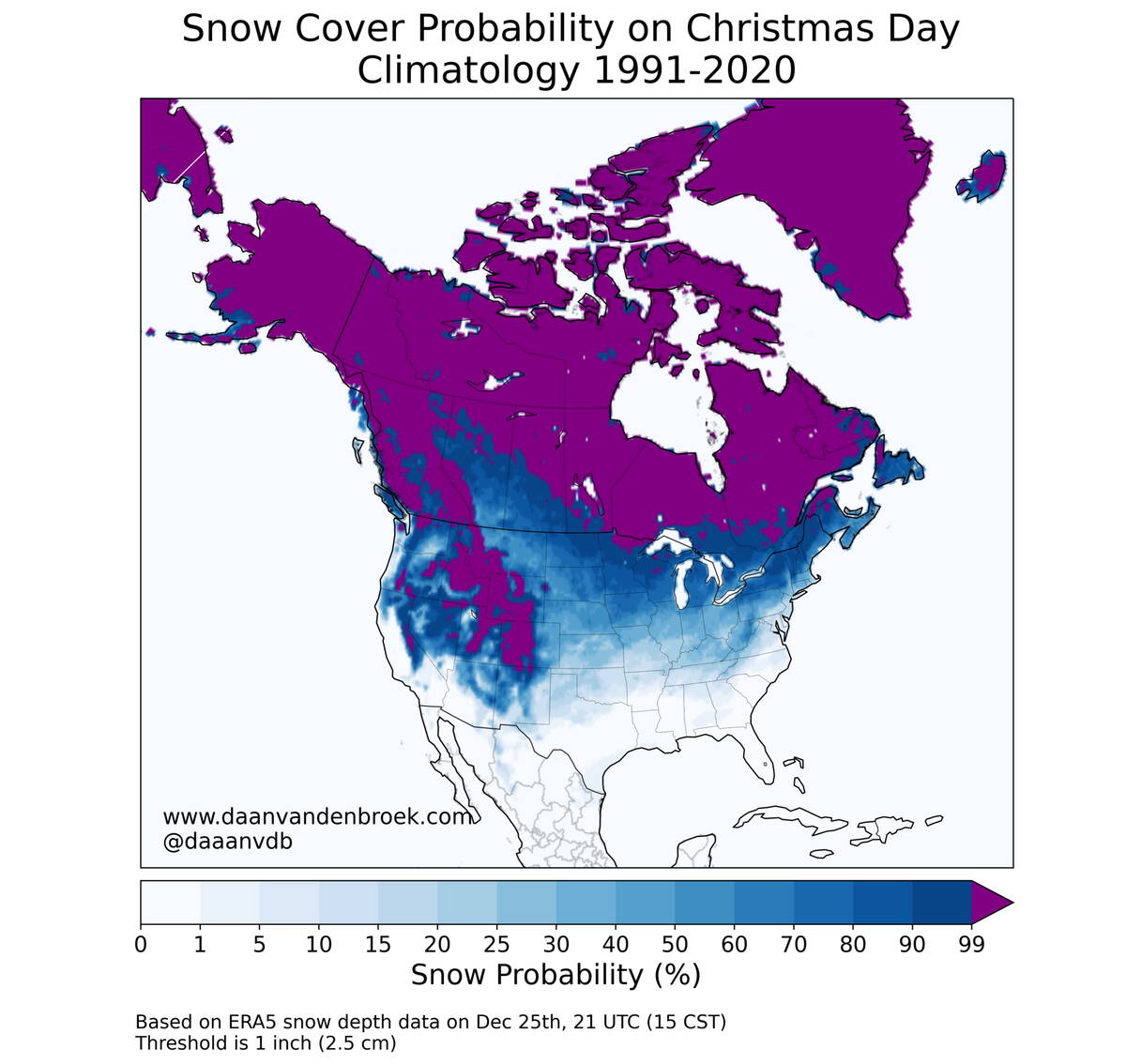
According to Environment Canada, perfect Christmas weather means there is already snow on the ground and at some point during Christmas Day there is measurable snowfall. So, what are the chances of this happening somewhere across the Prairies?
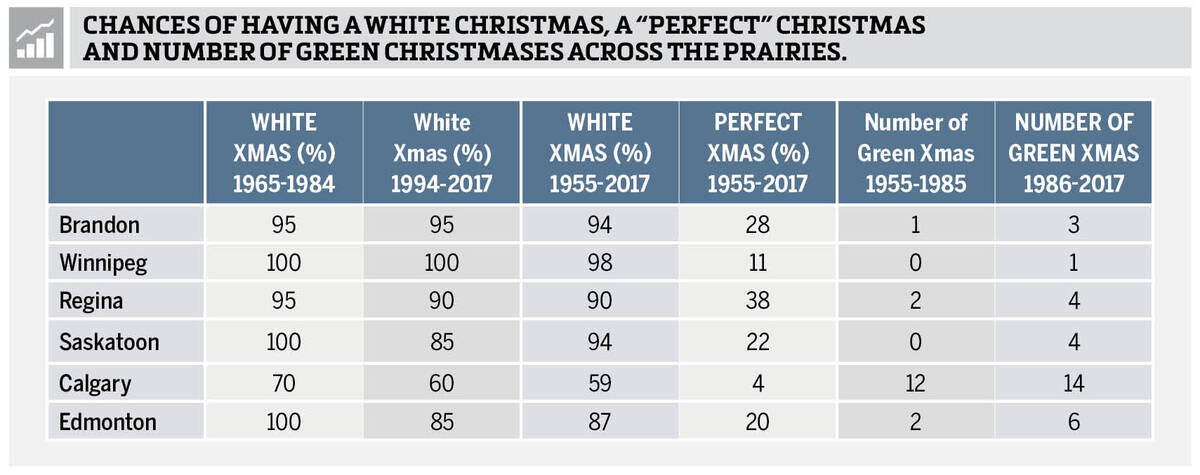
The first table shows the probability of having snow on the ground for Christmas along with having snow fall during the day. It breaks the data down into two periods to try and show how our winters seem to be becoming warmer with less snow.
Looking at this data it seems that if you want a white Christmas, then Winnipeg is your best bet. If you want Environment Canada’s version of a perfect Christmas, then Regina is your best bet.
If we look at the current snow cover across these locations (I am writing this in mid-December due to holiday deadlines) it’s going to be a close call as to whether this will be a white or a green Christmas. In Manitoba, both Winnipeg and Brandon are reporting three centimetres of snow on the ground and there’s a forecast for some above-freezing temperatures before the big day. With the low sun angle, I don’t think these locations will lose their snow cover.
In Saskatchewan, both Regina and Saskatoon are reporting only one centimetre of snow on the ground. With a few above freezing days, it is going to be close between a green or white Christmas.
In Alberta, Calgary is currently the snowiest location with six centimetres on the ground, but there’s a good chance that could all melt away before Christmas. Up in Edmonton, there’s only one centimetre of snow on the ground, so it’s in the same situation as Saskatoon and Regina, too close to call.
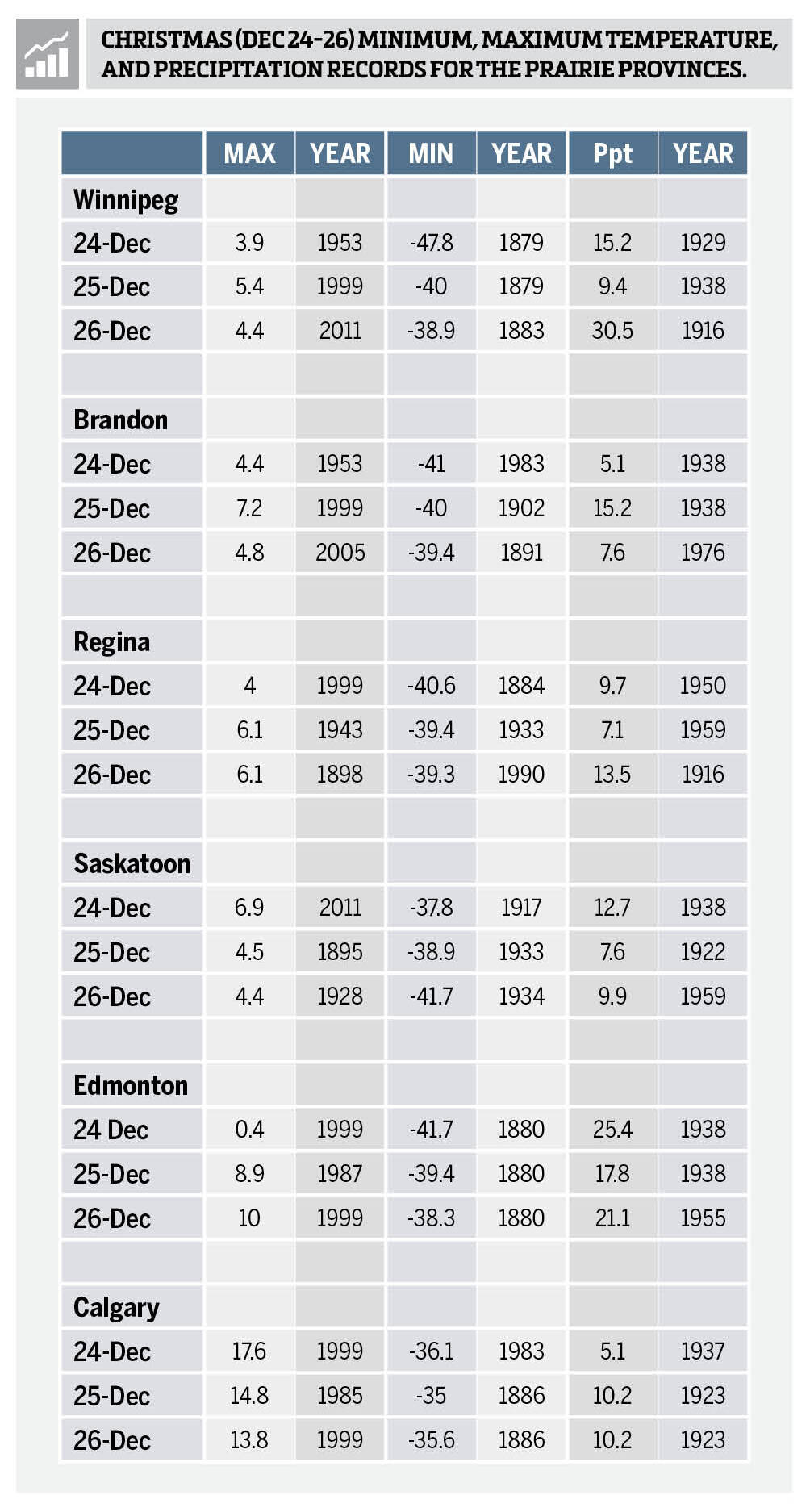
If your version of a perfect Christmas is to have record breaking warm or heck, even cold temperatures, then table two shows the warmest, coldest and snowiest Christmas periods on record for two major centres in each of the three Prairie provinces.
These records are based on the full set of data that each of these cities has, which means they go back to the late 1800s. While some might argue that these old records are not valid, I personally think they are and should be included.
If you’re looking for a place to go on the Prairies where you might experience a really warm Christmas, then Calgary would be the place for you. While all of the other centres have seen some nice warm Christmases in the past, not one of the major centres comes close to Calgary’s recorded highs.
If you want a chance at seeing some really cold weather during this period, then you could pick pretty much any place, as they have all seen Christmases colder than -35 C, although Winnipeg comes out the winner here, with a bone-chilling -47.8 C on Christmas Eve in 1879.
Interestingly, when you examine the precipitation records for these three days you’ll notice that the Christmas period has been a relatively dry, storm-free period, but there are a few exceptions. Winnipeg did see a heavy dump of 30.5 cm of snow on Boxing Day back in 1916, but the record for biggest Christmas snowstorms has to go to Edmonton. Back in 1938, Edmonton recorded over 25 cm of snow on Christmas Eve and then a further 18 cm of snow on Christmas day, for a total of 43 cm of snow. Looking at the other snowfall records, it seems like 1938 was a snowy Christmas right across the Prairies.
Whatever weather you do end up with I hope it is what you wanted, if not, then remember the season and try to make the best of it!