
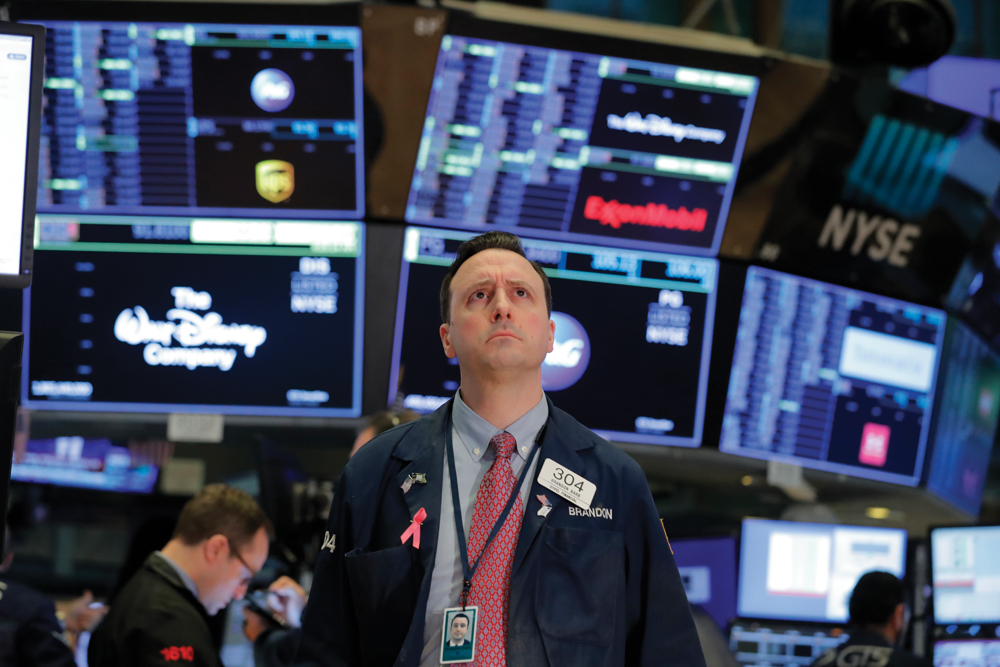
Canada’s grain markets haven’t been immune to the growing panic surrounding the COVID-19 coronavirus and its impact on global economies.
At the start of Monday’s trade, crude oil futures plummeted by over 30 per cent following a dissolved agreement between Russia and Saudi Arabia, the de facto leader of the Organization of Petroleum Exporting Countries (OPEC). COVID-19 had reduced global demand for oil, and OPEC was proposing deeper production cuts. Russia, however, balked at that agreement, and Saudi Arabia vowed to increase crude oil production to total 13 million barrels per day by April.
Read Also
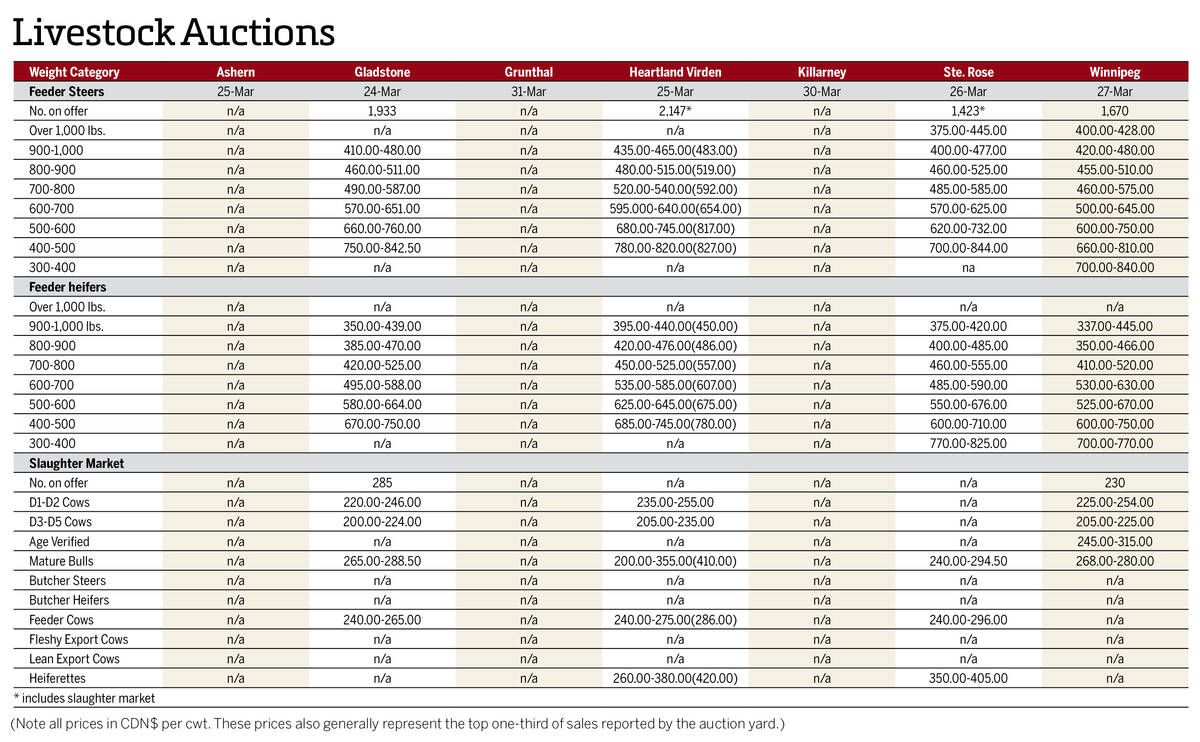
Manitoba cattle prices April 1
Here’s what cattle were selling for in Manitoba from March 24-31, 2026. Four of the seven main livestock auction marts held sales.
In response, global stock indices spiralled into a frenzy, triggering a circuit breaker within the first 15 minutes of trading in order to staunch rapid sell-offs.
Commodity markets were also wracked by negative sentiments, and canola values fell by $4.50 in nearby contracts to finish Monday at $455.30 per tonne.
Canola prices made a meagre recovery over the next two trading sessions, but many market participants have taken to the sidelines due to widespread uncertainty. Ultimately, the rally was not supported by significant buying, and prices returned to the downside later in the week.
On March 11, the World Health Organization (WHO) officially declared the COVID-19 coronavirus to be a global pandemic. In response to this, U.S. President Donald Trump announced a temporary ban on travel between the United States and Europe.
Global financial markets were once again thrown into chaos on Thursday morning, as the Dow Jones Industrial officially ended its bull run — the longest in U.S. history — and turned to a bear market.
At midday Thursday, the U.S. Federal Reserve announced it would inject more than US$1.5 trillion into debt markets in order to stymie free-falling financial markets and stabilize reserve balances in banking systems. Stock indices showed a brief rally in response to the injection, but ultimately closed at their lowest points in decades.
Commodity markets followed suit; the May canola contract lost $9.10 to close at $451 per tonne. Grain prices are expected to remain in lockstep with other financial markets until some normalcy returns to headlines.