
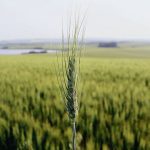
Mixed crop and livestock farming can be good for the soil.  Photo: Laura Rance

Conservation and livestock can be a good mix

While intensive livestock production can cause waste and nutrients to pile up, 
mixed farms are better able to recycle nutrients

When Ian Grossart harvests alfalfa on his farm in southwestern Manitoba, he knows where most of the nutrients he’s just removed are going to end up — back on his land. “With the cattle we compost all of our own manure, so that becomes a big part of our fertility program,” he said. “And because

John Heard (centre) of Manitoba Agriculture, Food and Rural Development says the 2014 Crop Diagnostic School, which was sold out this year, keeps evolving to agronomists’ needs.  photo: allan dawson

2014 Crop Diagnostic School sold out

The diagnostic school continues to evolve to meet the needs of Manitoba agronomists


The 2014 Crop Diagnostic School was sold out this year, proof that after almost 20 years the school has something new to teach. “We’re flattered by the interest,” John Heard, the school’s ringmaster and soil fertility specialist with Manitoba Agriculture, Food and Rural Development (MAFRD), said in an interview July 17. “It has been a


barn swallows on a fence

Volunteer birdwatchers keep tabs on local species

The Manitoba Breeding Bird Atlas is a scientifically designed, five-year project to assess the status, distribution and abundance of bird species that breed within Manitoba

A five-year effort to identify breeding bird species in Manitoba has confirmed golden eagles are back, snowy egrets have made unexpected appearances, and several species of native grassland birds are all but gone from most of agro-Manitoba. “We’re certainly seeing things that are indications of change,” says Manitoba Breeding Bird Atlas co-ordinator Christian Artuso, who