
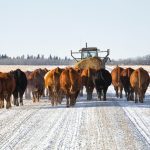
Dr. Allen Williams describes the ins and outs of forage management during the Aug. 14-15 grazing workshop in Brandon.

Graze better, not bigger

There’s more to grazing than leaving cattle in a single pasture all summer, 
attendees of the Aug. 14-15 workshop with Dr. Allen Williams heard

When it comes to managing a grazing operation, bigger isn’t necessarily better. That’s according to Dr. Allen Williams, a grazing specialist, grass-fed beef advocate, sustainable beef expert and the instructor at a two-day grazing workshop in Brandon Aug. 14-15. “They have a lot more options than they ever realized that they had in terms of
Manitoba counts the cost of dry conditions on hay harvest

Manitoba counts the cost of dry conditions on hay harvest

Hayfields and pastures have welcomed early-August rains, but some regions are still in need of moisture, including central Manitoba

This year’s hay harvest won’t match last year’s bumper crop, but there should still be enough to go around, an official with the Manitoba Forage and Grassland Association says. “Last year, the hay yields were phenomenal. Every field did well,” chair Dave Koslowsky said. “This year, it’s a little bit more hit and miss but,


Prime drying weather boosts first forage cut

Prime drying weather boosts first forage cut

Haying was in full force during the first week of June after forage quality fell to 
optimal cutting levels across the province

Grain producers may have been cursing the province’s dry spell in the first week of June, but it was good news for forage growers looking for their first cut. John McGregor, co-ordinator of the Manitoba Forage and Grassland Association’s Green Gold program, said farmers saw between seven and 10 days of good drying weather around

Alfalfa flowering and proper forage drying

Alfalfa flowering and proper forage drying

Forage and grassland conditions for Eastern, Central and Western Manitoba, and Interlake as of June 8

[Updated, June 16, 2017] This is the sixth (and final) release for the Green Gold program in 2017 assessing forage conditions in Manitoba. Reports will be issued from various areas of the Province (Eastern, Central, Interlake, and Western) in the weeks ahead. The reports below highlight the most recent forage conditions for Eastern, Central and Western


When grasses reach this height, it's a good time to consider cutting.

Alfalfa in early bud stage, time to cut alfalfa/grass mixes

Forage and grassland conditions for Eastern, Central and Western Manitoba, and Interlake as of June 1

This is the fourth release for the Green Gold program in 2017 assessing forage conditions in Manitoba. Reports will be issued from various areas of the Province (Eastern, Central, Interlake, and Western) in the weeks and months ahead. The reports below highlight the most recent forage conditions for Eastern, Central and Western Manitoba: Green Gold report for

First forage cuts fast approaching

First forage cuts fast approaching

Forage and grassland conditions for Eastern, Central and Western Manitoba, and Interlake as of May 29

This is the third release for the Green Gold program in 2017 assessing forage conditions in Manitoba. Reports will be issued from various areas of the Province (Eastern, Central, Interlake, and Western) in the weeks and months ahead. The reports below highlight the most recent forage conditions for Eastern, Central and Western Manitoba and the Interlake: Green


Window opens on first forage cut of 2017

Window opens on first forage cut of 2017

The Manitoba Forage and Grassland Association estimated the province’s ‘Hay Day,’ when 
forage quality begins to hit the cut-off for 
optimum quality at May 30

Hay Day is on the horizon, according to the first Manitoba Forage and Grassland Association Green Gold reports. Between May 18 and May 23, eastern Manitoba forage stands had dropped 34 points, although growth had slowed due to cooler temperatures, with plants adding only 1.3 inches in height. The east averaged 221 relative feed value

MBFI research co-ordinator Kristelle Harper stands in front of the herd at the Manitoba Beef and Forage Initiatives Johnson Research Farm.

Putting spurge on the menu for research — and cattle

With an incoming learning centre and research ranging from rodent control to grazing systems and leafy spurge, 2017 looks to be busy for Manitoba Beef and Forage Initiatives

Manitoba Beef and Forage Initiatives (MBFI) is ramping up for 2017. Preparations are underway for a long list of projects at the collaborative’s three test farms outside of Brandon. “Some of them are continuing projects from last year,” said MBFI president Ramona Blyth. “Research is never just done in one year, so there’s the carry-over


Forage growth in the West/Central area on May 23.

Some winterkill seen in forages, alfalfa growth advancing quickly

Forage and grassland conditions for Eastern, Central and Western Manitoba as of May 23

This is the first release for the Green Gold program in 2017 assessing forage conditions in Manitoba. Reports will be issued from various areas of the Province (Eastern, Central, Interlake, and Western) in the weeks and months ahead. The reports below highlight the most recent forage conditions for Eastern, Central and Western Manitoba: Green Gold report for

A field in the western Pembina Valley region is one of several in the area to report patchy regrowth.

Eyes on winterkill as producers assess forage stands

Some forage fields are lagging, a number of producers in the east and 
central Manitoba have said, but the final toll is still up in the air

It appears forage producers in eastern Manitoba are suffering the same weather-related winterkill that hit winter wheat in the region. The Manitoba Forage and Grassland Association (MFGA) says it has got reports of damage in the southeast corner of the province, while producers in the western Pembina Valley have also noted poor regrowth. “Part of