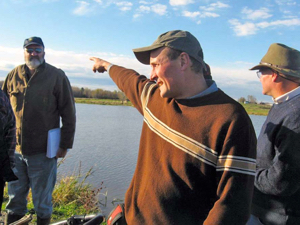
Global warming will mean a longer growing season and more forage production — as long as there’s enough water.

‘Change’ is the watchword in a warming world, says researcher

Longer summers and milder winters sound nice, but even the pluses come with some negatives

How will the Canadian cattle industry fare if global temperatures continue to rise? Count a reduced feed demand, a longer grazing season, and higher forage production among the benefits — but also expect more extreme weather, pests, and transport headaches, according to University of Manitoba research scientist Kim Ominski. “We know the future of our
The Manitoba Beef and Forage Initiative is well on its way to becoming a noted beef research and education centre of excellence.


Research and ranching

Brandon-based Manitoba Beef and Forage Initiatives is realizing its 
potential as education and research centre

The Manitoba Beef and Forage Initiative is fast becoming one of the key centres for sector education and research in Western Canada. The rapid ascent could not be more perfectly timed, as the MBFI is in the midst of adding a learning centre to the Brookdale site, to complement the activities on the farm. “Our


The beef industry has anted up in a big way to fund forage research through the Beef Cattle Research Centre.

Canadian forage research on the rise

The Beef Cattle Research Council has increased forage research funding from $40,000 to $6 million since its inception

The forage industry has begun to see a promised increase in research funding from the beef industry. According to Reynold Bergen, science director with the Beef Cattle Research Council (BCRC), more of Canadian cattle producers’ checkoff dollars are being put towards research and the piece of the pie that had been allocated towards forages has

Larry Wagner, a Virden-area producer discusses his management strategies in a pasture on his operation last summer.

Bale grazing – benefiting the pasture and your wallet

Bale grazing has the potential to reduce overwintering costs and leaves substantial 
nutrients behind, promoting increased forage production and quality

Not only can bale grazing reduce costs and time in the tractor, it can also boost forage growth and overall production. “The advantages of bale grazing are that you are able to save money and reduce operating cost by lowering yardage, tractor use and removing the need to haul manure,” said Shawn Cabak, livestock specialist


Greg Penner, associate professor with the University of Saskatchewan facility of animal science, says to achieve a productive rumen, producers need to focus on consistency.

Rumen management for best herd productivity

To achieve a healthy rumen and productive herd, experts say to focus on providing consistency in feed and nutrient intake

Making high-quality beef from forages requires an active and healthy rumen to break down those tough fibres, and you can foster these microbes that are the key to herd efficiency. One of the most important things to realize is that as you feed your cattle, you’re also feeding the rumen bacteria. Keeping the feed steady

Six limiting factors in your soil that will make or break your operation

Six limiting factors in your soil that will make or break your operation

Without these six key ingredients, your soil — and your farm — could be in trouble

Farms and grazing operations — organic or otherwise — are only as good as their worst resource, according to Oregon-based grazier Abe Collins. “Soil is our primary infrastructure on the farm,” said Collins, who spoke at the recent Organic Alberta conference. “Biologically, chemically, and physically, you need to be looking at the limiting factors in


Young graziers need to do more with less, and cover crop cocktail mixes are a way they can do that, says grazier Graeme Finn.

This ain’t your grandad’s grazing system

Innovative producers, especially younger ones, are looking to cover crop cocktail mixes to get more production per acre

Nearly 150 people — some from as far away as Manitoba — converged on a farm near Hardisty recently to learn more about cover crop cocktail mixes. But tour organizer Graeme Finn noticed something a little different about the crowd at the event in late August — it was mainly young farmers. “Young people can’t

Land management specialist with Manitoba Agriculture, Marla Riekman discusses the impacts forage and grazing practices have on the soil.

Applied research already well underway at MBFI

MBFI has kick-started a number of research projects, examining everything from energy-dense annual forages to riparian health

Just 18 months into its existence, the Manitoba Beef and Forage Initiative (MBFI) has hit the ground running with a number of research projects. “Transitioning from the initial concept of MBFI to successfully completing several research projects in such short order is no small feat,” said Ramona Blyth, chair of the MBFI board during the


South African holistic management specialist, Ian Mitchell-Innes from South Africa, discussed management tactics with a group of Manitoba producers in Lenore on July 12.

Focusing on nutrition will also help the pasture

World-renowned holistic management specialist 
says green is not the only right colour for grass

Many graziers have a theory that if you look after the soil, the rest of the operation will take care of itself, but Ian Mitchell-Innes looks at it the other way around. “The biggest mistake that people make after learning about holistic management is they try and save the ground. I did this also when

Early spring grazing sets the stage for the entire growing season

Early spring grazing sets the stage for the entire growing season

Here's a few management options for you to consider

Manitoba Forage & Grassland Association – Even though winter feed stores may still be adequate the urge to get cows to grass is escalating. Turning cows out on immature forages too early can have consequences, with the biggest challenge being to avoid permanent damage by overgrazing. If forages are overgrazed early, permanent damage of the stand