CBOT May 2023 soft red winter wheat with 20-day moving average, MGEX May 2023 hard red spring wheat (yellow line) and K.C. May 2023 hard red winter wheat (orange line). (Barchart)

U.S. grains: Wheat, corn get boost off weaker dollar after multi-month lows

Expectations grow for Black Sea deal extension

Chicago | Reuters — Chicago wheat futures closed higher on Friday, boosted by a weaker U.S. dollar, after hitting a 20-month low, while corn futures rose from a seven-month low. The markets recovered after a week that saw expectations for an extended Black Sea export deal and a lower U.S. government estimate for corn export

CBOT May 2023 corn with 20-, 50- and 100-day moving averages. (Barchart)

U.S. grains: Chicago corn dampened by prediction of El Nino rain

Black Sea export deal hopes drag wheat to 18-month low

Chicago | Reuters — Chicago corn futures hit their lowest price since August on Thursday on expectations that the El Nino climate phenomenon could boost U.S. crops and concerns about rising interest rates. La Nina has ended, the National Weather Service’s Climate Prediction Center said on Thursday, and El Niño could possibly form during summer


Pacific Ocean sea surface temperature anomalies (in degrees Celsius) for the week centred on Sept. 14, 2022. (CPC.ncep.noaa.gov)

La Nina set to continue for third year

Other weather patterns may override temporarily

MarketsFarm — With fall soon upon North America, there’s nothing overly unusual with the continuation of La Nina, according to Drew Lerner, president of World Weather Inc. at Overland Park, Kansas. Going into its third year, some people might think this is the third consecutive La Nina — but Lerner said it’s the same one,

Weekly-average Pacific Ocean surface temperature anomalies for the week centred on Aug. 3, 2022, in degrees Celsius. (CPC.ncep.noaa.gov)

La Nina conditions to continue, but odds lower into winter

Reuters — Chances for La Niña are expected to gradually decrease from 86 per cent in the coming season to 60 per cent during December to February in 2022-23, a U.S. government weather forecaster said on Thursday. The La Niña weather pattern is characterized by unusually cold temperatures in the equatorial Pacific Ocean. According to


Sea surface temperature anomalies over the equatorial Pacific Ocean for the week centred on Jan. 5, 2022. (CPC.ncep.noaa.gov)

La Niña likely to continue into spring, U.S. forecaster says

Reuters — La Nina conditions are likely to continue during the Northern Hemisphere spring, a U.S. government weather forecaster said on Thursday. The La Niña weather pattern, characterized by unusually cold temperatures in the equatorial Pacific Ocean, has a 67 per cent chance of persisting from March through May this year, the National Weather Service’s

Average sea surface temperature anomalies over the equatorial Pacific Ocean for the week centred on May 5, 2021 compared to 1981-2010 base period. (CPC.ncep.noaa.gov)

La Nina done, U.S. CPC says

Neutral weather likely through summer

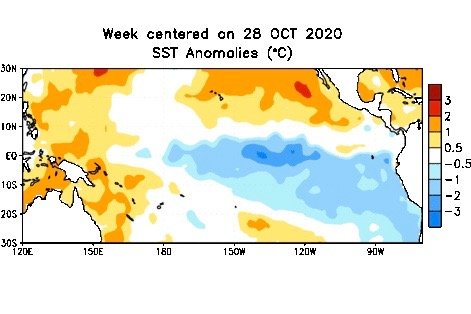
Reuters — A U.S. government weather forecaster said on Thursday La Nina has ended and El Nino-Southern Oscillation (ENSO) neutral conditions are likely to continue through the Northern Hemisphere summer. “ENSO neutral” refers to periods in which neither El Nino nor La Nina is present, often coinciding with the transition between the two weather patterns,


Average sea surface temperature anomalies over the equatorial Pacific Ocean for the week centred on Oct. 28, 2020 compared to 1981-2010 base period. (CPC.ncep.noaa.gov)

WMO officially calls a La Nina winter

MarketsFarm — A La Nina weather event has officially developed in the Pacific Ocean and is expected to continue into 2021, affecting temperatures, precipitation and storm patterns around the world, according to the World Meteorological Organization (WMO). The global declaration of the La Nina event by the United Nations’ agency will be used by governments

A surfer walks into the Pacific Ocean at Hermosa Beach near Los Angeles on Sept. 4, the first day of a record heat wave in the area.

The Pacific Ocean’s impact on our weather

In a La Niña event, sea surface temperatures cool down in spots that are usually warm

In the last issue, I pointed out that La Niña conditions have developed across the Pacific Ocean and these conditions have sustained themselves for three months, meaning we are now into a La Niña period which is forecast to last through most, if not all, of the winter. Before we look to see how this


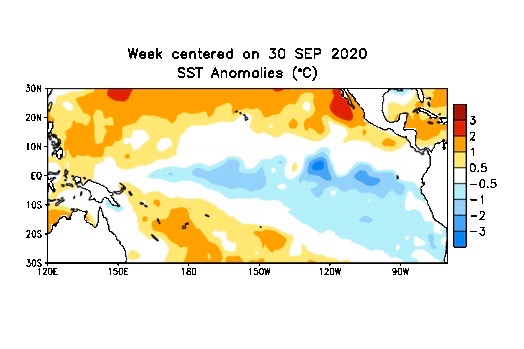
Sea surface temperature (SST) anomalies over the southern Pacific for the week centred on Sept, 30, 2020. (CPC.ncep.noaa.gov)

La Nina to bring colder, drier winter

MarketsFarm — There’s a La Nina poised to exert influence on the coming North American winter, according to Drew Lerner, senior agricultural meteorologist for World Weather Inc. in Kansas. A La Nina generates colder-than-normal temperatures, as opposed to the warm temperatures garnered from an El Nino. Both weather phenomenon can be found over the Pacific