

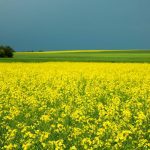
canola plant

Editorial: We might need 100-bushel canola

The Canola 100 Agri-Prize for the first to achieve 100-bushel canola makes for an interesting challenge. Despite a favourable lingering PR image as the “Cinderella crop,” a look at the numbers suggests canola is showing signs of middle age. A few patches in a good growing year might even approach 80 to 90 bushels now,
VIDEO: Research on volunteer canola in soybean crops

VIDEO: Research on volunteer canola in soybean crops

Crop Diagnostic School: Wider rows, integrated management being studied to pressure volunteer canola

At the recent Crop Diagnostic School, Rob Gulden, an associate professor at the University of Manitoba, spoke about current and ongoing research to address the problem of volunteer canola in soybean crops. Wide row spacing and integrated management techniques with cereal crops are being tested as well as combining herbicide groups for in-crop application to measure


Volunteer canola grows amid soybean test plots.

Less nitrogen equals less volunteer canola

Tighter row spacing may put the squeeze on late-emerging or slow-growing weeds, but not so for volunteer canola

Looking to reduce volunteer canola in your soybeans? Hold off on that extra nitrogen, or better yet, find a field that’s been depleted. Standing amid research plots at the Ian N. Morrison Research Farm near Carman, University of Manitoba PhD student Charles Geddes explained some of the work being done to combat volunteer canola during

White head from wheat stem maggot (l), and larva of wheat stem maggot.

Manitoba crop insect and disease update

Summary of conditions as of July 28, 2015

Plant Pathogens: At the Crop Diagnostic Lab there are canola plants coming in with blackleg and sclerotinia. Some soybeans have been showing root rot – rhizoctonia and fusarium. Some sunflower fields are showing basal and mid-stalk sclerotinia. Some flax fields are showing pasmo lesions on stem and leaves. Insects: Levels of armyworms are starting to decline in some fields as


Anastasia Kubinec

VIDEO: Count your flowers before deciding to spray canola for sclerotinia

Crop Diagnostic School: Whether your pants get wet when walking through the field can tell you if it's a good time to spray a fungicide

Assessing your canola crop during the flowering stage is essential to discover if sclerotinia is present and if a fungicide can be of benefit. In this video from the 2015 Crop Diagnostic School, Anastasia Kubinec of Manitoba Agriculture, Food and Rural Development (MAFRD), talks about the risk factors for the fungal disease and offers tips for canola

grain truck

Canola growers urged to be smart: don’t use Clever (quinclorac) until importers set MRLs

Those who have sprayed canola with the herbicide need to inform buyers at delivery time

The Canola Council of Canada is warning growers that using the newly released herbicide called Clever on their canola crops this year might not be a smart idea. That’s because Japan, one of Canada’s biggest canola customers, has not yet established a maximum residue level (MRL) for the active ingredient, quinclorac, which means all grain


wheat midge insect

Manitoba crop insect and disease update

Conditions as of June 30, 2015

Summary Scout cereal crops for rusts, and consider whether fusarium is a risk. Insects noted in cereal crops include armyworms and cereal leaf beetle, although not at economic levels. Insect populations are currently light in canola and oilseed crops. Some higher levels of alfalfa weevil are still present in the Interlake. Read the full report on the

Blackleg infections girdle canola stalks preventing the plant from taking up moisture and nutrients. Sometimes the disease will appear in strips of what appears to be prematurely ripening canola, which occurs sometimes with sclerotinia, another fungal disease that attacks canola.

To spray or not to spray canola for blackleg?

Longer canola rotations and switching varieties can reduce the need and cost of a fungicide

The best time to spray canola with a fungicide to control blackleg is at the two- to four-leaf stage, but there are things farmers can do to avoid having to spray at all and save money, says Anastasia Kubinec, Manitoba Agriculture, Food and Rural Development’s (MAFRD) oilseed specialist. “Blackleg becomes a greater risk when you


Much of Manitoba’s reseeded canola is looking “impressive,” the Canola Council of Canada’s Angela Brackenreed said during the Westman webinar June 17.


Should crop insurance have a ‘do not seed before’ date?

This spring has prompted some to ask the question

There’s a crop insurance seeding deadline, so should there be restrictions on how early certain crops are planted? It’s a question some have put to the Manitoba Agricultural Services Corporation (MASC), following what started off as an early spring, but saw crop emergence delayed by cool soil temperatures, a snowstorm on the Victoria Day long