
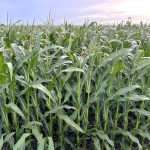
Wheat crops respond well to better management.

Some don’t like it hot — and that’s key to big wheat yields

Wheat growers should start thinking about frost seeding or 24-hour seeding 
shifts to get their crop in the ground as early as possible

It’s time to start treating wheat like it’s a “real crop,” says Ontario agronomist ‘Wheat Pete’ Johnson. “Wheat is the most responsive crop to management we grow, and yet it’s the crop that we manage the least,” Peter Johnson said at the Farming Smarter conference last month. “You just put it in the ground and

Two fields with high-enough levels of clubroot to produce yield-robbing galls on canola roots have been found in the Swan River area by agronomist Ryan Immerkar.

Two fields of canola with clubroot galls found near Swan River

MAFRD’s advice remains the same: soil test for the pest, extend canola 
in the rotation and seed resistant varieties if appropriate

Two canola fields in the Swan River Valley had enough clubroot spores this year to produce yield-robbing root galls that characterize the soil-borne disease, says local agronomist Ryan Immerkar, owner of RSI AgriCoaching and New Era Ag Technology. Laboratory testing confirmed the fields have the potentially devastating pest. That brings the number of Manitoba fields


Assiniboine Community College (ACC) will be establishing a weed identification garden after a donation  from the Manitoba Zero Tillage Research Association (MZTRA) — MZTRA board chair, Brad Lewis (l),  ACC agribusiness instructor, Danielle Tichit.

College to build weed identification garden

Assiniboine Community College looks to establish a weed identification garden to 
house more than 80 of Manitoba’s most common annual and perennial weeds

Southwestern Manitoba will soon be crawling with more weeds but these weeds are for a good cause. Assiniboine Community College is creating a weed identification garden with financial assistance from the defunct Manitoba Zero Tillage Research Association (MZTRA). “The garden will provide students in multiple programs with tangible and real learning opportunities and has the

rye seed

2015 MCVET winter wheat, fall rye data released

Farmers can use this data to make head-to-head comparisons of varietal performance at specific sites

Since 2008, MCVET (Manitoba Crop Variety Evaluation Team) has been publishing winter cereal data collected from its trials shortly after harvest to help farmers and seed growers in Manitoba make variety decisions. In 2015, data is being released for five locations — Boissevain, Carman, Melita, Roblin and Winnipeg — for winter wheat and fall rye.


Greg Bartley takes producers through his research plots.

Black earth doesn’t equate to warmer soil temperatures

Spaces went fast for this year’s Manitoba Pulse & Soybean Growers SMART Day

Wagons were filled to capacity and then some at the Ian N. Morrison research farm near Carman late last month, as the Manitoba Pulse & Soybean Growers held its annual SMART Day for soybean producers and agronomists. “Programs like this are hugely beneficial, especially for guys like myself, who are just realizing that I know

Volunteer canola grows amid soybean test plots.

Less nitrogen equals less volunteer canola

Tighter row spacing may put the squeeze on late-emerging or slow-growing weeds, but not so for volunteer canola

Looking to reduce volunteer canola in your soybeans? Hold off on that extra nitrogen, or better yet, find a field that’s been depleted. Standing amid research plots at the Ian N. Morrison Research Farm near Carman, University of Manitoba PhD student Charles Geddes explained some of the work being done to combat volunteer canola during


Somerset-area organic farmer Jeremiah Evans is impressed with the weed control he’s getting with a new U.K.-made in-row cultivator.

Precision tillage offers new option for organic weed control

Frustrated with lack of weed control, organic farmer Jeremiah Evans has 
tried a U.K.-made in-row cultivator and he’s impressed with the results

Jeremiah Evans has a new high-tech hand helping him control weeds on his organic farm. Last fall the Somerset-area farmer took delivery of a custom-built U.K.-manufactured Garford Robocrop in-row cultivator, which uses special software to identify and target weeds, leaving the crop behind. After seeing what it could do to his wild oats, thistle and

MAFRD’s Anastasia Kubinec says the Manitoba Crop Diagnostic School gives agronomists hands-on training.

Manitoba Crop Diagnostic School focuses on topics important to agronomists

July 17 is set aside for farmers only to attend with a reduced registration fee

This year’s Manitoba Crop Diagnostic School is expected to sell out — again. As of last week there were still some openings July 16 and for farmers only — July 17, said Anastasia Kubinec, oilseed specialist with Manitoba Agriculture, Food and Rural Development (MAFRD). “We’re pretty much sold out,” she said in an interview June 25. “I


The result of a severe thunderstorm on the afternoon of Saturday June 27 that hit near the Roseisle area west of Carman. Many fields in the area were destroyed or damaged by hail including this corn field south of Roseisle along PR 240.

VIDEO: MASC still assessing hail-damaged crops in Roseisle-Miami area

A hail storm damaged or destroyed some crops June 27

Crop insurance officials were still assessing the damage Monday caused by a vicious hail storm that hit the Roseisle-Miami area the afternoon of June 27. As of noon Monday the Manitoba Agricultural Services Corporation (MASC) had received around 100 claims province-wide, David Van Deynze, MASC’s manager of claim services said in an interview. About half

kochia weeds in a farmer's field

Tank mixing weed killers helps delay herbicide-resistant weeds

But don’t forget to rotate crops, including fall seeded and perennials, 
advises AAFC’s Hugh Beckie

Tank mixing two herbicides with different modes of action targeting the same weed is a good way to delay the development of herbicide-resistent weeds, a study by weed scientists at the University of Illinois and United States Department of Agriculture concludes. “We don’t say that mixing is the end-all solution,” study co-author Pat Tranel of