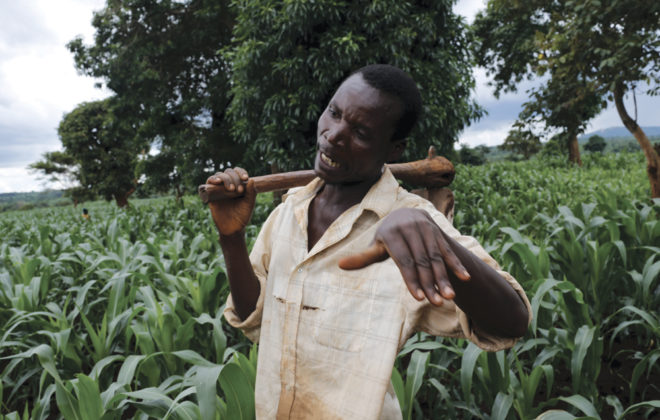
Farmer Ayuba Rasong stands outside of his destroyed home in Kaduna, Nigeria.

Farmers and herders clash in Nigeria

The often-overlooked religious and ethnic conflict has already killed 200

When 60-year-old Ladi Habila heard gunshots ring around her village in Nigeria’s Kaduna state on Christmas Eve, she cast aside the meal she had been preparing, and ran for her life. Habila returned the next day to find her house razed to the ground, and the burnt body of her husband. “My children lost their

A woman at work pounding millet in Ndiael, Senegal, December 9, 2016.

Women lead battle to save Senegal’s shrinking farmland

Female-led work is vital to rural communities in Senegal — now women are organizing 
to lead the fight against multinational agribusiness

The women of Thiamene, a tiny straw hut village in northern Senegal, used to scrape together a living by collecting wild baobab fruit and selling milk from their cows. But their earnings have plummeted since an Italian-Senegalese agribusiness, Senhuile, took over the surrounding land five years ago, blocking their paths to the local market and


Malawian subsistence farmer Simon Sikazwe stands beside communal maize fields in Dowa near the capital Lilongwe, February 3, 2016. Late rains in Malawi threaten the staple maize crop and have pushed prices to record highs. About 14 million people face hunger in Southern Africa because of a drought exacerbated by an El Niño weather pattern, according to the United Nations World Food Program (WFP).

Smarter farming could cut hunger in drought-hit Southern Africa — researchers

Too few resources are available to educate the continent’s farmers 
about potential solutions to their problems

Southern African farmers facing hunger as a result of worsening drought know a lot about climate change but lack the resources to put solutions that work into place, agriculture and development researchers say. That is in part because government agricultural extension services, which offer training and advice to farmers, have too few agents, according to

Villagers collect their monthly food ration provided by the United Nations World Food Program (WFP) near Masvingo, in drought-hit Zimbabwe January 25, 2016. Malnutrition and hunger could be quickly curtailed if more countries signed on to a plan to boost yields, says the Alliance for a Green Revolution in Africa.

Agriculture investment yields growth and nutrition gains for Africa

Agricultural productivity gains of 5.9 to 6.7 per cent a year offer a bright ray of hope for the continent

African countries that took early action in the past decade to invest in agriculture have reaped the rewards, enjoying higher economic growth and a bigger drop in malnutrition, a major farming development organization said Sept. 6. In a report, the Alliance for a Green Revolution in Africa (AGRA) said: “After decades of stagnation, much of


The International Criminal Police Organization (INTERPOL) rescues children, who were the victims of child trafficking, from cocoa fields in Cote d’Ivoire in June.

The dark taste of chocolate

There are an estimated 1.5 million child labourers in Cote d’Ivoire

Arouna stands shirtless in a cocoa field in Côte d’Ivoire. The 12-year-old holds a hoe and his ribs are clearly visible under his skin. He says, “I have to get up very early each day to be the first in the field with my younger brother to start clearing (the land). I’m so tired.” Arouna

Promoting conservation agriculture in Africa

Canadian Foodgrains Bank will receive federal funds to scale 
up smallholder adoption 


Canadian Foodgrains Bank (CFGB) has received $14 million from the federal government to scale up conservation agriculture programs in three African countries. The funding provided on a three-to-one matching basis, will enable the organization to assist 50,000 farmers in Ethiopia, Kenya and Tanzania, up from 5,000 farmers it is currently assisting, it says in a


Jessica McKague is assistant curator at Steinbach’s Mennonite Heritage Village Museum where the exhibit, Mennonite Food: Tastes in Transition, is on display until early 2016.

Steinbach museum reveals a global recipe swap

A new exhibit at Steinbach’s Mennonite Heritage Village Museum explores the impact of migration and other influences on Mennonite food

Why do Mennonites eat watermelon and roll’kuaka? Where’d their recipe for varenikje come from? And what’s up with all that farmers’ sausage, anyways? A new food history exhibit at the Mennonite Heritage Village Museum in Steinbach answers those questions and more. Typical Mennonite foods like kielke (egg noodles, schmauntfat (white cream gravy) and/or pereschtje (meat-filled

Editorial: Just print your food and eat it?

Those of us who still garden have a rather quaint view of food and technology. We plant seeds, help them grow, harvest and eat (cooking optional). Meat or other sources of protein are a bit of an afterthought compared to the taste of those first seasonal bites of melt-in-your mouth potatoes, beans, beets and carrots.


A farm employee pulls out cornstalks on an 18-hectare operation owned by a retired educator near Livingstone.  hotos: Shannon VanRaes

A mix of pragmatism and fear keeps GMOs out of Zambia

While the debate over GMO labelling continues in North America, Zambians take it for granted that they aren’t consuming products made with genetically modified ingredients

In Zambia, it’s practically everywhere. Maize is in tiny garden plots, on small farms, huge estates, in markets and on dinner plates. Since its introduction to Africa by the Portuguese in the 16th century, maize has become the main staple crop in this region. Two megalithic-size cobs even flank the entrance to the Zambia National

bee on a flower

Surprisingly few ‘busy bees’ make global crops grow

Conservation of wild pollinators can’t be based on economics alone

A major international study published in Nature Communications, suggests that only two per cent of wild bee species pollinate 80 per cent of bee-pollinated crops worldwide. The study is one of the largest on bee pollination to date. While agricultural development and pesticides have been shown to produce sharp declines in many wild bee populations,