On June 17, 1972, a mysterious break-in at Democratic National Committee headquarters in the Watergate complex in Washington, D.C., was reported.
A group of mostly Cuban burglars, led by former intelligence agents Howard Hunt and G. Gordon Liddy, were found ransacking filing cabinets and planting listening devices.
By the time the whole tawdry tale came out, a new naming convention for political scandals was firmly ensconced in the public imagination, senior members of president Richard Nixon’s administration were jailed and Nixon was forced to resign in August 1974.
Read Also
Canada’s crop breeding system needs farmer-led evolution, not just preservation
The pressures facing Canada’s crop breeding system are structural, not cyclical. Darcy Pawlik argues farmer ownership is the path forward.
Over time it’s become apparent that Nixon knew nothing of the mission until after the fact. Yet he and his administration were held accountable because once they did know, they attempted to cover it up. They destroyed evidence, obstructed investigators and bribed the arrested burglars.
In the end, Nixon was forced from office when the contents of a tape recorded conversation between he and his chief of staff, H.R. Haldeman, were made public. They can be heard scheming to influence the investigation, and Nixon can be heard ordering the FBI to end its investigation.
Fifty years ago that sort of conduct by a sitting president was taken seriously by the American public, and American politicians. Eleven Republicans on the judiciary committee, who had previously voted against impeachment, announced they would change their vote. Rather than delay the inevitable, Nixon resigned.
An idiom that exists to this day emerged from this scandal: “It’s not the crime, it’s the cover up.”Essentially, something can be bad, but taking the wrong action can always make it worse.
I couldn’t help but think of this recently, when word of the retraction of a landmark study on the safety of glyphosate reached my desk. The study, published 25 years ago in the journal Regulatory Toxicology and Pharmacology, concluded glyphosate was safe for humans.
The study has been described as “foundational” to many public regulatory reviews, including Health Canada’s. Not surprisingly, there are now calls worldwide for further review, including here in Canada.
In retracting the study, the journal noted that documents released as part of litigation suggest employees of Monsanto were the ghostwriters of the study and that the company paid the study’s authors of record.
The retraction notice further stated that the conclusions on whether glyphosate causes cancer in the study were based entirely on unpublished studies from the chemical firm.
This scandal — Glyphos-gate, if you will — is just another nail in what could be the coffin of a keystone weed control agent that underpins the minimum tillage production systems used so widely on the Canadian Prairies.
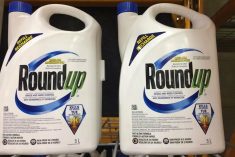
Last March, Bayer chief executive officer Bill Anderson warned that the firm was likely to stop producing Roundup if costly lawsuits continued.
He told the Wall Street Journal payouts had already cost the company US$10 billion, and were causing annual losses of $2 to $3 billion on total Roundup sales of $2.8 billion last year.
“We’re pretty much reaching the end of the road,” Anderson told reporter Patrick Thomas in an interview.
“We’re talking months, not years.”
Losing the glyphosate molecule would be difficult to imagine, given its near-total adoption in Prairie production systems. But the greater issue for the agriculture sector is going to be how this will undermine public trust.
Agriculture has long counselled critics to “stick with the science” because decisions can’t be made on feelings.
However, when a scientific study has been deemed by reviewers to be unduly influenced or ghostwritten by those seeking to benefit from regulatory approval, it’s going to be a tough sell to the public.
If agriculture does have to face up to a post-glyphosate world, Monsanto will have a lot to answer for.
Unlike Nixon, who had to face his nation for the coverup, Monsanto has disappeared by way of corporate merger, leaving farmers nobody to kick around for the consequences.