Advisors, clear values and family history were important to successful farm transitions for two Canadian farm families.
Jan. 10 was Farm Transition Appreciation Day, a day in which groups such as Farm Management Canada, Farm Credit Canada and Glacier FarmMedia (the Co-operator’s parent company) encourage farmers to start the process of planning their farm’s transition to the next generation.
In preparation for that day, Simon Ellis and Andrew Campbell, young Canadian farmers from different parts of the country, told their farm transition stories to the Manitoba Co-operator. They reflected on what went well and what they’d advise others to do differently.
Read Also
Who pays for plant breeding? A renewed push for farmer levies
With fed support on the decline, grain sector faces tough choice: pay more out-of-pocket or fall behind global competitors.
Simon and Amanda Ellis
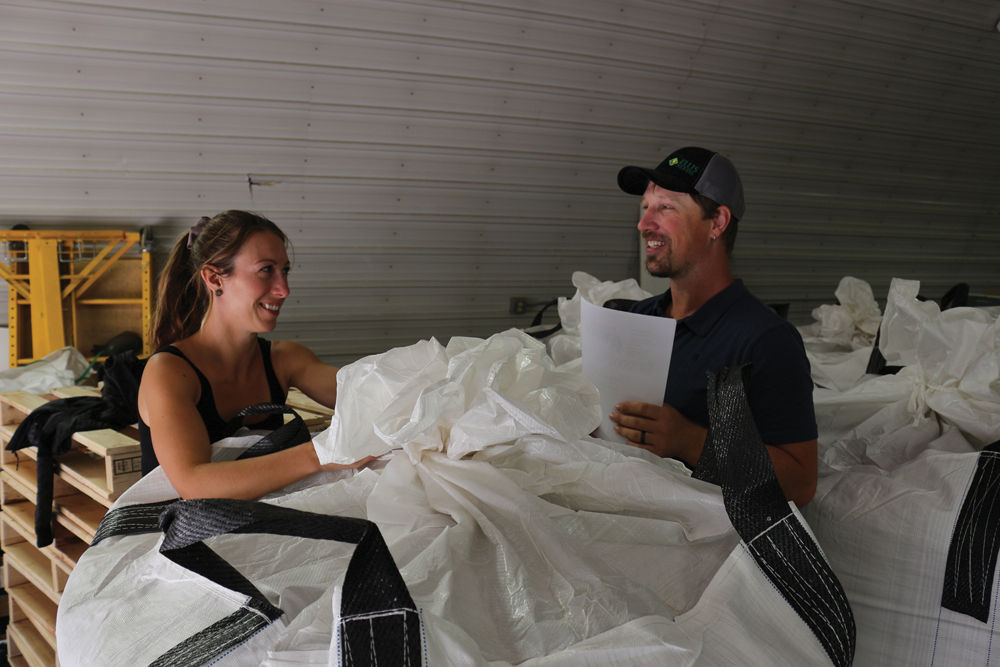
Simon and Amanda Ellis began taking over Simon’s parents’ pedigreed seed production and retail operations after they got married in 2013.
Simon had worked on the farm, near Wawanesa, Man., since 2009. Amanda’s interest in co-running the farm and retail businesses gave him more confidence to take over management.
“I don’t think I would have done it without her,” said Simon.
Hiring a farm transition advisor was vital to the process.
“We realized that we don’t know what we’re doing,” Simon said. “We’re good at farming, we’re good at pedigreed seed. Don’t ask me to figure out how to transition a farm.”
The advisor helped each person identify their own goals and values. For instance, Simon and Amanda were interested in healthy living and food production. His parents wanted to retire and travel.
They saw where their goals overlapped. They all valued family, for instance, so that was common ground.
They also analyzed each business enterprise and fine-tuned them for transition, Simon said.
Third-party help kept the family communicating and forced them to talk about things they might not have on their own. It also helped them to be careful about overstepping bounds or pushing too hard.
In hindsight, Simon said even more empathy may have been needed.
He and Amanda moved into what had been his parents’ house. Suddenly, 25 years of traditions, such as those of Christmas morning, changed for his parents and two sisters.
“You kind of have to think about what experience somebody else might have had with the farm and give them time, almost, to grieve the loss of them, or the change,” he said.
Andrew and Jess Campbell
When was time for Andrew and Jess Campbell to take over the family farm, they had a clear historic precedent to follow.
The grain and dairy operation in Middlesex County in southern Ontario goes back at least four generations, though the Campbells have been farming “as far as the genealogy books go,” Andrew said.
His grandparents’ mindset was that the generation in its prime should manage the farm. So when Andrew’s parents were ready to take over the farm in the 1980s, his grandparents moved off. At the time, the farm couldn’t support more than one family. Andrew’s grandparents weren’t ready to retire, so his grandpa took a trucking job.
Andrew and Jess’s transition onto the farm followed a similar pattern.
“When we’re in our prime of farming, we’re making the decisions,” he said. “Mom and Dad had their time to grow the farm… Everyone has had their 20 years.”
His parents still work on the farm and are important advisors, but the management transitioned to Andrew and Jess. The assets are slowly following. Recently, one of Andrew’s brothers joined the farm and took over the bulk of the grain operation.
Expert advisors were also key and continue to be important, Andrew said. The complexity of taxes is a constant cloud, and he relies heavily on his accounting team. They’re also working to structure the farm with a transition to the next generation in mind.
To date, they haven’t identified any big mistakes in their succession plan, Andrew said. If he could redo the experience, he’d get even more information.
Andrew also took pains to say that every family has its own dynamic. His family’s approach won’t work for everyone.
The important thing is to start the conversation and develop a map for succession, “even if there are roadblocks up along the way.”