Spiders are important insect predators, and understanding what’s in their gut could help agriculture deploy them against pests.
That’s easier said than done.
Spider diet, and how much they actually target crop pest species, is crucial to determine how effective spiders are at biocontrol. However, since spiders liquefy the remains of prey with digestive enzymes, there is often little left to identify what kind of bug the spider is eating.
Read Also
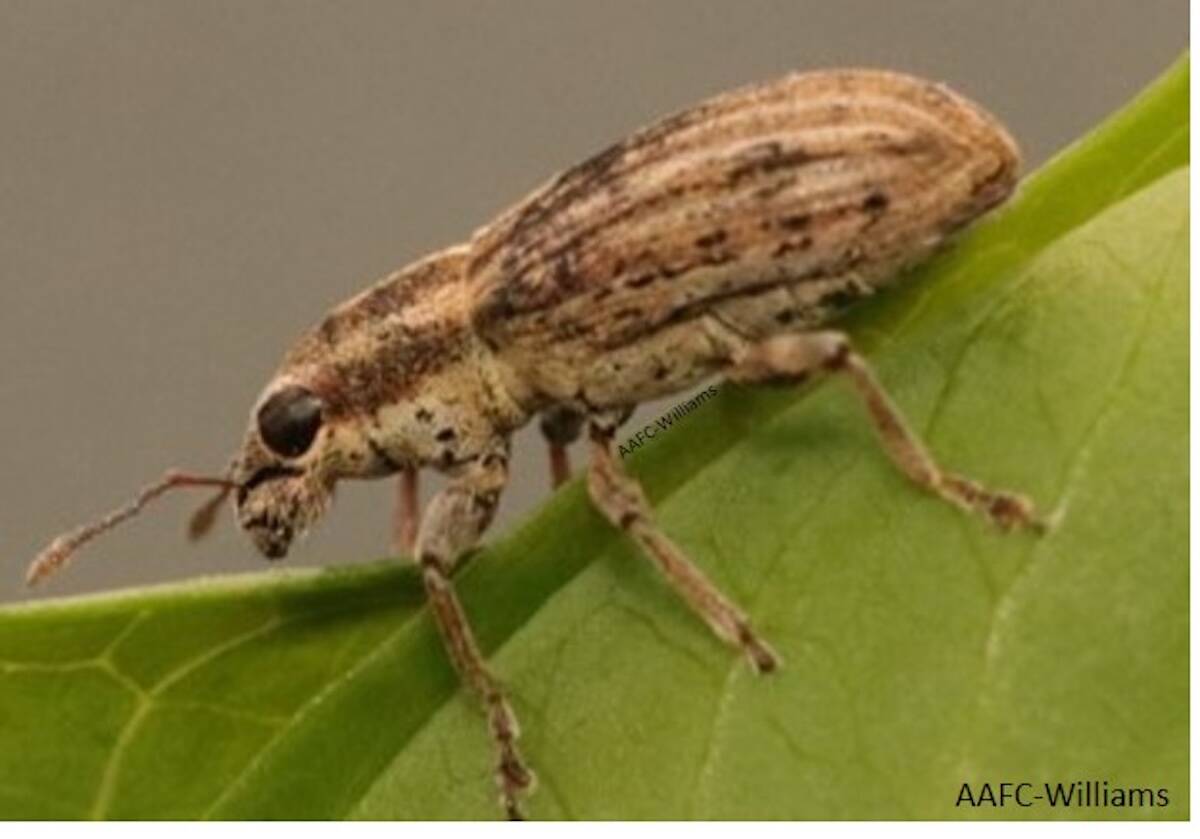
Pea leaf weevil chows down on Western Manitoba
Pea leaf weevil has spread as far east as Manitoba’s Ontario border, while the west has become a Prairie-wide hotspot for the pest insect.
One solution is to use DNA bar coding to analyze gut contents, a technique that involves sequencing a short, standardized fragment of DNA from a particular gene to identify a species.
The history of the practice dates back two decades, when biologist Paul Hebert applied DNA bar coding to arthropods. Hebert pointed out that animal species could be distinguished by sequencing a specimen’s DNA.
Over the years, this technology has become increasingly sophisticated. Advances in DNA sequencing and bioinformatics make it possible to quickly and accurately identify species from a wide range of samples.
The use of DNA bar coding specifically for spider-gut-content analysis has become increasingly popular.
The process begins by capturing spiders in the field. They are then ground up whole into a ‘DNA soup’ using a specific set of steps to extract the DNA from the stomach contents. This grinding step is important because a spider’s stomach extends into many different parts of the body.
Researchers can use DNA bar coding to determine if a spider is a generalist (feeding on a wide range of prey species) or a specialist (feeding on a particular species or group of species, like agricultural pests).
Generalist predators eat whatever they can find in agricultural landscapes. This includes both pest species like aphids and non-pests like springtails.
Previous research found that early-season sampling revealed more predators with “empty guts,” while gut content volumes increased later in the season. This research investigated only three spider species and only during the early- and late-cropping season.
Our research hopes to tackle those gaps.
Our research is conducted in agricultural landscapes with one thing in common: They all have restored habitat adjacent to the crop field. This includes tall-grass prairie and wetlands.
The semi-natural areas around farm fields are important sites for spiders, providing shelter and alternative food sources when crop fields might be too harsh to live in because of spraying or tilling.
Different habitat types on farms (whether aquatic, as in the case of wetlands, or terrestrial, as in the case of grass) will undeniably change the food web’s structure, with different prey and predator groups throughout the season.
We sampled spider communities for four months between May and August. Samples were taken at different distances from crop fields to study spider movement throughout the growing season.
This knowledge is largely important to help determine pesticide application timing.
Our preliminary data found several functional spider groups — web-spinning, ground spiders, ambush spiders and hunters — on the studied farms.
A total of 20 spider families have been consistently found through the sampling period, with some spiders more prevalent in certain habitats than others.
We have been finding spiders and their insect prey at a higher abundance in the semi-natural areas surrounding fields and closer to the restored habitats.
Preliminary data also shows that June and August are peak times for spider activity on farms, and they move around a lot more than in May and July.
According to a meta-analysis of 58 published studies, spiders suppressed agricultural pest insects in 79 per cent of studies, which resulted in improved crop performance.
Gleaning information from spider stomach contents will help us understand the role they play in the ecosystem. This is particularly important in agriculture to promote environmentally sustainable crop protection inspired by natural pest control.
Relying excessively on chemicals to control crop pests is not a sustainable option. Using ecologically based approaches is urgently needed.
– The authors are with the University of Guelph. This article first appeared in The Conversation, by Reuters.