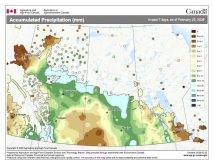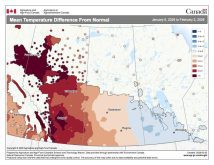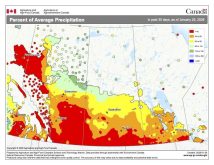
Well, that didn’t take long. At the end of last week’s article I pointed out it only takes one big storm system to totally change a monthly weather outlook. For western regions, this happened last week, as a very strong area of low pressure formed over Montana and then slowly pushed north-northeast through Saskatchewan and northern Manitoba. The heaviest amounts of rain fell in a line from extreme southeastern Saskatchewan up toward Dauphin and then northward. General rainfall amounts were in the 50- to 70-mm range, with some regions reporting over 100 mm. Farther north, the rain turned into snow with total accumulations ranging from a few centimetres all the way up to 60 cm. To the east of this system, rainfall amounts dropped off dramatically, with most areas seeing less than 10 mm.
Read Also
Forecasting spring 2026 weather on the Prairies
What weather can farmers expect across Manitoba, Alberta and Saskatchewan as they head into seeding? Plus: a lesson on what makes the seasons turn
Along with rainfall this system also pumped in some fairly mild temperatures over central and eastern regions. Daytime highs early last week topped out in the mid-20s, with overnight lows only falling into the mid-teens. While I didn’t see any daytime high records fall, there were a few record-warm minimum temperatures broken.
If you recall back to the article I wrote about frost, I said I would like to revisit that topic. In particular, I wanted to look at the dates for the last spring frost, the first fall frost and the resulting length of the frost-free season to see if there have been any local trends. The other day I bumped into a farming friend who was pretty sure that our frost-free season is getting longer. With this in mind, I began to go through the data with the full intention of looking at all three of the major centres in Manitoba (Winnipeg, Brandon and Dauphin). What I didn’t realize was just how long it would take to go through all that data! So, for this first article, I’m just looking at Winnipeg’s data going back 40 years.
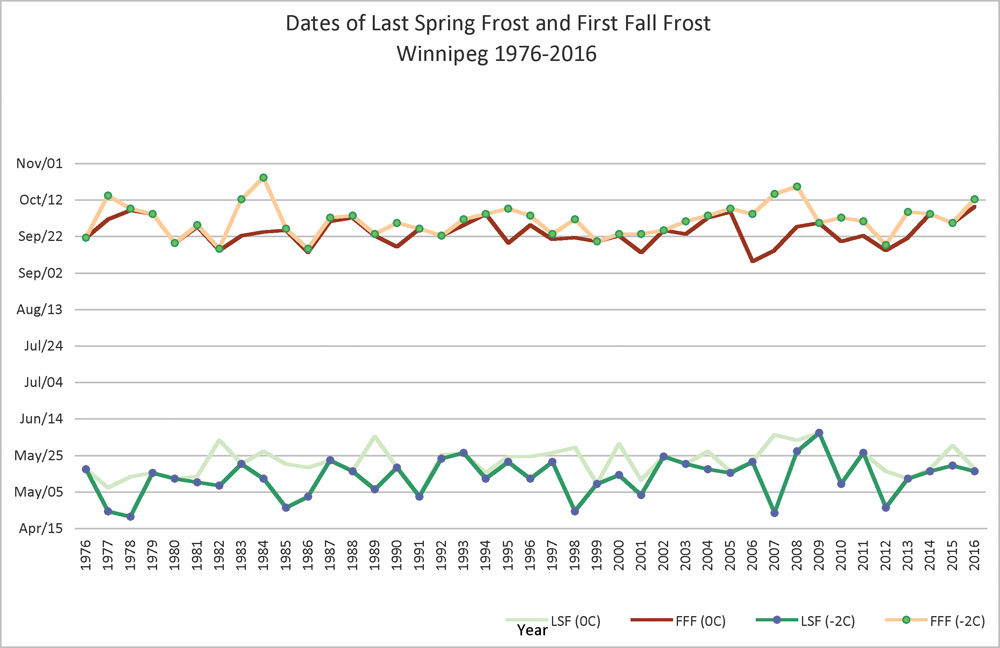
For this study, I went through the spring and fall temperature records for Winnipeg, looking for the last and first days where temperatures fell below 0 C. I then plotted the dates to see if there were any observable trends. I have included a graph showing this data and, as you can see — and what surprised me — is that for 0 C there is no significant trend in the data. Dates for both the last spring frost (LSF) and the first fall frost (FFF), while showing the expected variation from year to year, did not have any trend toward earlier or later dates. I then went back through the data looking for the dates of the last and first killing frosts, which I recorded as minimum temperatures colder than -2 C. When I plotted this data I found the results were very similar with no real trends evident. If anything, there does appear to be a slight trend toward a later occurrence of a killing spring frost and an accompanied later occurrence of a killing fall frost.
This then led me to look at the overall length of the frost-free season (FFS). This time, when I plotted this data, I was not surprised to find there was no trend in the data at either the 0 C or the -2 C mark. What was interesting was some of the changes to the length of the frost-free season in a given year, depending on whether it was 0 C or -2 C. For example, 2007 had a 0 C frost-free season that was 25 days shorter than average, due mostly to an early June frost. Looking at the length of the -2 C frost-free season, 2007 was 34 days longer than average.
I will definitely continue my look into this topic by examining both Brandon and Dauphin’s data to see if it will follow Winnipeg’s “non-trend.”